


Taxonomy
Rarity
Abundance rates how many are in suitable habitat. Find difficulty rates how hard it is to locate one on a daylight snorkel or freedive through 50 ft. A higher find score means a harder search. The rarity category also reflects the kind of encounter; it is not an average of the 2 scores.
Regulations
CDFW rules verified 2026-10-12
Seasonality
Edibility
Location
The species lives from San Simeon in San Luis Obispo County south to Guerrero Negro in Baja California Sur, Mexico. SeaLifeBase records it from the shoreline down to about 65 feet, on sand, on mud and on rocky reef. The Marine Biological Laboratory in Woods Hole, Massachusetts, which raises the animal for research, describes it as an octopus of intertidal rocky reef that often hides in man-made pipes.
The name needs care, because 2 octopuses on this coast are called the California two-spot. This page covers the smaller one, which scientists call the bimac. SeaLifeBase and the American Fisheries Society's list of mollusk names call it the lesser two-spotted octopus. The larger relative has its own page in this Ichthyopedia as the California two-spot octopus. It lives from Point Conception, Santa Barbara south into Mexico and is recorded deeper, to about 165 feet. The 2 look so much alike that they share a common name, and the published accounts of either animal often mix the 2.
Harvest Brief
San Simeon, California to Guerrero Negro, Baja California Sur; small personal-use harvests at places such as La Jolla.
California allows 35 octopus per person per day, with no size limit and no closed season. Regulation 29.10 allows octopus to be taken only with the hands or on hook and line, so spears, gaffs and hooked tools are not legal gear. Octopuses are one of the few groups of invertebrates that may be taken in tidepools and elsewhere in the intertidal zone, which matters for an animal that lives this close to shore. That allowance does not reach inside marine protected areas or other special closures, and take of all invertebrates is prohibited inside state marine reserves.
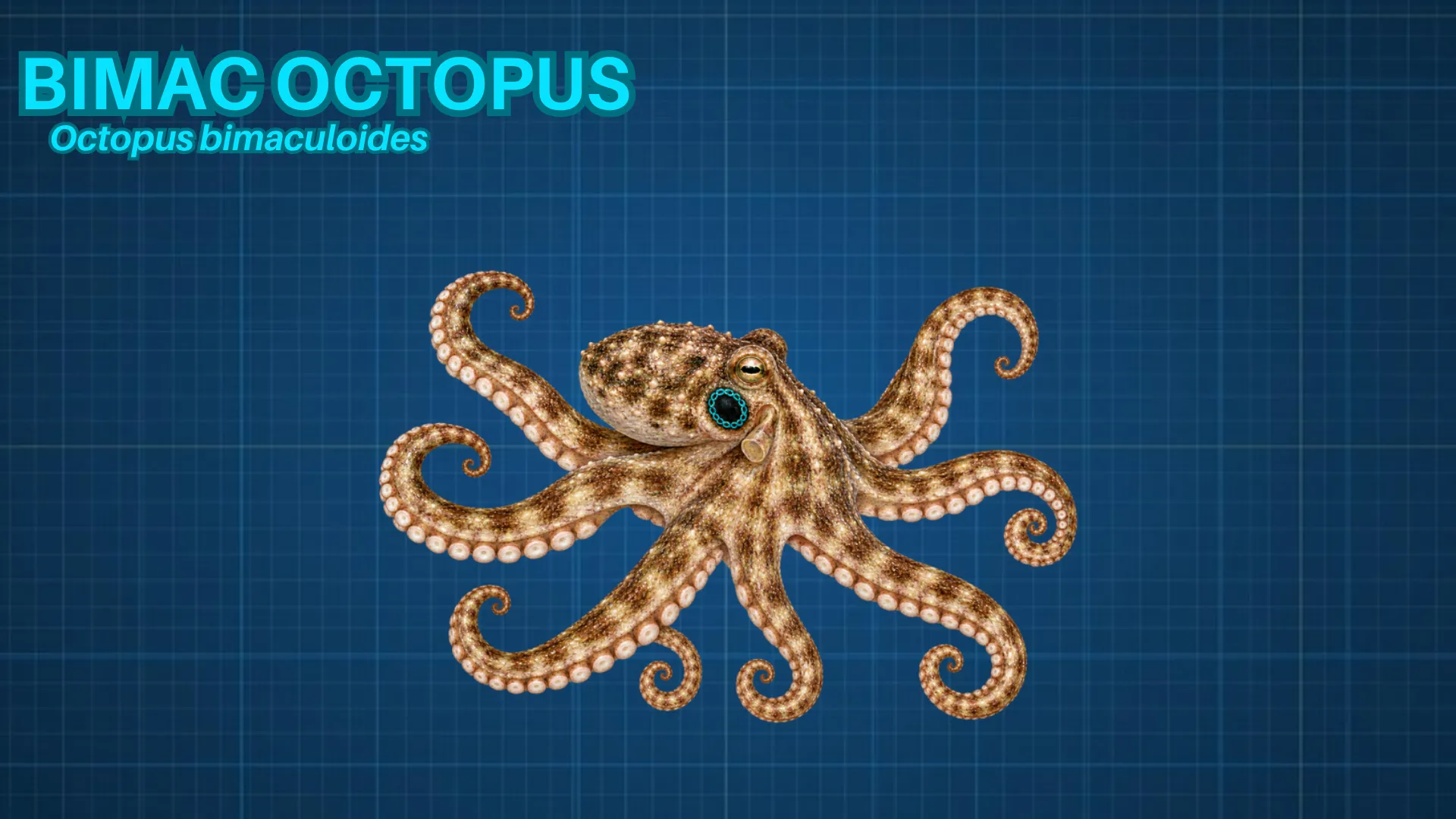
The find rates a 4 on the 1 to 5 scale. The animal's skin is mottled brown, and it can change both color and texture to hide. By day it is tucked into a crevice, a hole or a length of pipe, so the search is for a den rather than for an octopus in the open.
Deep Dive
The lesser two-spot is a small octopus. SeaLifeBase gives a maximum body length, measured along the mantle (the rounded body behind the eyes), of about 4.7 inches, and a published maximum weight of about 1.8 pounds. The name comes from 2 false eyespots, one on each side of the head. Each is an iridescent blue ring called an ocellus. Like other octopuses, it has 3 hearts, 2 gills and blue blood. Its brain is shaped like a doughnut. It can regrow a lost arm, it moves by jet propulsion, and it tastes its surroundings with the hundreds of suckers that line its arms.
Much of what is known about its life comes from the laboratory. In a study published in Marine Biology in 1988, the cephalopod researchers J. W. Forsythe and Roger Hanlon raised 40 of them through their whole life cycle at 2 water temperatures, 64°F and 73°F. At 64°F the octopuses grew from hatchlings of 0.07 grams, a tiny fraction of an ounce, to an average of about 1.4 pounds in 404 days. The largest reached about 1.9 pounds. Animals in the warmer water grew faster at first, but warmth sped up breeding and shortened life by as much as 20%, from about 16 months to about 13. Males grew slightly larger than females and matured sooner.
Its eggs are large for an octopus, about 0.4 to 0.5 inch long, while the larger California two-spot lays eggs of only about 0.1 inch. The size difference changes how the young start out. Hatchlings of this species settle on the bottom right away and skip the drifting plankton stage that many octopus young go through. The 1988 study notes that the species has one of the longest life cycles of any octopus with large eggs and bottom-living hatchlings.
The animal breeds once and then dies. The Marine Biological Laboratory reports that a mother guards her eggs for 2 to 4 months. She stops eating during that time and declines quickly.
The lesser two-spot octopus holds a place in the history of biology. In 2015 it became the first cephalopod, the group that includes octopuses, squid and cuttlefish, to have its full set of genes sequenced. The work was published in the journal Nature, where the team called the animal the California two-spot octopus. The Marine Biological Laboratory raises the species to study development, the nervous system and behavior, and its scientists are using the genome to build tools for testing the genetics behind the octopus brain, its color changes and its jet propulsion.
Where to Find Them
Researched habitat and range candidates
San Diego · 14 beaches
Orange County · 10 beaches
Catalina Island · 6 beaches
Los Angeles · 10 beaches
Channel Islands · 21 beaches
Ventura · 15 beaches
Santa Barbara · 10 beaches
San Luis Obispo · 20 beaches
These locations have suitable habitat within the species range. An assignment is a possible encounter, not a confirmed sighting at every beach. Season, depth, and local conditions still matter. Historical habitat without present-day evidence is excluded.