

Taxonomy
Rarity
Abundance rates how many are in suitable habitat. Find difficulty rates how hard it is to locate one on a daylight snorkel or freedive through 50 ft. A higher find score means a harder search. The rarity category also reflects the kind of encounter; it is not an average of the 2 scores.
Seasonality
Location
Blue marlin live throughout the tropical and subtropical waters of the Pacific, Atlantic and Indian oceans. NOAA describes them as preferring warm surface water that is well mixed by wind and even in temperature and salinity, and says they spend their time in open water, moving mostly between the surface and about 330 feet. FishBase gives a water temperature range of about 72 to 88 degrees Fahrenheit and notes that, at least in the northern Gulf of Mexico, they prefer clear blue water.
They are an open-ocean fish. Mexican Fish, a guide to the fishes of Mexico, says they are usually found over very deep water away from land and seldom in shallow water, and that satellite tags have tracked them to about 3,000 feet. FishBase adds that they rarely school and are usually found as scattered single fish.
Deep Dive
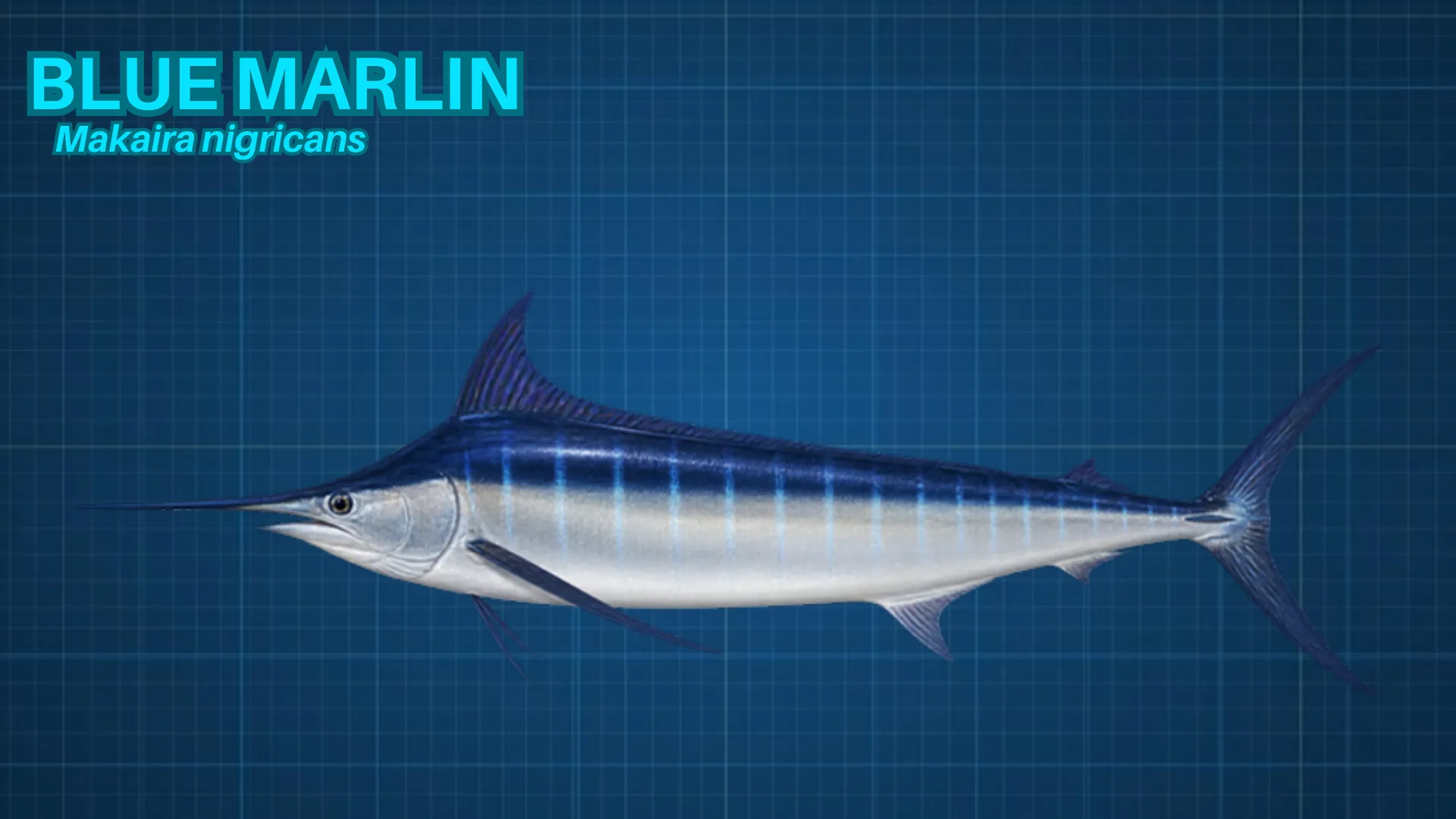
NOAA describes the blue marlin as deep cobalt blue on top and silvery white underneath, with a pronounced dorsal fin and a long, spear-shaped bill. FishBase adds about 15 rows of pale cobalt stripes along the sides. The lateral line, the row of sensory pores along the side, forms a net of linked canals, a detail FishBase uses to tell it apart. Mexican Fish names the black marlin and the striped marlin as the 2 fish most easily confused with it.
It grows enormous. NOAA says a blue marlin may grow to more than 12 feet and up to 2,000 pounds. Females grow much larger than males. NOAA gives females a lifespan of about 20 years, while males reach about 7 feet and live up to 10 years. They grow fast, reaching 3 to 6 feet in their first 1 to 2 years. Mexican Fish notes that every trophy-size fish is a female, since males do not exceed about 300 pounds. The world record listed by the International Game Fish Association is 1,402 pounds, caught off Brazil in 1992.
Blue marlin feed by day. NOAA says they eat mostly tuna and other open-water fish, and FishBase adds octopus and squid. Mexican Fish reports that they are believed to use the bill to stun prey, and that some drive the bill into objects, including boats and whales, often breaking it off. Fish that have lost the tip of the bill have been found apparently healthy. White sharks and shortfin makos prey on them.
Scientists do not all agree on what a blue marlin is. FishBase treats the Pacific fish as a separate species from the Atlantic fish, while NOAA and Mexican Fish treat them as 1 species found worldwide. This page follows NOAA.
Recreational anglers prize the species for the leaps and long fights of a hooked fish, and NOAA reports that most caught in tournaments are tagged and released. In Hawaii, where sale is still legal, commercial landings in 2024 were about 1.3 million pounds. NOAA describes the meat as firm and rich, similar to swordfish.
Where to Find Them
Researched habitat and range candidates
San Diego · 2 beaches
Catalina Island · 2 beaches
Los Angeles · 1 beach
Channel Islands · 1 beach
These locations have suitable habitat within the species range. An assignment is a possible encounter, not a confirmed sighting at every beach. Season, depth, and local conditions still matter. Historical habitat without present-day evidence is excluded.