
Also calledPacific round herring, eastern round herring

Taxonomy
Rarity
Abundance rates how many are in suitable habitat. Find difficulty rates how hard it is to locate one on a daylight snorkel or freedive through 50 ft. A higher find score means a harder search. The rarity category also reflects the kind of encounter; it is not an average of the 2 scores.
Seasonality
Location
FishBase gives the range as Monterey Bay to Chile. Mexican Fish describes it as an open-water schooling fish found over all types of bottom down to about 655 feet, and reports it along both coasts of Baja California and down the mainland coast to Guaymas.
Deep Dive
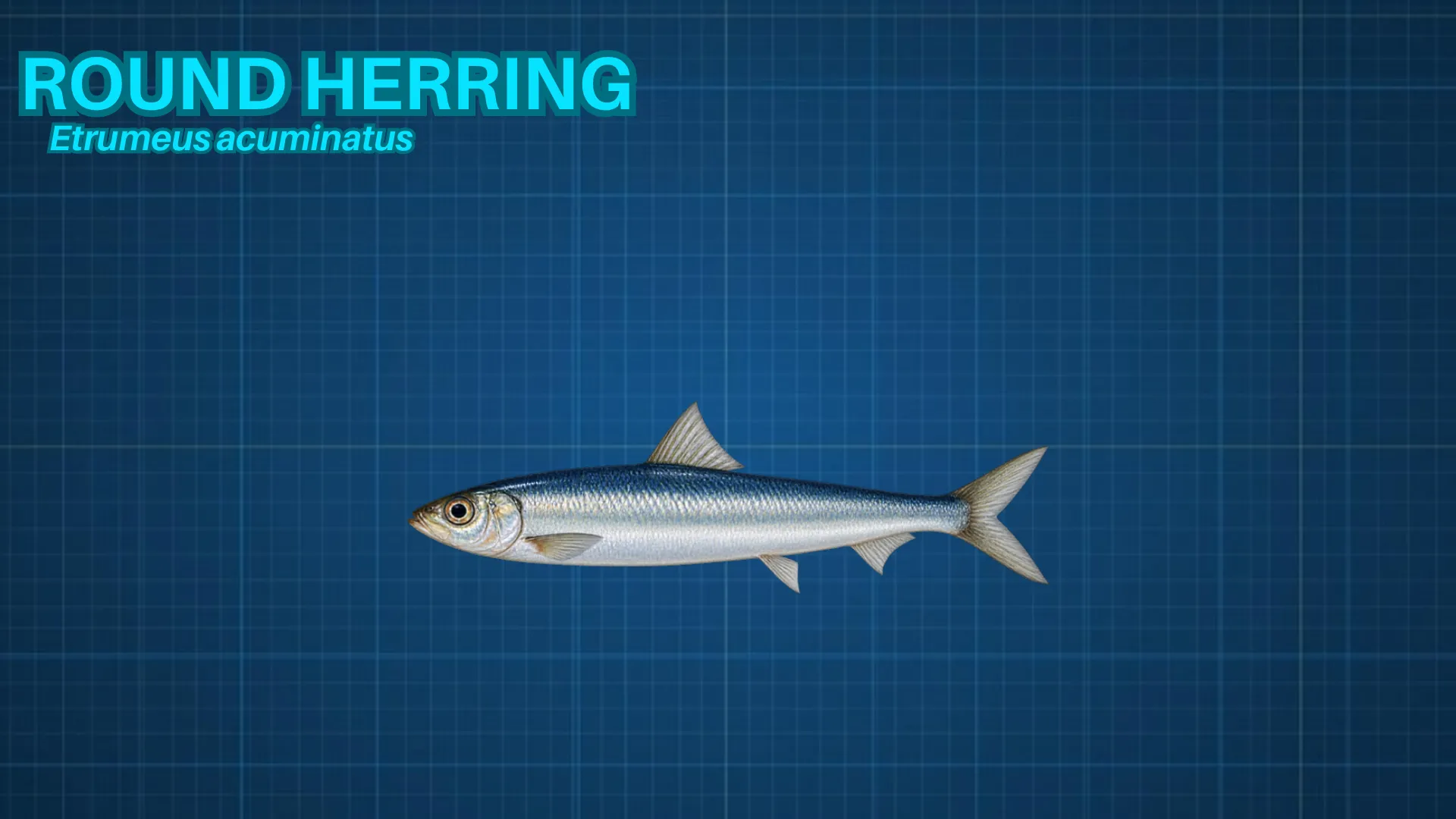
The round herring is a slim herring with a rounded body, unlike the flat-sided sardine. Mexican Fish describes it as blue above and silvery below, with a small mouth, a dorsal fin set in the middle of the back and the pelvic fins behind it. Once out of the water, it quickly turns a deep blue-black and its scales stand out. It grows to about 12 inches. Mexican Fish lists 5 species worldwide in its genus.
It is easy to mix up with 2 other baitfish. Mexican Fish notes that the Pacific sardine has a row of black dots along its side and a flatter body, and that the Pacific chub mackerel has a patterned back.
Its main use is bait. Mexican Fish reports that it is a bycatch of the chub mackerel fishery in Mexico and a targeted baitfish around Los Cabos during cold-water spells, when anglers catch thousands from December to February on multi-hook rigs fished near the bottom in deep water over sand. It does not survive well as live bait, so it is usually frozen and trolled slowly as a dead bait, a favorite of dorado, or cut into strips.
Predators drive it ashore at times. Mexican Fish includes a photograph of a round herring picked up by hand from the surf at Bahia Santa Rosalillita in Baja California in August 2019, among several chased onto the beach by fish below while cormorants, pelicans and gulls attacked from above.
Where to Find Them
Researched habitat and range candidates
San Diego · 2 beaches
Catalina Island · 2 beaches
Los Angeles · 1 beach
Channel Islands · 8 beaches
Ventura · 1 beach
San Luis Obispo · 12 beaches
Monterey · 1 beach
These locations have suitable habitat within the species range. An assignment is a possible encounter, not a confirmed sighting at every beach. Season, depth, and local conditions still matter. Historical habitat without present-day evidence is excluded.