



Taxonomy
Rarity
Abundance rates how many are in suitable habitat. Find difficulty rates how hard it is to locate one on a daylight snorkel or freedive through 50 ft. A higher find score means a harder search. The rarity category also reflects the kind of encounter; it is not an average of the 2 scores.
Seasonality
Location
Pacific herring live around the rim of the North Pacific. FishBase gives a range from the White Sea in Arctic Russia east to Nunavut in Canada, south along Asia to Japan and Korea, and south along North America from the Beaufort Sea to northern Baja California. FishBase notes that the species may reach depths of about 1,560 feet.
In California, the Department of Fish and Wildlife describes herring living offshore in spring and summer and moving inshore to spawn. The schools first gather in the deeper channels of a bay, where they may wait up to 2 weeks while their eggs and sperm ripen. Then they move into shallow, calm water where the salinity is low. They lay their eggs on marine plants or rocky shoreline, and often on pier pilings and riprap as well.
Ken Jones lists the best piers as those in San Francisco Bay and farther north, including Fort Point, the San Francisco Municipal Pier, Agua Vista, Oyster Point, Ferry Point in Richmond, Elephant Rock and Fort Baker, along with Eureka and Crescent City. He reports that some reach the Santa Cruz Wharf, where he has caught them in April. The best months in the Bay Area are usually December through February.
Deep Dive
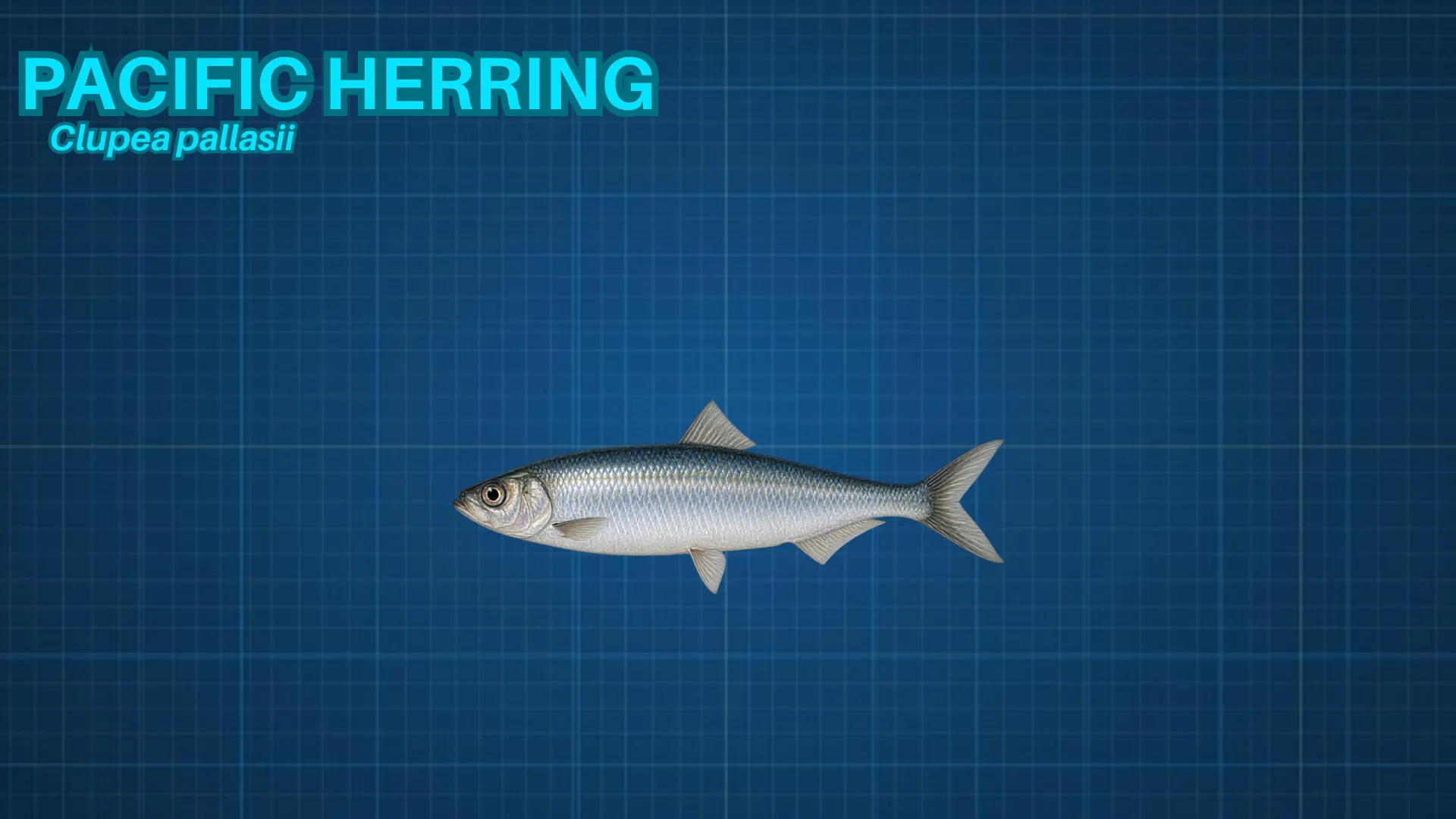
The Pacific herring is a slim, silvery fish built for open water. FishBase describes it as dark blue to olive above, shading to silver below, with no dark spots on the body or fins. Ken Jones notes that the lack of spots is the easy way to tell it from a Pacific sardine, which has dark spots on its side. FishBase gives a maximum length of about 18 inches and a maximum age of 19 years. Ken Jones reports that most caught from piers are under 14 inches.
Spawning is a mass event. FishBase describes a female turning on her side to lay her eggs on the bottom, then righting herself and repeating the process, sometimes for several days. Males release their milt over the eggs as they are laid, with no pairing between the sexes, until the whole spawning area turns white. The sticky eggs cling to eelgrass, kelp and pilings, and Ken Jones notes that they draw many other fish to feed on them.
Young herring spend their first summer schooling at the surface of shallow bays, inlets and channels. FishBase reports that these schools disappear in the fall and stay in deep water for the next 2 or 3 years. The young eat mostly small crustaceans, while adults take larger crustaceans and small fishes. Because herring do not migrate far along the coast, FishBase notes, fish from different local populations seldom mix.
Most of the commercial catch in the eastern Pacific goes to roe markets in Asia. FishBase describes a fishery for herring eggs laid on kelp, which in Japan is salted and eaten as a delicacy called kazunoko kombu. On the table, Ken Jones rates the fish slightly below Atlantic herring and Pacific sardine, with soft, dark, strongly flavored flesh, and lists baking, broiling, barbecuing and pickling.
Herring also make an odd sound. Ken Jones cites a 2003 National Geographic News report on research in British Columbia and Scotland, which found that herring release air from the anus at night, producing bursts of high-pitched ticking up to 22 kilohertz, always with a fine stream of bubbles. The researchers thought the sound might help the fish stay together in schools after dark.
Where to Find Them
Researched habitat and range candidates
San Diego · 5 beaches
Orange County · 1 beach
Catalina Island · 2 beaches
Los Angeles · 2 beaches
Channel Islands · 10 beaches
Ventura · 4 beaches
Santa Barbara · 2 beaches
San Luis Obispo · 16 beaches
Monterey · 2 beaches
Oregon North Coast · 1 beach
Hood Canal · 4 beaches
Central Sound · 7 beaches
North Sound · 4 beaches
San Juan Islands · 1 beach
Strait of Juan de Fuca · 1 beach
Cape Flattery · 2 beaches
These locations have suitable habitat within the species range. An assignment is a possible encounter, not a confirmed sighting at every beach. Season, depth, and local conditions still matter. Historical habitat without present-day evidence is excluded.