

Taxonomy
Rarity
Abundance rates how many are in suitable habitat. Find difficulty rates how hard it is to locate one on a daylight snorkel or freedive through 50 ft. A higher find score means a harder search. The rarity category also reflects the kind of encounter; it is not an average of the 2 scores.
Seasonality
Location
FishBase describes the black marlin as a fish of tropical and subtropical waters in the Indian and Pacific oceans that occasionally enters temperate water. A few strays reach the Atlantic around the Cape of Good Hope, but there is probably no breeding population there. FishBase gives a water temperature range of about 59 to 86 degrees Fahrenheit.
Unlike the blue marlin, it often comes close to land. FishBase says it is usually found in surface water above the thermocline, the layer where temperature drops sharply with depth, and often near shore, close to land masses, islands and coral reefs. It usually lives from the surface to about 660 feet, and it has been recorded to about 3,000 feet.
Deep Dive
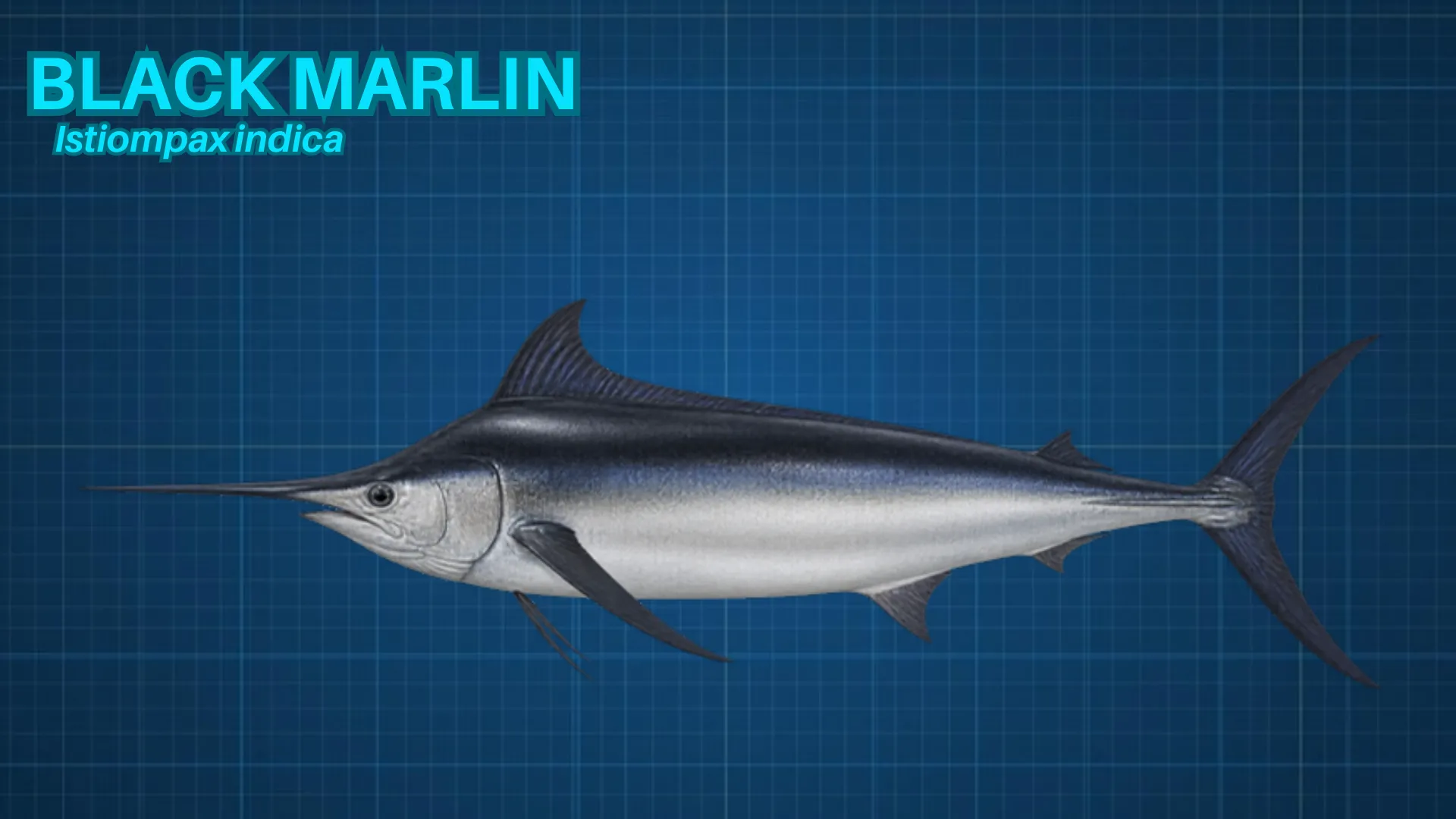
The black marlin has a feature no other marlin shares. Its pectoral fins, the long fins on its sides, are rigid and cannot fold flat against the body. FishBase describes the back as dark blue and the belly silvery white, sometimes with pale blue vertical stripes, and the first dorsal fin as low, lower than the body is deep. Mexican Fish, a guide to the fishes of Mexico, adds that the fish turns white after death, which is why it is sometimes confusingly called white marlin.
Mexican Fish calls it the largest of the billfish. FishBase gives a maximum published weight of 750 kilograms, about 1,650 pounds, and a length of more than 15 feet. The world record listed by the International Game Fish Association is 1,560 pounds, caught off Peru in 1953. Mexican Fish notes that every trophy-size fish is a female, since males do not exceed about 300 pounds.
FishBase lists its food as fish, squid, cuttlefish, octopus and large crustaceans, and says it eats mostly small tunas when they are plentiful. Mexican Fish reports that it stuns prey with its bill and then circles back to eat it, and that adults have few predators. A female can release up to 40 million eggs a year, and the eggs drift in open water.
Anglers prize the black marlin for its size and for the leaps and long fight of a hooked fish. FishBase rates its flesh as good quality, and Mexican Fish notes a large market for it as sashimi in Japan. Most commercial catches come as bycatch on longlines set for tuna.
Where to Find Them
Researched habitat and range candidates
San Diego · 2 beaches
These locations have suitable habitat within the species range. An assignment is a possible encounter, not a confirmed sighting at every beach. Season, depth, and local conditions still matter. Historical habitat without present-day evidence is excluded.