
 Spearfishing
Spearfishing Stats
Present off Southern California only when warm water from the south brings them in, and the adults stay in deeper water.
Taxonomy
Rarity
The bigeye tuna is a major commercial fish in the tropics and an occasional visitor off California. NOAA Fisheries includes the waters off Southern California in its range and describes when the fish appear there. The coastal purse seine fleet, which fishes off California for sardine and anchovy, sometimes catches bigeye when warm water from the south brings them within reach. A purse seine is a large net drawn closed around a school of fish.
The global rating and the Pacific assessments tell different stories. The International Union for Conservation of Nature listed bigeye tuna as Vulnerable in 2021. In the Pacific, NOAA's most recent assessments found both the Western and Central Pacific population, assessed in 2023, and the Eastern Pacific population, assessed in 2024, neither overfished nor subject to overfishing.
Regulations
CDFW rules verified 2026-09-14
Seasonality
Edibility
Location
Bigeye tuna live in the tropical and subtropical Atlantic, Indian and Pacific oceans. NOAA gives their preferred water as 55 to 84 degrees Fahrenheit, and FishBase puts the best range at about 63 to 72 degrees. FishBase also links where they show up to seasonal and climate-driven changes in surface temperature and in the thermocline, the layer where warm surface water gives way to cold water below.
Where a bigeye lives depends on its size. Young bigeye and small adults school at the surface, sometimes mixed with skipjack and young yellowfin tuna, and gather under floating objects and under large, slow animals such as whale sharks and manta rays. NOAA also records groups near seamounts and underwater ridges. FishBase notes that adults stay in deeper water, and records the species usually from the surface to about 1,640 feet and as deep as about 4,900 feet. In Hawaii, the Hawaii Seafood Council says smaller bigeye are usually caught around fish aggregation buoys and over seamounts, while large fish come from the deep open ocean.
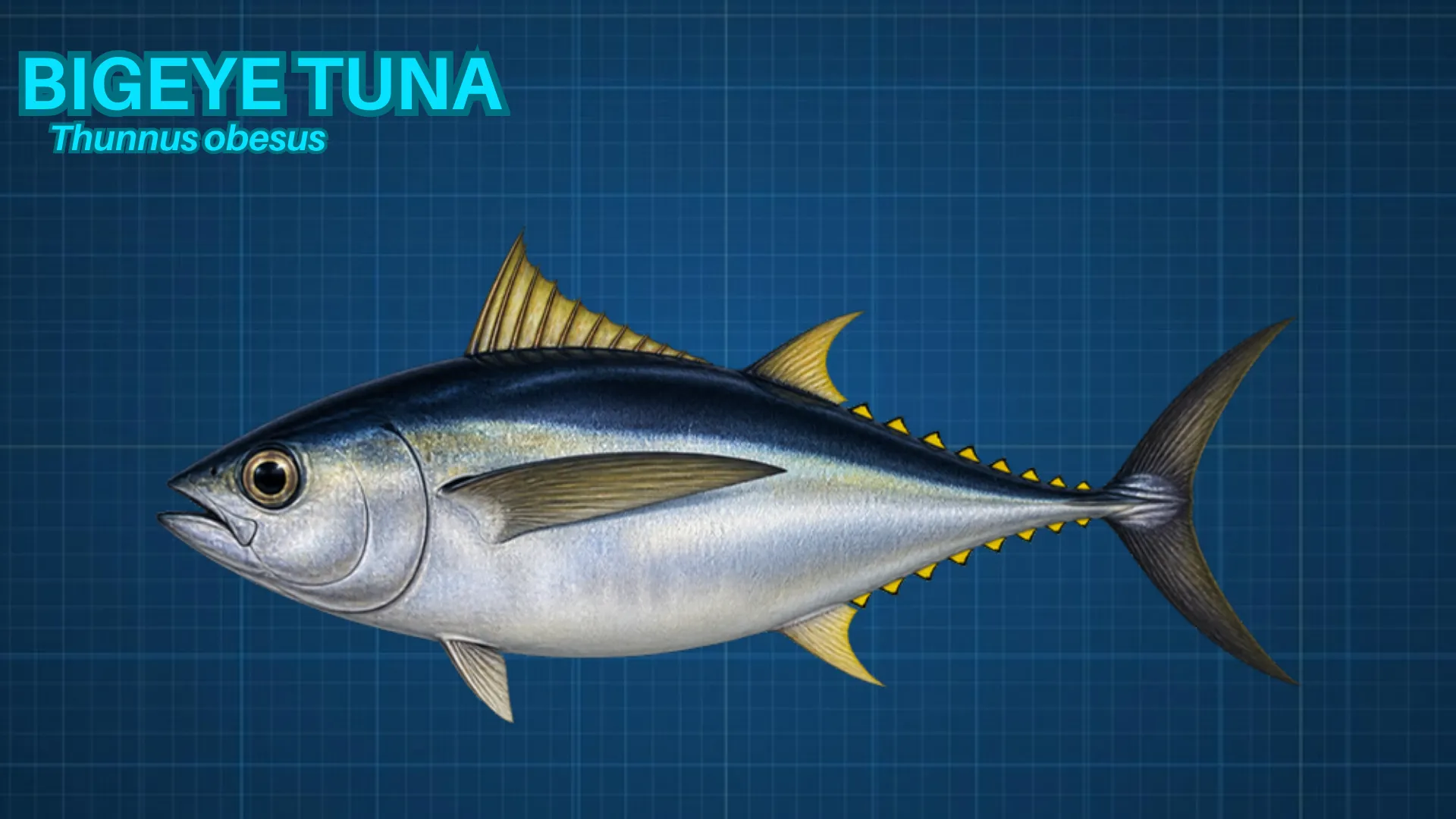
Telling a bigeye from a yellowfin is hard, and NOAA says it takes experience. Both have a dark metallic blue back and a white belly. On a bigeye the first dorsal fin is deep yellow, the second dorsal and anal fins are pale yellow, and the finlets, the row of small fins toward the tail, are bright yellow with black edges. The black edges and the larger eyes are the marks NOAA points to. The Hawaii Seafood Council adds a plumper body and a larger head. In Hawaii both species are sold under the same name, ahi.
Spearfishing Brief
The research for this page found no account of a bigeye speared off California, so the approach described here comes from the world record. On June 23, 2014, Paulo Afonso speared a 242.5-pound bigeye off Pico Island in the Azores. The International Bluewater Spearfishing Records Committee, which keeps spearfishing world records, recognizes it as the record. His account shows why both the search and the shot rate a 5.
The search took most of a morning. Seabirds called shearwaters were active over the area, which Afonso took as a sign of tuna, and a large tuna jumped near the boat. He used no flashers and no chum. He dove and waited in open water, hoping a curious tuna would pass, and swam up-current from the shallow peak where the boat was anchored into deeper water. Around 11 in the morning a single bigeye came toward him at about 33 feet, alone and fairly calm. He dove to cut across its path, leveled off at its depth and waited.
The fish passed farther away than he expected. He took a long shot anyway, aiming at the rear half of the body to be sure the spear would hold, and hit it about 2 feet ahead of the tail. The bigeye ran hard. His float line used long stretch cords called bungees. A 98-foot bungee stretched and pulled a rigid float under, and then a 49-foot bungee pulled a second, high-pressure float under as well. The water there was only 260 to 390 feet deep, so the fish could not sink the whole rig. He describes the fight as lasting an hour.
The gear on this page comes from that account: a long bluewater speargun and a float rig with enough stretch and flotation to wear down a fish of more than 200 pounds. Abundance off California rates a 1.
Bigeye are also a commercial and rod-and-reel fish. NOAA says fishermen in Hawaii and the US Pacific islands take them with hook and line, longlines and trolling gear, and that anglers off California fish for them under a license and daily bag limits.
Deep Dive
Bigeye tuna grow fast. NOAA says they can reach about 6.5 feet, can reproduce at 3 years old and live 7 to 8 years. FishBase records a much older maximum age of 17 years and a maximum published weight of about 463 pounds. The figures on this page follow NOAA, the agency that assesses the Pacific populations.
They hunt near the top of the food chain, taking fish, crustaceans and squid, and FishBase notes that they feed both day and night. NOAA lists larger tunas and billfish, the fish with a long spear-like upper jaw such as marlin, among their predators.
In warm water they breed almost constantly. NOAA says bigeye spawn year-round in the tropics and seasonally in cooler water, and can spawn almost daily, releasing millions of eggs each time. FishBase adds that they may spawn every 1 or 2 days for several months and that spawning happens around the full moon. Each egg floats in the top layer of the ocean, held up by a single droplet of oil until it hatches.
The meat is highly prized. FishBase says it is made into sashimi in Japan. The Hawaii Seafood Council explains why sashimi buyers prefer bigeye: the fish live in deeper, cooler water and usually carry more fat than yellowfin. Good bigeye meat is reddish pink. The high fat also makes it one of the most desirable fish for grilling, and larger fish are preferred for both their fat and their greater yield.
That value shows in the catch figures. NOAA reports US commercial landings of Pacific bigeye tuna of 13.8 million pounds in 2024, worth 58 million dollars, most of it from Hawaii.
Where to Find Them
Beaches whose habitats match this species
Ventura · 1 beach
Channel Islands · 8 beaches
Los Angeles · 1 beach
Catalina Island · 2 beaches
San Diego · 2 beaches
Matched by habitat: a beach is listed when its biome tags overlap this species' biomes.