

Taxonomy
Rarity
The striped marlin is the marlin of Southern California's sport fishery. NOAA Fisheries writes that the species is part of the West Coast's federal fishery plan because of its importance to California's recreational fishery, and that there is no commercial fishery for it. Selling one is illegal. The federal Billfish Conservation Act and other billfish rules prohibit selling billfish, with an exception for fish caught in Hawaii and the US Pacific island territories.
California allows anglers 1 marlin per day. The state's spearfishing rule does not name marlin, but spears, harpoons and bow-and-arrow gear may not be aboard a boat on any trip where a marlin has been taken. NOAA notes that most striped marlin caught in recreational tournaments are tagged and released.
It is not an easy fish to find here. Salt Water Sportsman, in a 2025 guide to the Southern California fishery, says striped marlin are not plentiful locally and that the hard part is finding them rather than catching them, because large numbers are not present at any one time.
The International Union for Conservation of Nature rated the species Least Concern in 2021. NOAA's assessments split by population. The Eastern Tropical Pacific population was neither overfished nor subject to overfishing in a 2010 assessment, while the Central Western Pacific population is rebuilding but still subject to overfishing.
Seasonality
Location
Striped marlin live in tropical, subtropical and temperate parts of the Pacific and Indian oceans. FishBase calls them the most dominant and widely distributed of all the billfish, the fish with a long spear-like upper jaw, and says they live in cooler water than blue or black marlin. NOAA gives their preferred temperature as about 68 to 77 degrees Fahrenheit. Tracking studies found them spending 86 percent of their time in the surface layer above the thermocline, the layer where water temperature changes sharply with depth. FishBase adds that they become more common farther from the continental shelf and usually come close to shore only where the bottom drops off steeply.
Their arrival in California follows its own pattern. Salt Water Sportsman says striped marlin usually reach Southern California in late summer and stay until the water cools in autumn, with September historically the best month. Most of the region's other gamefish follow warm water up from the south, but striped marlin come in from the west. The first fish usually show up near Santa Catalina Island or on the offshore banks southeast of it. Later in the season they move to Santa Barbara Island and often finish around Santa Cruz and Anacapa islands. In 2024 most of the fish stayed around Catalina, while the year before most were caught at the Channel Islands. During the 2015 El Niño, marlin were still biting after Thanksgiving in a small patch of warm water off Santa Barbara Island.
The same guide describes the water they look for. Striped marlin favor warm, clean, purple-blue offshore water, especially where it meets a current break with greener water on the other side. Eddies along those breaks trap the tiny drifting plants and animals that small baitfish eat, and the baitfish draw the marlin. Underwater drop-offs, seamounts and ridges create upwellings and eddies that hold bait, and marlin tend to stay along the edges of the banks rather than on top of them.
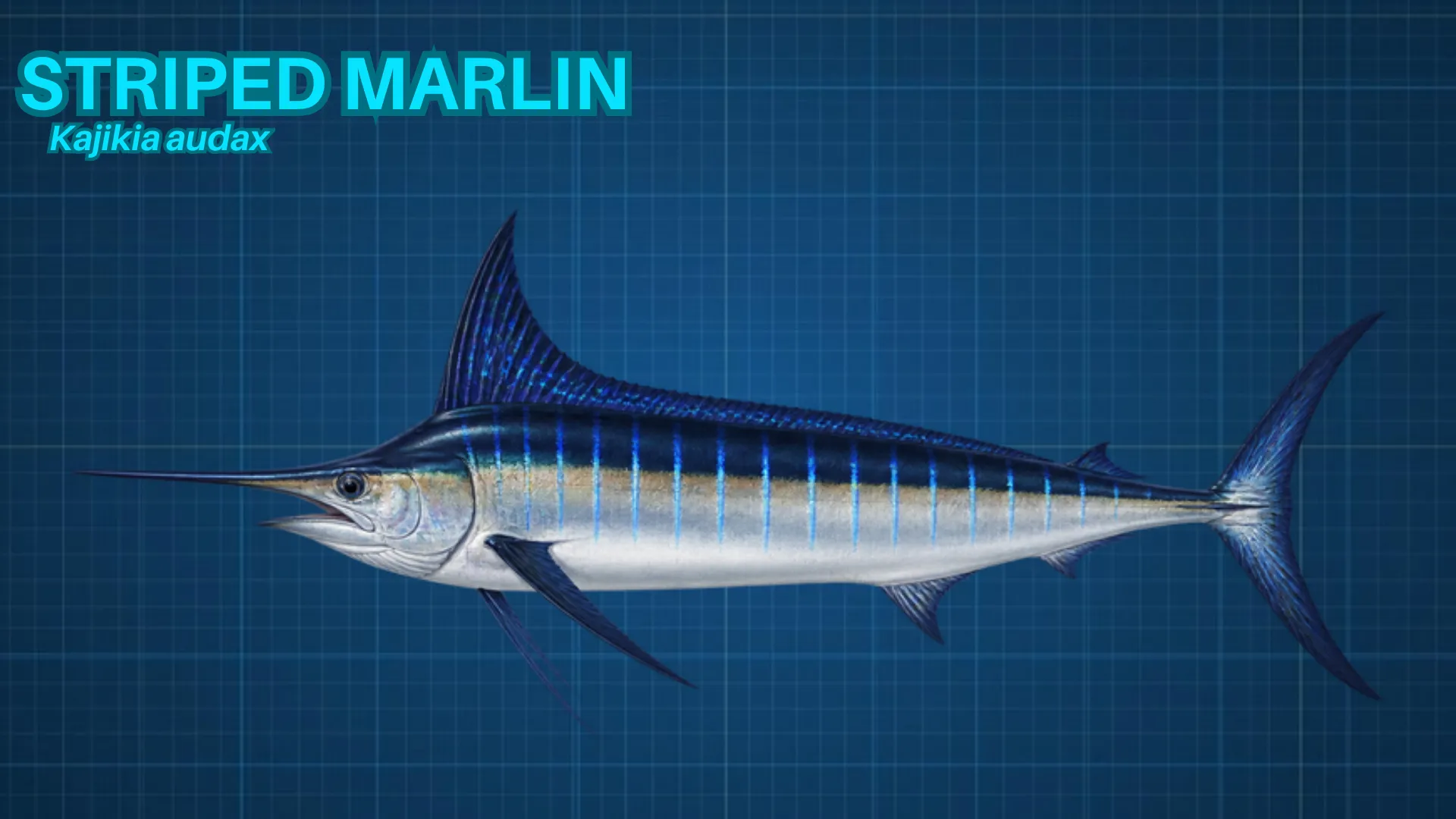
A striped marlin is dark blue-black on top and silvery white below, with rows of blue stripes made of small round dots or narrow bands. NOAA describes a long, round bill, small teeth and a tall dorsal fin.
Deep Dive
Striped marlin eat whatever small fish are available. NOAA lists mackerel, sardine and anchovy, along with squid, and says that off Southern California they often feed at the surface on small coastal fish and squid. The Salt Water Sportsman author describes watching one feed on small bonito in 100 feet of water off the back side of Catalina. Anglers search for them by scanning the surface for seabirds and for marlin whose tails break the water, jumping or feeding. Adults have predators too. NOAA names large open-ocean sharks and toothed whales.
NOAA describes the striped marlin as smaller than the other marlin species but still able to reach 12 feet and more than 450 pounds, and gives a lifespan of up to 20 years. FishBase records a much shorter maximum age of 9 years. The figures on this page follow NOAA.
The life cycle spans the Pacific. NOAA says spawning happens in the central Pacific and off central Mexico. The young fish then move east toward the Mexican coast and are found in high numbers around the tip of the Baja California peninsula. FishBase describes adults as mostly solitary and spread over wide distances, except in the spawning season, when they form small schools of fish of similar size.
The fight is why anglers want them. NOAA calls the striped marlin one of the most sought-after billfish in the region, because the fish leap and fight hard when hooked. Hawaii hosts one of the largest billfish tournaments in the United States. FishBase says its flesh is the best of all the billfish for sashimi and sushi, though on the US mainland it cannot be sold.
Where to Find Them
Beaches whose habitats match this species
Ventura · 1 beach
Channel Islands · 8 beaches
Los Angeles · 1 beach
Catalina Island · 2 beaches
San Diego · 2 beaches
Matched by habitat: a beach is listed when its biome tags overlap this species' biomes.