
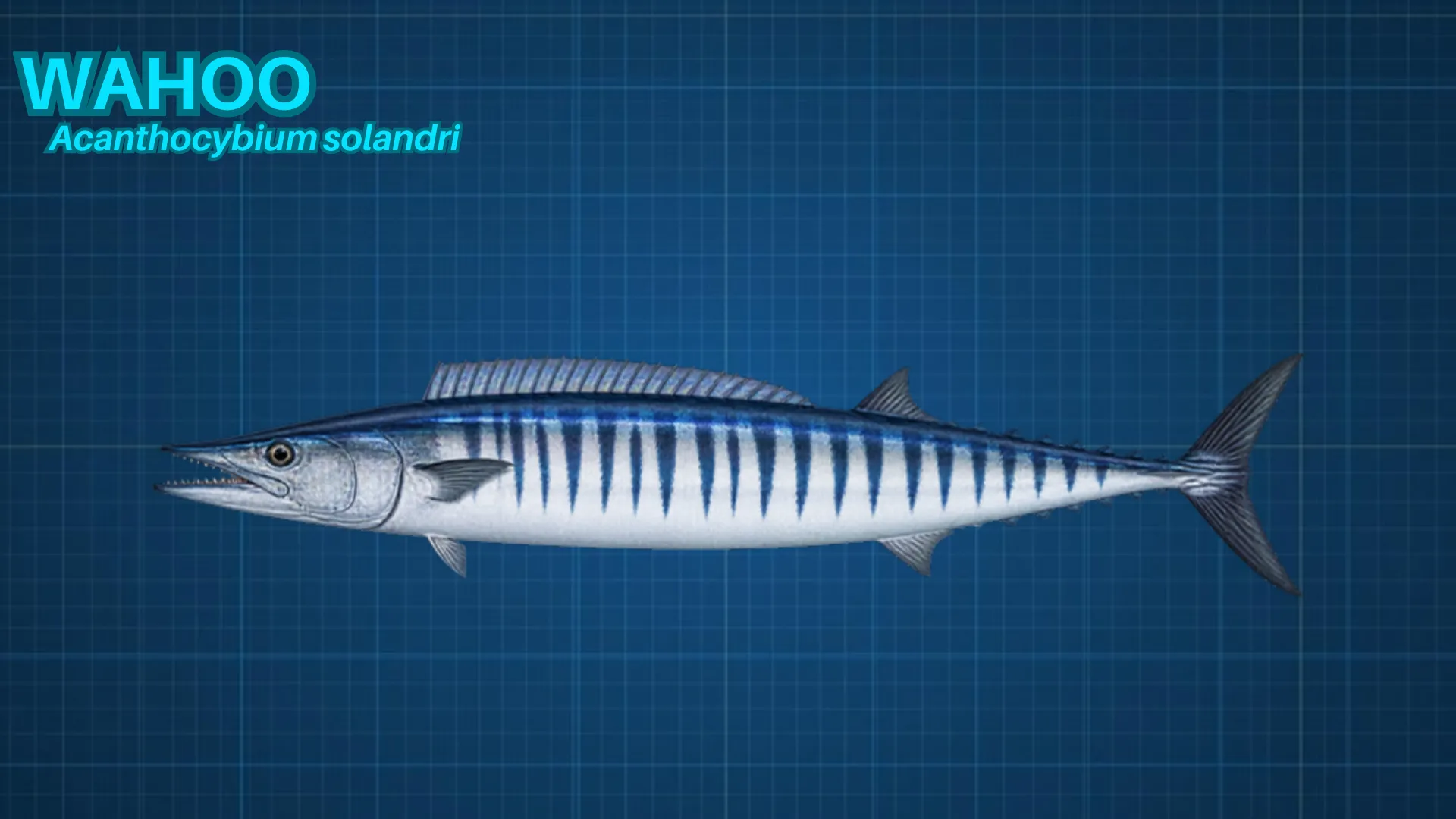
 Spearfishing
Spearfishing Stats
Unknown in California waters until 2014 and still a rare warm-water visitor. Confirmed fish have come from south of Dana Point and off San Diego.
Taxonomy
Rarity
Wahoo are a tropical and subtropical fish, and California sits outside their normal range. Sport Fishing magazine reported in 2014 that wahoo were unknown from state waters until that year. Then a warm-water season brought a handful of them north. California anglers took several fish of up to about 50 pounds, and on October 26, 2014, Alex Dupre of Dana Point landed an 84.3-pound wahoo south of Dana Point in water that measured 72.8 degrees. He had seen a group of 6 large wahoo together. His fish became the state record.
They have not become regular visitors since. In August 2026 a wahoo was caught off San Diego aboard the sportfishing boat The San Diego, whose crew announced the catch as a sign that El Niño had arrived. The report described wahoo off Southern California as exceedingly rare and noted offshore water running into the mid-70s. The International Game Fish Association places seasonal concentrations of wahoo off the Pacific coasts of Panama, Costa Rica and Baja California in summer.
Worldwide the species is not considered threatened. The International Union for Conservation of Nature rates the wahoo Least Concern in a 2022 assessment.
Regulations
CDFW rules verified 2026-09-14
Seasonality
Edibility
About 60 to 65 percent of a whole wahoo's weight comes off as fillet, according to the Hawaii Seafood Council.
Location
Wahoo live in tropical and subtropical water in the Atlantic, Indian and Pacific oceans, including the Caribbean and the Mediterranean. They stay near the surface. FishBase records them from the surface to about 65 feet, usually in the top 40 feet, and describes them as often alone or in small, loose groups rather than tight schools.
They do gather around structure in the open ocean. The Hawaii Seafood Council, writing from that state's fishery, says wahoo rarely school but can be found in groups around fish aggregation buoys, the anchored floats that fishermen use to attract open-ocean fish. Catches at the surface come from banks, pinnacles and floating debris, while catches on longlines set far offshore show the species spread widely through open water too.
FishBase gives a maximum length of about 98 inches and a maximum published weight of 183 pounds. The International Game Fish Association's all-tackle world record is a 184-pound fish from Cabo San Lucas, Mexico, caught in 2005. Most wahoo are far smaller. The Hawaii Seafood Council says the usual Hawaii fish runs 8 to 30 pounds, with some over 100.
Spearfishing Brief
Finding a wahoo in California starts with being offshore in one of the rare years when they are here at all, which is why abundance rates a 1. Once a diver is in the right water, the search is mostly waiting. Lisa Stengel, a Florida Freedivers team diver who has hunted wahoo in the Florida Keys and Baja California, describes drifting in open water beside a flasher rig, a line of shiny attractors hung below the boat, and watching the blue. She writes that patience is the key and that wahoo appear without warning, alone or in groups. Finding them rates a 4. They are not camouflaged, but nothing predicts when one will show up.
The shot rates a 5. In her account a wahoo came in fast to look at the flasher and was already turning away when she dove to cut it off. The fish tipped its head slightly sideways to glance back at her, and that brief pause let her judge that it was still in range. She placed the shot in the rear half of the body. She also counts 2 lost wahoo for every 1 she has landed. One of those escaped when she hauled in the float line quickly because sharks were close, and the spear tore free.
The rig in her account is a bluewater speargun with a slip tip, a spear point that turns sideways inside the fish so it cannot slide back out, tied by a float line to a float on the surface. After the hit she let the float absorb the fish's run instead of grabbing the line. When the float slowed, she brought the fish in hand over hand and let the line slip through her fingers whenever it pulled. Her rule is that bluewater spearfishing is not a time to get aggressive.
Wahoo are also a popular rod-and-reel fish. The Hawaii Seafood Council calls them a popular light-tackle gamefish in Hawaii, where trolling boats land most of the commercial catch. California's state record wahoo was caught by an angler.
Deep Dive
The wahoo belongs to the mackerel and tuna family. FishBase describes it as an open-ocean hunter of fish and squid, usually alone or in loose groups. It matures at about 39 inches. Its spawning season appears to run a long time, because fish at different stages of ripeness are regularly caught at the same time. The eggs and larvae drift in open water.
The name has a Hawaiian story behind it. In Hawaii the fish is called ono, a Hawaiian word meaning good to eat. The Hawaii Seafood Council says early European maps of the islands often spelled Oahu as "Wahoo," and that spelling is believed to be where the English name came from. The same source records that ancient Hawaiians said the ono was the parent of the opelu, a small mackerel-like fish that was important food for early Hawaiians.
The Hawaiian name fits the meat. FishBase calls the flesh very good quality. The Hawaii Seafood Council describes it as whiter, flakier and more delicate than the meat of other fast open-ocean fish, with less of the strong-tasting dark muscle that tuna and marlin use for long-distance swimming. It is a lean fish, so it cooks best by methods that keep it from drying out, such as poaching, and it is also served raw as sashimi. About 60 to 65 percent of a whole fish's weight comes off as fillet.
Fresh wahoo does not keep long. The council gives a shelf life of about 10 days with proper care, and says the fish lasts longer if it is gutted, hung head down and left unfilleted until shortly before it is cooked. The first signs of a fish going bad are discolored skin around the head and gill covers and flesh that turns soft.
There is also a health caution. FishBase lists reports of ciguatera poisoning from wahoo, a type of food poisoning that comes from eating certain fish.
Where to Find Them
Beaches whose habitats match this species
Ventura · 1 beach
Channel Islands · 8 beaches
Los Angeles · 1 beach
Catalina Island · 2 beaches
San Diego · 2 beaches
Matched by habitat: a beach is listed when its biome tags overlap this species' biomes.