
 Spearfishing
Spearfishing Stats
A major rod-and-reel fish, with 1.9 million pounds of Pacific albacore landed by US recreational anglers in 2024, but an offshore and seasonal one that rarely comes within a diver's reach.
Taxonomy
Rarity
Albacore are an abundant fish that lives far from where divers go. NOAA Fisheries found the North Pacific population neither overfished nor subject to overfishing in its 2023 assessment, and the International Union for Conservation of Nature rated the species Least Concern in 2021. US recreational anglers landed 1.9 million pounds of Pacific albacore in 2024, and the commercial fleet landed about 10 million pounds, most of it in Washington and Oregon.
Nearly all of those fish live far from shore. Albacore follow temperature fronts in open water, and the young fish that reach the West Coast are partway through a crossing of the Pacific. That puts them in the path of boats rather than divers.
Regulations
CDFW rules verified 2026-09-14
Seasonality
Edibility
Location
Albacore live in the open waters of every tropical and temperate ocean. The Pacific holds 2 separate populations, a northern and a southern, and NOAA's Voices of the Bay program says the 2 do not appear to mix. The North Pacific population ranges from the central Pacific coast of Mexico to the Gulf of Alaska and west across the ocean to Japan.
The young fish cross the Pacific. According to NOAA, North Pacific albacore of 2 to 4 years old begin moving in spring and early summer off Japan. They reach the inshore waters off the US Pacific coast by late summer and spend late fall and winter back in the western Pacific. How far they travel and when they arrive depend on ocean conditions in a given year. They travel in schools of similar-sized fish that can spread up to 19 miles wide.
Water temperature shapes where they go. While migrating they generally follow water between 59 and 67 degrees Fahrenheit, but they also spend time in upwelling water as cold as 49 degrees, where schools of sardines and other prey feed. FishBase notes that they gather along the boundaries where cooler and warmer water meet, and that they sometimes school with skipjack, yellowfin and bluefin tuna under floating objects, including drifting seaweed. NOAA records adults to depths of at least 1,250 feet.
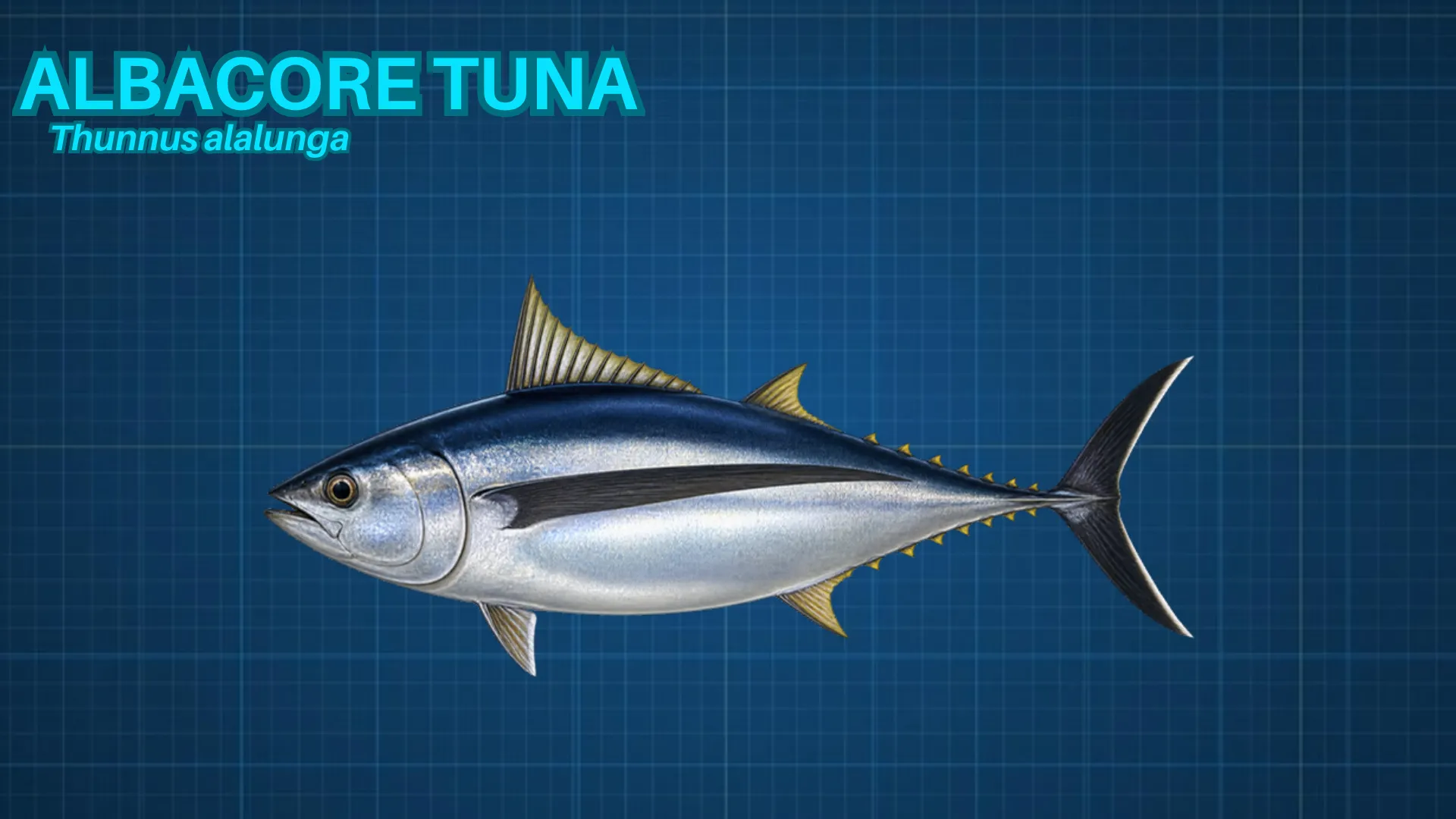
The fins are the easiest mark. NOAA describes a metallic dark blue back, silvery white sides and belly, and a white edge on the tail. The pectoral fins, the long fins just behind the gills, are at least half the length of the body. FishBase warns that young bigeye tuna also have long pectoral fins and are often confused with albacore. The bigeye's fins have rounded tips.
Spearfishing Brief
In California the albacore is mainly an angler's fish. NOAA describes the West Coast commercial fleet catching them by trolling and with pole and line, and calls albacore a popular and important recreational species. The research for this page found no account of an albacore speared in California waters.
The documented spearfishing method comes from New Zealand. The New Zealand spearfishing retailer Ocean Hunter describes albacore as a great fish to hunt and says they are best taken while they are feeding on bait balls, tight balls of small fish, or by laying a chum trail to bring them into range. Both methods bring a fast, far-ranging fish close enough for a shot.
Finding them rates a 4, the same as the other open-ocean tunas on this site. An albacore is easy to see once it is close. The difficulty is being in the water where they are, far offshore, in the right season and along the right temperature break. The shot rates a 4. Albacore are fast, and NOAA credits them with speeds over 50 miles per hour, but they are smaller than the yellowfin and bluefin tuna that sit at the top of the scale. Abundance rates a 2, because plenty of albacore reach the West Coast and very few come within a diver's reach.
California treats albacore more generously than yellowfin or bigeye tuna. The daily limit is 10 south of Point Conception, Santa Barbara County, and 25 north of it, and both limits are taken on top of the general 20-finfish daily bag limit rather than counted inside it.
Deep Dive
The albacore is built for long-distance swimming. NOAA describes a circulatory system that regulates body temperature and makes the muscles more efficient, along with a high metabolism and high blood pressure, blood volume and hemoglobin, the protein that carries oxygen in the blood. Albacore eat fish, crustaceans and squid. They grow quickly when young and more slowly with age. NOAA gives a maximum of almost 80 pounds and about 47 inches, maturity at 5 to 6 years and a life of 10 to 12 years. FishBase records a heavier maximum of 133 pounds and a shorter maximum age of 9 years. The figures on this page follow NOAA, the agency that assesses and manages the population that reaches California.
Spawning happens far from California. North Pacific albacore spawn from March to July in tropical and subtropical Pacific water. Females release their eggs near the surface, where the eggs are fertilized, and a single spawning can produce between 800,000 and 2.6 million eggs depending on the size of the female. The eggs hatch 24 to 48 hours later.
Southern California is where the albacore first became a valuable fish. NOAA's Voices of the Bay history says that at the turn of the 20th century, albacore were mostly treated as a nuisance. Fishermen trolling for the larger and more valuable bluefin tuna threw them away. In 1903 a packing plant in San Pedro ran short of sardines and began canning albacore as an experiment to keep the plant running. The 700 test cases were labeled simply "Tuna." They sold, both because canned fish kept well and because of what the history calls albacore's choice white, tasty meat. By 1914 that plant was packing 400,000 cases a year.
The fishery grew fast from there. Southern California's commercial albacore catch peaked in 1925 at 22 million pounds. By the late 1930s trollers were fishing the nearshore waters of California, Oregon and Washington, and by the mid-1940s boats were fishing several hundred miles offshore. In 1949 an agreement between the United States and Costa Rica made the first attempt to manage tuna in the eastern Pacific, and it led to the creation of the Inter-American Tropical Tuna Commission in 1950. The center of the fishery has since moved north. Most Pacific albacore today is landed in Washington and Oregon.
FishBase describes the meat as highly appreciated. Albacore is sold fresh, smoked, frozen and canned, and it is eaten steamed, broiled or fried.
Where to Find Them
Beaches whose habitats match this species
San Luis Obispo · 12 beaches
Ventura · 1 beach
Channel Islands · 8 beaches
Los Angeles · 1 beach
Catalina Island · 2 beaches
San Diego · 2 beaches
Matched by habitat: a beach is listed when its biome tags overlap this species' biomes.