

Taxonomy
Rarity
The swordfish is one of the few fish California divers are not allowed to spear. The state's spearfishing rule names the broadbill swordfish, California's name for the species, in a short list of fish that divers may not take, alongside giant sea bass, garibaldi and salmon. Anglers may keep 2 swordfish a day on rod and reel. On any boat trip that has taken a swordfish, spears, harpoons and bow-and-arrow gear may not even be aboard.
Most of the swordfish California eats comes from somewhere else. NOAA Fisheries says most of the swordfish landed in California is caught by longline boats based in Hawaii, and that more than 80 percent of the swordfish eaten on the West Coast is imported.
The International Union for Conservation of Nature lists the species as Near Threatened in a 2021 assessment. The 2 North Pacific populations NOAA tracks are in different condition. The Western and Central North Pacific population was neither overfished nor subject to overfishing in 2023. The Eastern Pacific population was not overfished but was subject to overfishing in its most recent assessment, from 2014.
Seasonality
Location
Swordfish live in tropical, temperate and sometimes cold water around the world, including off the US West Coast. In the Pacific, NOAA says scientists know little about their migrations, but tagging suggests they move east from the central Pacific north of Hawaii toward the West Coast. FishBase describes a fish that moves toward temperate or cold water in summer and back to warm water in fall, and that prefers water between about 64 and 72 degrees Fahrenheit.
They move up and down every day. NOAA says swordfish generally stay in deeper, cooler water during the day and rise into shallower, warmer water at night. Off California, the Aquarium of the Pacific describes them hunting mackerel and squid at around 985 feet during the day. FishBase records the species usually from the surface to about 1,800 feet and as deep as about 9,400 feet. Not every swordfish stays deep all day. California's harpoon fishermen hunt swordfish basking at the surface in daylight.
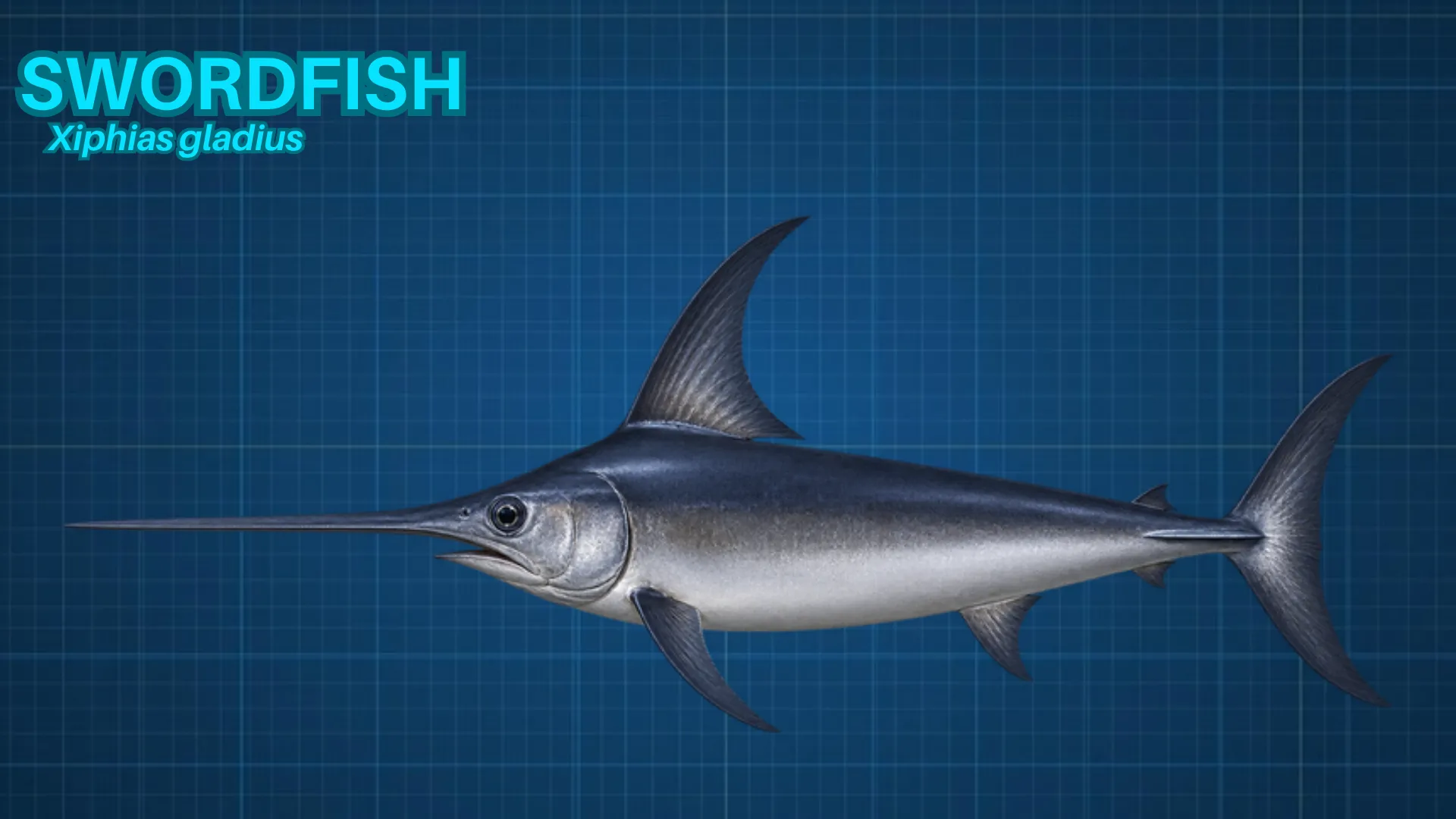
The body is easy to recognize. The upper jaw extends into a long, flat, pointed bill, the sword. The body is stout and rounded, darkest on top and usually black or brown, with large eyes, a tall crescent-shaped first dorsal fin and a broad crescent-shaped tail. NOAA notes a detail that sets adults apart from marlin and the other billfish: adult swordfish have no scales and no teeth.
Deep Dive
The sword is a hunting tool. NOAA describes swordfish slashing their bills back and forth through prey such as squid and smaller fish, stunning or injuring them before eating. FishBase says adults feed opportunistically from the surface to the bottom over a wide range of depths, taking mostly fish along with crustaceans and squid. The sword appears early. FishBase records it as well developed on a young swordfish less than half an inch long, and says the young live near the surface and quickly become predators that eat a great deal.
Swordfish can hunt in deep, cold water because of 2 adaptations that NOAA describes: specialized eye muscles and a heat-exchange system. NOAA also credits them with speeds of up to 50 miles per hour.
They grow large and they grow fast. NOAA gives a maximum of 14 feet and nearly 1,200 pounds, though the fish caught in the fishery average 50 to 200 pounds. Swordfish can reproduce at 5 to 6 years old and typically live about 9 years. FishBase notes that females grow fastest. Aging a swordfish is difficult, because the ear bones scientists normally use are very small and adults have no scales. Researchers instead count yearly growth rings in thin cross sections of the fin rays, the stiff supports inside the fins.
Adults have few natural enemies. NOAA says swordfish are rarely eaten by other animals, although young swordfish are sometimes taken by sharks and larger predatory fish. They spawn often throughout the year in warm tropical and subtropical water and mainly in spring and summer in cooler regions. The eggs are fertilized outside the body and float at the surface for about 2.5 days before hatching. FishBase adds a caution for anyone eating one: large swordfish may build up high levels of mercury in their flesh.
California's commercial fishermen take swordfish with several kinds of gear, and each works differently. Harpoon fishing, as the Aquarium of the Pacific describes it, uses a pole thrown by hand, with a dart tied to a line several hundred feet long that ends at a float. It needs calm seas to spot the fish, and some fishermen hire spotter planes. Because the harpooner picks each fish, the method catches no protected animals by accident, and harpooned swordfish sell for higher prices. In 2017, 21 harpoon boats landed nearly 53,000 pounds of swordfish in California.
Large-mesh drift gillnets, long curtains of net set at night to about 200 feet, landed far more fish in 2017, about 388,000 pounds, from a fleet that has shrunk sharply. The aquarium counts 141 drift gillnet boats in 1990 and 20 active in its 2017 figures. A newer method, deep-set buoy gear, hangs baited hooks deep in the water during the day, below the warm surface layer where sea turtles, marine mammals and seabirds spend their time. In trials from 2011 to 2017, 81 percent of the catch was swordfish, and every fish that could not be sold was released alive. NOAA says the gear was formally added to the West Coast fishery plan in 2023. Recreational anglers fish for swordfish with rod and reel and may not sell or trade their catch.
Where to Find Them
Beaches whose habitats match this species
San Luis Obispo · 12 beaches
Ventura · 1 beach
Channel Islands · 8 beaches
Los Angeles · 1 beach
Catalina Island · 2 beaches
San Diego · 2 beaches
Matched by habitat: a beach is listed when its biome tags overlap this species' biomes.