


Taxonomy
Rarity
Abundance rates how many are in suitable habitat. Find difficulty rates how hard it is to locate one on a daylight snorkel or freedive through 50 ft. A higher find score means a harder search. The rarity category also reflects the kind of encounter; it is not an average of the 2 scores.
Seasonality
Location
FishBase gives the range as southeastern Alaska to Point Arguello in central California, with records as deep as about 420 feet. The fish spawns on the same beaches as the surf smelt. Most of the catch comes from Northern California, and the 2001 report credits the area around Eureka with about 60 percent of all commercial smelt landings and Crescent City with another 33 percent.
Deep Dive
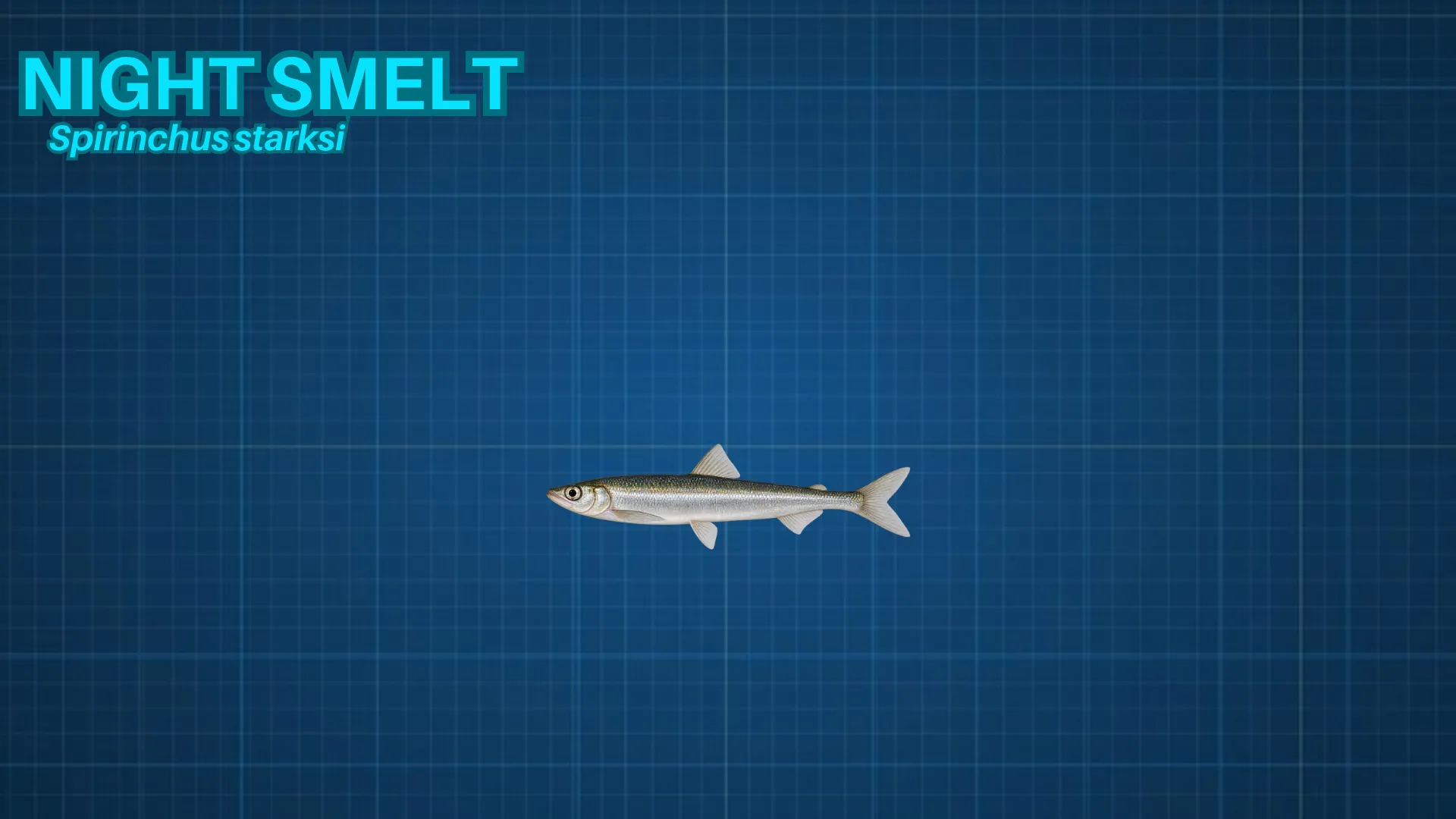
The night smelt is a true smelt, related to the surf smelt and distinct from silversides such as jacksmelt and topsmelt. FishBase describes it as green with silvery sides. Males have longer pectoral fins than females and small bumps on the head, scales and lower fins. The 2001 report notes that it rarely grows past 6 inches or lives past 3 years, though FishBase lists a maximum of about 9 inches.
It spawns in the dark. The report describes runs from January through September, peaking between dusk and midnight on outgoing tides, and less tied to the height of the tide than surf smelt spawning. The 2 species use the same beaches, sometimes on the same day, with night smelt spawning at night and surf smelt by day. Because night smelt run earlier in the year, the report suggests that most smelt caught before June are night smelt.
The spawning crowd is mostly male. The report found 8 males for every female near shore early in the season, rising to nearly 100 to 1 by the end, while offshore catches ran about even. Females spawn repeatedly through the season, dashing in to release their eggs among the waiting males. The eggs stick to the gravel and hatch in about 2 weeks.
Fishermen take it the same way as the surf smelt, with A-frame dip nets from the beach. The catch is sold fresh or shipped to aquariums as food for fish, birds and marine mammals, according to the report. Sport catches recorded by federal surveys were tiny, with the largest at 131 pounds in 1986, and the authors suggest this is because surveyors rarely meet anglers fishing at night. Like the surf smelt, it is a schooling fish that eats plankton, and FishBase notes that it feeds on small, shrimp-like crustaceans. The report adds that it is important prey for other fish, marine mammals and birds.
Where to Find Them
Researched habitat and range candidates
Santa Barbara · 3 beaches
San Luis Obispo · 25 beaches
Monterey · 8 beaches
Oregon South Coast · 10 beaches
Oregon Central Coast · 7 beaches
Oregon North Coast · 4 beaches
South Sound · 2 beaches
Cape Flattery · 1 beach
These locations have suitable habitat within the species range. An assignment is a possible encounter, not a confirmed sighting at every beach. Season, depth, and local conditions still matter. Historical habitat without present-day evidence is excluded.