
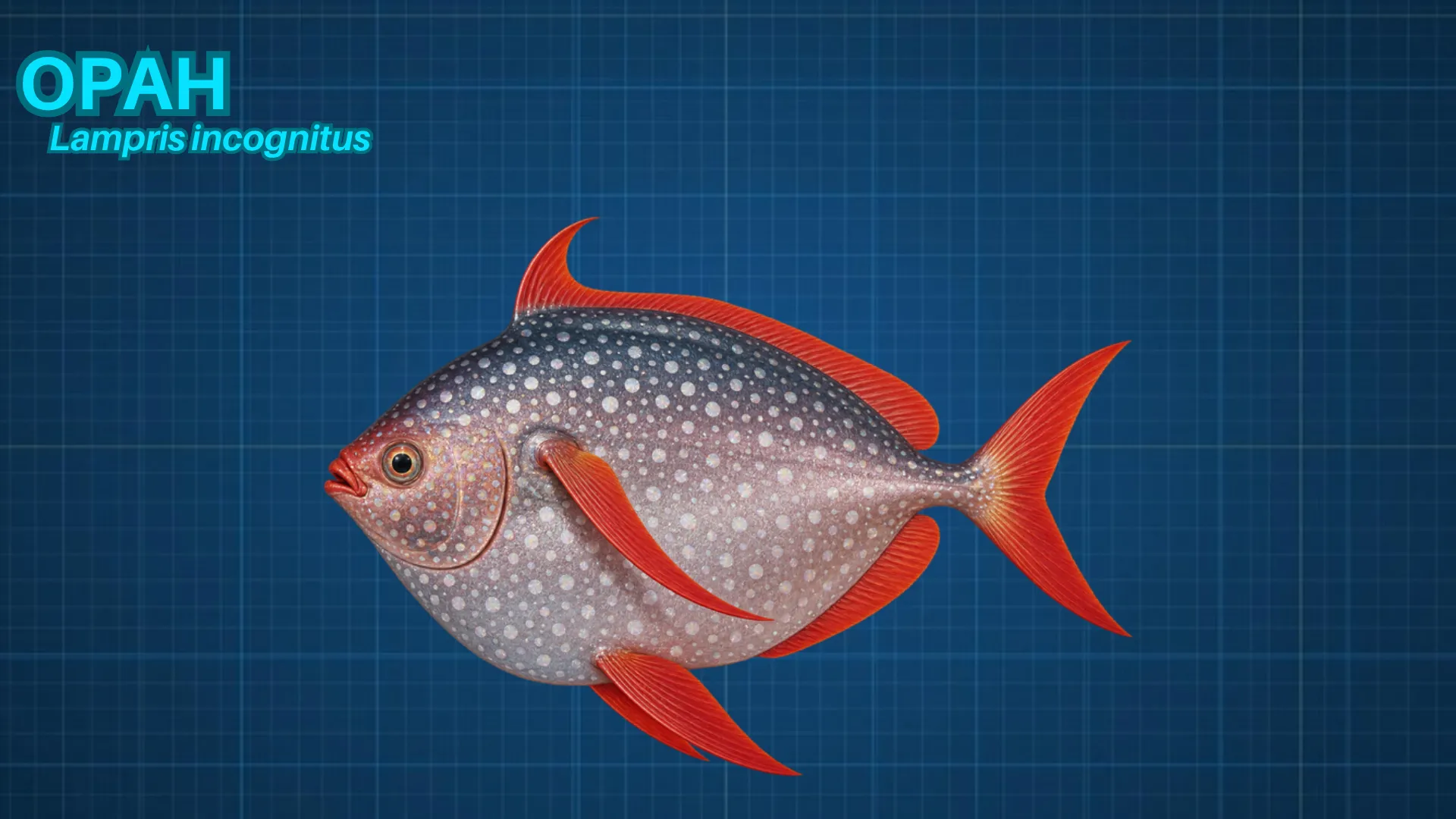
Also calledmoonfish, Hawaiian moonfish, mariposa, Jerusalem haddock

Taxonomy
Rarity
Abundance rates how many are in suitable habitat. Find difficulty rates how hard it is to locate one on a daylight snorkel or freedive through 50 ft. A higher find score means a harder search. The rarity category also reflects the kind of encounter; it is not an average of the 2 scores.
Seasonality
Location
The smalleye Pacific opah lives in the central and northeastern Pacific. California Sea Grant places it from at least Washington to well offshore south of Baja California, and the 2001 state report records opah landed as far north as Crescent City.
It is an open-ocean fish of deep water. California Sea Grant gives a depth range from the surface to more than 1,600 feet. NOAA reports that opah move up to about 165 feet at night and down to about 650 feet during the day, and its scientists report that opah spend most of their time between about 150 and 1,300 feet deep. Within California, the 2001 report says, many sport-caught opah come from the northern Channel Islands south to the Coronado Islands, just below the border.
Deep Dive
The opah is round, flat and brightly colored. NOAA describes a silvery gray body that shades to rose red toward the belly, covered in white spots, with red fins, a red mouth and large eyes ringed in gold. FishBase separates the smalleye Pacific opah from its relatives by its eye, which is less than 30% of the length of the head, and by its spots, which are small, round, packed close together over the whole body, and come in 2 distinct sizes. Its small mouth has no teeth, and the bones of the jaw can swing forward when it feeds.
It is the first fish known to be fully warm-blooded. In 2015, NOAA scientists Nicholas Wegner, Owyn Snodgrass and colleagues reported in the journal Science that opah caught on surveys off the West Coast kept their muscles about 9 degrees Fahrenheit warmer than the water around them. The heat comes from the opah constantly flapping its fins. Its gills hold it in: the vessels carrying warm blood into the gills wind around those carrying cold blood back, so the warm blood heats the cold, and fat surrounds the gills, heart and muscle. NOAA reports that the warmth lets the opah chase fast prey such as squid in cold, deep water. The fish also stays buoyant with a working swim bladder and bones that are porous and filled with oil.
Opah hunt in the middle depths. The 2001 state report lists squid, crustaceans and fish such as anchovy, lancetfish and cutlassfish, NOAA adds barracudinas, and California Sea Grant adds saury and mackerel. Predators of adult opah have not been documented.
Size records for this species are thin. Most published sizes come from before 2018, when all opah were counted as 1 species. NOAA gives an average of about 100 pounds and 3 feet across, and the 2001 state report gives opah as known to reach at least 54 inches and 160 pounds, with reports of fish up to 72 inches and 500 to 600 pounds. The largest smalleye Pacific opah that FishBase lists measured about 33 inches without its tail fin. NOAA reports that most opah caught on longlines are estimated to be 1 to 6 years old.
The meat is prized. The 2001 report describes it as salmon-colored, darker over the pectoral fin, very fatty just under the skin and otherwise rich, firm and delicate, and excellent smoked. NOAA calls the taste rich and creamy, a cross between tuna and swordfish. The report lists other names for the fish, including moonfish, Hawaiian moonfish, mariposa and Jerusalem haddock, and says the name opah itself comes from West Africa.
Where to Find Them
Researched habitat and range candidates
San Diego · 2 beaches
Catalina Island · 2 beaches
Los Angeles · 1 beach
Channel Islands · 8 beaches
Ventura · 1 beach
San Luis Obispo · 12 beaches
Monterey · 1 beach
Cape Flattery · 1 beach
These locations have suitable habitat within the species range. An assignment is a possible encounter, not a confirmed sighting at every beach. Season, depth, and local conditions still matter. Historical habitat without present-day evidence is excluded.