
Also calledCalifornia aglaja

Taxonomy
Rarity
Abundance rates how many are in suitable habitat. Find difficulty rates how hard it is to locate one on a daylight snorkel or freedive through 50 ft. A higher find score means a harder search. The rarity category also reflects the kind of encounter; it is not an average of the 2 scores.
Seasonality
Location
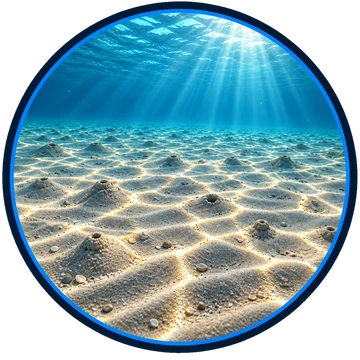
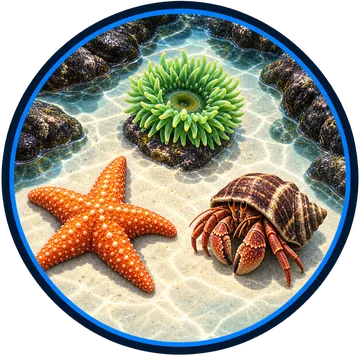
Navanax live on sheltered sandy and muddy bottoms, on mudflats and on rocky shores. The sources read for this page give no depth range.
The animal is long and soft, with 2 large flaps of skin along its sides that nearly meet over the middle of its back. Sea slug references put the maximum length at about 9 inches, and a Gulf of California guide gives a range of 2.5 to 10 inches. The body is dark brown to black, lined lengthwise with cream to yellow streaks that are sometimes broken into spots, and the edges of the flaps carry yellow or orange lines and bright blue dots. It holds a small shell inside its body.
Deep Dive
The navanax looks like a nudibranch, but it belongs to a different group of sea slugs, the head-shield slugs. It is probably the largest member of its family. It is also a hunter of other sea slugs, and the way it hunts is the most interesting thing about it.
A sea slug moves on a film of slime and leaves a trail behind it. The navanax follows those trails by chemical sense, tracking prey along the path it has already taken. Its usual prey are bubble snails, small sea snails with thin shells, and it also eats other sea slugs, sometimes nudibranchs, and small fish. It feeds by using part of its throat as a suction pump to draw prey in.
Its defense uses the same slime. A disturbed navanax releases a bright yellow substance into its trail, and the yellow can stay in the trail for several hours. Chemists who studied it in 1980 described the substance as an alarm pheromone, a chemical signal of danger, and it causes some predators to stop pursuing the slug.
Every navanax is male and female at the same time. To mate, the animal acting as the male approaches the other from behind, and mating sometimes runs in chains of up to 4 animals at once. In the southern part of the range the species spawns all year, and a single animal can lay up to 800,000 eggs at a time. The young are released after 7 to 19 days of development and drift as plankton.
Where to Find Them
Researched habitat and range candidates
San Diego · 5 beaches
Orange County · 3 beaches
Los Angeles · 7 beaches
Channel Islands · 5 beaches
Ventura · 4 beaches
Santa Barbara · 3 beaches
San Luis Obispo · 4 beaches
Monterey · 2 beaches
These locations have suitable habitat within the species range. An assignment is a possible encounter, not a confirmed sighting at every beach. Season, depth, and local conditions still matter. Historical habitat without present-day evidence is excluded.