
 Pier
Pier
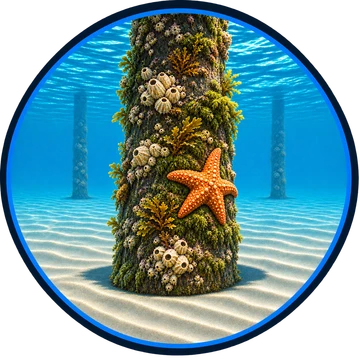
The pilings of a pier and the shaded sand beneath them. Mussels, barnacles, anemones and sea stars cover the posts, and fish gather around them.
About
The Pier biome is the habitat made by the pilings of a pier and the shaded seafloor beneath its deck. Each piling is a column of hard surface standing in water that is often open sand, and it ends up covered in barnacles, mussels, anemones, sponges, and tube worms, along with the crabs, octopus, and fish that live among them. The biome differs from a natural reef in 2 ways. The deck overhead blocks much of the sunlight, and each post runs straight up from the seafloor, through every depth, to the air.
Hard posts over a soft bottom
A pier puts hard surface where there was little or none. Animals that live attached to hard surfaces arrive as drifting larvae, settle on the posts, and grow into what biologists call a fouling community, the crust of barnacles, mussels, anemones, sponges, and tunicates that builds up on anything left in seawater. Tunicates, also called sea squirts, are soft, bag-shaped filter feeders.
Because a piling reaches from above the high-tide line to the bottom, its top section is uncovered at every low tide, much like a rocky shore. When storm waves broke off part of the Santa Cruz Wharf in December 2024, California naturalist Allison J. Gong examined pilings that had been hauled out of the water. She found many of the same animals she sees on the rocks of the intertidal zone, the strip of shore between high and low tide: acorn barnacles, pink barnacles, the threads mussels use to anchor themselves, aggregating anemones, and sunburst anemones. The posts also carried giant acorn barnacles (Balanus nubilus), a species she never sees on the shore because it lives only below the low-tide line.
Life on the posts
Below the waterline, a single kind of animal often covers a post from top to bottom. On Municipal Wharf 2 in Monterey, some pilings are carpeted from the waterline to the bottom with strawberry anemones (Corynactis californica), small pink to red relatives of sea anemones, and others with white plumose anemones, tall anemones with a feathery crown of tentacles, according to California Diving News. Sheep crabs hang upside down on the posts, and small red octopus live among the plumose anemones.
In shallow water, Monterey's wharf pilings also grow a mat known as piling moss. The name is misleading, because an animal makes it. Thousands of slender tubes, each built by a polychaete worm (a segmented marine worm) about 1 millimeter wide, twist together and collect sand. A City College of San Francisco lab guide lists crabs, shrimp, brittle stars, bat stars, and nudibranchs (sea slugs) among the animals living inside the mat.
The shade beneath the deck
A pier deck casts shade that a natural reef never has, and the shade changes what lives below it. In marinas in Sydney, Australia, researcher Tim Glasby compared pilings with nearby sandstone reef and found different communities on the 2. Bryozoans (tiny colonial animals that build crusts), tube worms, sponges, and sea squirts dominated the pilings, while algae were common on the rock. A follow-up experiment found that shading and a surface's height above the seafloor explained much of the difference.
In Puget Sound, a 2017 study found fewer small invertebrates under both city piers and ferry piers, including animals that juvenile salmon eat, and less algae and seagrass there as well. A 2014 study of seawalls and piers in the sound found that juvenile salmon fed least directly beneath piers and most in the water next to them. Kelp perch were rarely seen under the piers, while red rock crabs were more common there.
Fish around the pilings
The posts give small fish shelter and food, and small fish draw larger ones. The pile perch, a surfperch, lives around kelp, pilings, and other underwater structures in water up to 46 meters (150 feet) deep, according to the Washington Department of Fish and Wildlife. Under Monterey's Wharf 2, California Diving News reports large numbers of young lingcod, none longer than about 14 inches.
Scripps Institution of Oceanography runs a live camera on a piling of its pier in La Jolla, about 4 meters (13 feet) below the surface. Its page tells viewers to watch for drifting organic bits and mysid shrimp, small shrimp-like crustaceans, and notes sightings of a school of topsmelt, a spiny lobster, and a leopard shark or bat ray. The sharks and rays are animals of the sand bottom, and at Scripps Pier the Pier biome blends into the Sandy Flats biome below it.
Where the biome occurs
Piers stand along the whole West Coast, from fishing piers on open surf beaches to harbor wharves, ferry docks, and research piers. What grows on them depends on the water around them. A pier on a surf beach stands in breaking waves and moving sand, while a harbor or bay pier sits in calmer, often cloudier water. Scripps Pier is 1,084 feet (330 meters) long and 1 of the longest research piers in the world. The first pier there was finished in 1916, and storms in 1982 damaged 105 of its pilings, which led to the all-concrete pier completed in 1988.
Many West Coast piers are fishing piers. In California, the Department of Fish and Wildlife does not require a fishing license to fish from a public pier in ocean or bay waters, though size limits, bag limits, and seasons still apply.
Diving under a pier
Visibility under a pier follows the water around it. On a surf beach, waves stir up the sand and cloud the water under the pier the same way they do in the Surf Zone biome. California Diving News gives visibility at Monterey's Wharf 2 as 5 to 40 feet, in 20 to 30 feet of water. Most of the hazards come from people. The same report describes monofilament fishing line everywhere under the wharf, sharp protrusions on the pilings, and small boats that take shortcuts beneath it. Access rules vary from pier to pier. Diving under Wharf 2 requires the harbor master's permission, and several California cities ban swimming, diving, or spearfishing near their piers.
Threats
The materials piers are built from carry their own risks. Many older wooden pilings were treated with creosote, a tar-based wood preservative. Creosote contains polycyclic aromatic hydrocarbons, a family of chemicals that includes known causes of cancer, and it causes high death rates and developmental problems in herring eggs, according to the Washington Department of Natural Resources. Since 2007 the department has pulled 14,461 pilings and more than 21,300 tons of creosote out of Puget Sound. Wood can also be eaten. Shipworms, clams that bore into wood, destroyed wharves, piers, and ferry slips in San Francisco Bay at a rate of about 1 major structure a week from 1919 to 1921, according to the Texas Invasive Species Institute.
Storms are the other threat, and when a pier falls, its community goes with it. Most of the animals on the Santa Cruz pilings that Gong examined had died out of the water, though some barnacles were still barely alive. The biome lasts only as long as the pier that holds it.
Marine Life
Listed here are many of the aquatic species that you can find in this biome.
 Spearfishing