
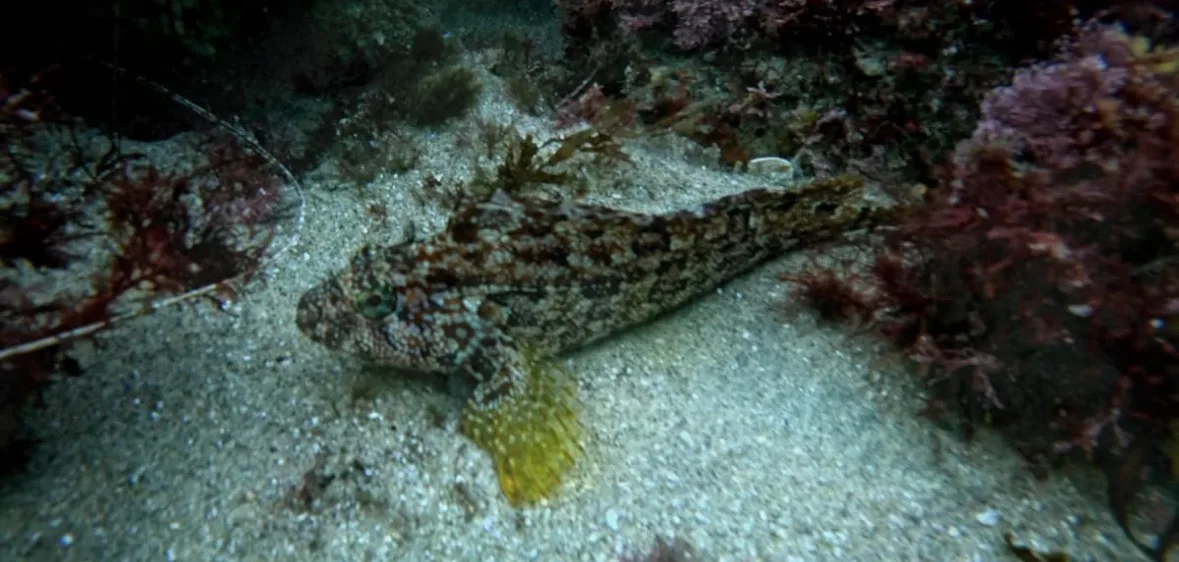
Also calledRock Blenny

Photos: David J Karp, Marine Room shallow reef, La Jolla
Taxonomy
Rarity
Abundance rates how many are in suitable habitat. Find difficulty rates how hard it is to locate one on a daylight snorkel or freedive through 50 ft. A higher find score means a harder search. The rarity category also reflects the kind of encounter; it is not an average of the 2 scores.
Seasonality
Location
The largemouth blenny lives from Santa Cruz Island in Southern California through the Gulf of California to Jalisco, Mexico. Before 2015, its known range ended in Mexico. A listing from northern Chile may have been a similar fish, the porehead blenny. This is a bottom fish of low rocks and boulders, found from tide pools to about 70 feet, and Mexican Fish describes weed-covered rocky shores down to about 35 feet. The first California fish sat among low rocks in about 10 to 16 feet of water. Others have been found under boulders in Agua Hedionda Lagoon in Carlsbad, at the edge of the tide. In a 2018 survey at Catalina Island, the site with the most fish had more small and medium boulders and fewer sand patches than the other 2 sites. The biggest fish there were at about 15 feet, and the smallest were at about 5 feet.
Deep Dive
The largemouth blenny belongs to the labrisomid blennies, a family of small bottom fish closely related to the kelp blennies and tube blennies. It reaches about 7.8 inches, though FishBase gives 7. Most of the year it is greenish brown, with 8 dark bars down each side and small white spots on the lower head and body. A black blotch marks the front of the dorsal fin, the long fin on its back.
Breeding males look like a different fish. They turn bright red, with a large black spot on the front of the dorsal fin. The first male recorded in California was also covered in small blue spots, with a partial bright blue ring at the base of each eye. Its pectoral fins, the pair of side fins behind the head, were red shading to yellow. It had rows of small, fur-like growths called cirri on top of its head. Mature males lose the red outside the breeding season. The green blenny and the porehead blenny look similar, and each has 2 slanted bars on the cheeks. The porehead blenny also has more sensory pores on its head.
This blenny hunts by day and feeds mostly on small crabs and other crustaceans that live on the bottom. It is highly territorial. An early California fish chased off a California sheephead and lunged at a diver's video camera, though a researcher at Catalina Island also described the species as shy. Females lay their eggs in protected places, and the male then guards and fans them.
Divers Callie Mack and Tara Howell saw the first known California largemouth blenny on July 15, 2015, in front of the Marine Room in La Jolla. Scientists count it among the many tropical fish that reached California during the strong El Niño of 2015. In August of that year, diver Roger Uzun recorded a red male courting 2 duller fish and then guarding their eggs. The species appeared off Casino Point on Catalina Island on October 31, 2015. By 2016, 1 researcher counted 19 fish in a band about 500 feet long at Big Fisherman Cove on Catalina, and an angler caught ripe fish in Agua Hedionda Lagoon.
The scientists who first reported the fish in California were not sure it would last. No young fish had been seen by the fall of 2016, and they wrote that it might disappear. The 2018 Catalina survey found at least 4 age groups, which pointed to a well-established population there. Those researchers said more study was needed to show that it sustains itself. iNaturalist has held new California records in every year since 2016.
Where to Find Them
Researched habitat and range candidates
San Diego · 4 beaches
Catalina Island · 2 beaches
Los Angeles · 1 beach
These locations have suitable habitat within the species range. An assignment is a possible encounter, not a confirmed sighting at every beach. Season, depth, and local conditions still matter. Historical habitat without present-day evidence is excluded.