
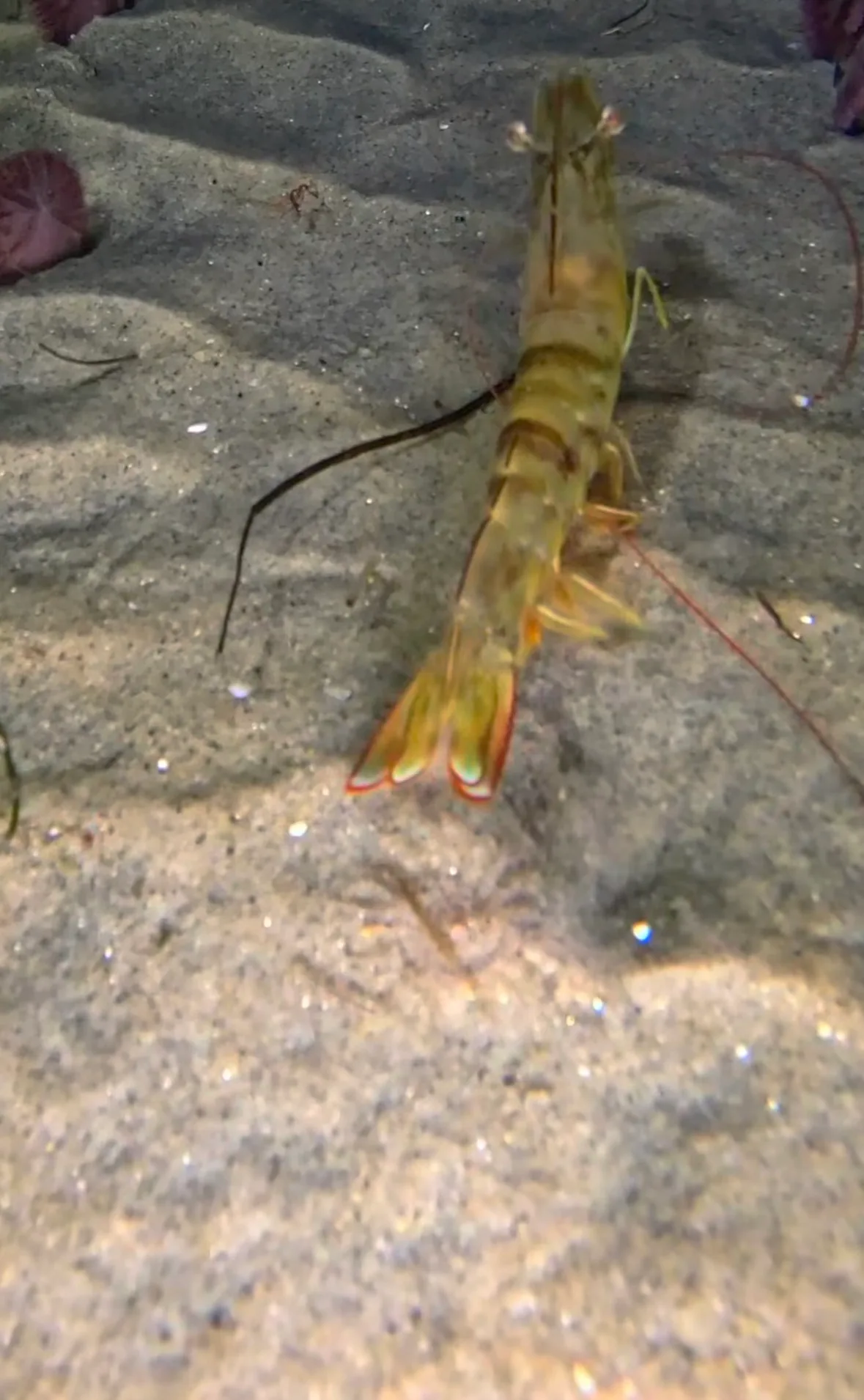
Also calledBrown Shrimp, Pacific Brown Shrimp

Taxonomy
Rarity
Abundance rates how many are in suitable habitat. Find difficulty rates how hard it is to locate one on a daylight snorkel or freedive through 50 ft. A higher find score means a harder search. The rarity category also reflects the kind of encounter; it is not an average of the 2 scores.
Seasonality
Location
The yellowleg shrimp ranges from San Francisco Bay to Concepcion, Chile. A taxonomic treatment notes that it is the 1 species in its group that occurs regularly in California, and that it usually reaches north of Point Conception only in years of warm currents. It lives on mud and sandy mud at about 50 to 330 feet and is most common at about 80 to 165 feet. Juveniles are rarely found in estuaries, where rivers meet the sea. Divers have also photographed it on sand at La Jolla, shallower than most of those depths.
Deep Dive
This large shrimp reaches about 8 to 9 inches and 3 ounces, and females grow larger than males.
The same animal goes by several English names. Other sources use brown shrimp or Pacific brown shrimp. Juveniles may feed on a green seaweed in the genus Ulva, according to SeaLifeBase.
Where to Find Them
Researched habitat and range candidates
San Diego · 4 beaches
Orange County · 1 beach
Los Angeles · 4 beaches
Channel Islands · 4 beaches
Ventura · 2 beaches
Santa Barbara · 3 beaches
San Luis Obispo · 4 beaches
These locations have suitable habitat within the species range. An assignment is a possible encounter, not a confirmed sighting at every beach. Season, depth, and local conditions still matter. Historical habitat without present-day evidence is excluded.