

Taxonomy
Rarity
Abundance rates how many are in suitable habitat. Find difficulty rates how hard it is to locate one on a daylight snorkel or freedive through 50 ft. A higher find score means a harder search. The rarity category also reflects the kind of encounter; it is not an average of the 2 scores.
Seasonality
Location
The cheekspot goby ranges from Tomales Bay in Northern California to southern Baja California, including the Gulf of California. It lives on mudflats and in shallow bays and estuaries, where rivers meet the sea, from the intertidal zone, the band of shore between high and low tide, to about 79 feet. Mature fish dig their own burrows.
Deep Dive
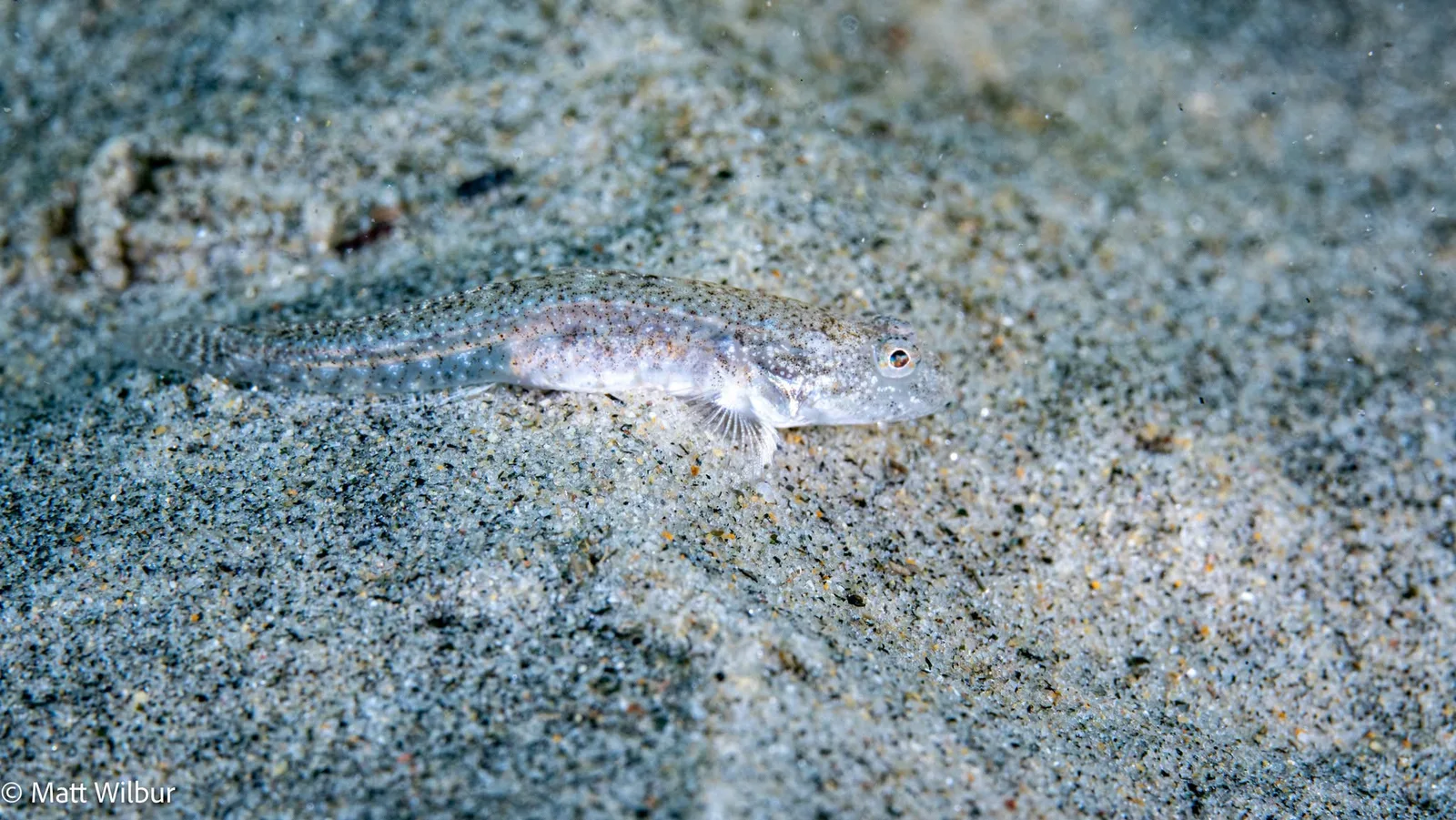
This is a very small fish, reaching about 2.7 inches, with females larger than males. It is light tan with fine dark spots along the sides. The name comes from an iridescent blue-black blotch on the gill cover. Bright white patches mark the upper corner of the mouth and the tip of the chin, and the pectoral fins, the paired fins behind the head, have white edges. Its pelvic fins, the lower paired fins, form a cup.
Mexican Fish describes the cheekspot goby as a daytime predator that goes back to its burrow at night. It feeds on tiny crustaceans called amphipods, young crabs, small colonial animals called hydrozoans and large numbers of marine worms. Many fishes and herons eat it. The male guards the eggs, which are attached to the burrow walls.
Where to Find Them
Researched habitat and range candidates
San Diego · 4 beaches
Orange County · 1 beach
Los Angeles · 4 beaches
Channel Islands · 4 beaches
Ventura · 2 beaches
Santa Barbara · 3 beaches
San Luis Obispo · 4 beaches
These locations have suitable habitat within the species range. An assignment is a possible encounter, not a confirmed sighting at every beach. Season, depth, and local conditions still matter. Historical habitat without present-day evidence is excluded.