
Also calledPacific sand dollar, western sand dollar, sea-cake, biscuit-urchin

Taxonomy
Rarity
Abundance rates how many are in suitable habitat. Find difficulty rates how hard it is to locate one on a daylight snorkel or freedive through 50 ft. A higher find score means a harder search. The rarity category also reflects the kind of encounter; it is not an average of the 2 scores.
Seasonality
Location
The eccentric sand dollar ranges from Alaska to Baja California, and it is the only sand dollar in Washington and Oregon. It lives on sandy bottoms just past the surf zone, on the open coast, in bays and in sandy lagoons. Most beds sit in shallow water, though SeaLifeBase records the species as deep as about 295 feet. A few turn up on flat sandy beaches during very low tides. A Scripps collection record estimates 16 to 33 feet as the depth where the species is typical at La Jolla Shores.
Deep Dive
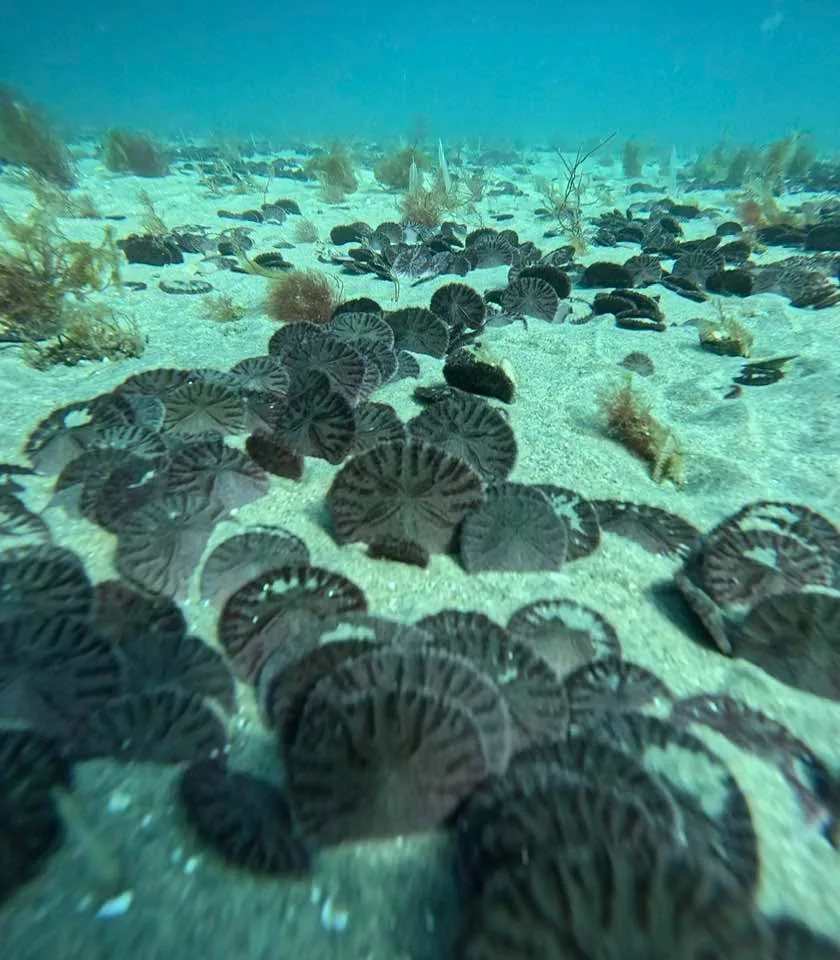
A sand dollar is a flattened sea urchin. A living one is covered in very short dark spines that make it look almost velvety, in gray, brown, black or shades of purple. A dead one loses its spines and leaves a gray skeleton, called a test. An average adult measures about 3 inches across, and the largest on record reached about 4.7 inches.
How a sand dollar sits depends on the water. In calm water with a current, most stand at an angle with the front edge buried in the sand, and most animals in a bed lean the same way. In rough water, most lie flat and partly buried, and the flat ones move around. Beds can be crowded, with as many as 625 sand dollars counted in 1 square yard.
Sand dollars feed on detritus and diatoms that tiny hairs sweep to the mouth. When standing at an angle, they also catch small prey and algae from the passing water with their tube feet, spines and tiny pincers. Copepods, crustacean larvae and plankton are among the foods recorded. A threatened sand dollar buries itself. Its predators include a sea star, the starry flounder, crabs and gulls.
The species can live 10 to 13 years. Growth rings on the plates of the test can be counted to estimate an animal's age.
Where to Find Them
Researched habitat and range candidates
San Diego · 6 beaches
Orange County · 1 beach
Los Angeles · 4 beaches
Channel Islands · 4 beaches
Ventura · 2 beaches
Santa Barbara · 2 beaches
Central Sound · 1 beach
These locations have suitable habitat within the species range. An assignment is a possible encounter, not a confirmed sighting at every beach. Season, depth, and local conditions still matter. Historical habitat without present-day evidence is excluded.