

Taxonomy
Rarity
Abundance rates how many are in suitable habitat. Find difficulty rates how hard it is to locate one on a daylight snorkel or freedive through 50 ft. A higher find score means a harder search. The rarity category also reflects the kind of encounter; it is not an average of the 2 scores.
Seasonality
Location
The sea pansy has been reported from the southern California coast, including Santa Barbara, and it lives in shallow water on sand. SeaLifeBase gives a very wide range of Canada to Mexico, though the iNaturalist records do not reach north of Southern California. The sources read do not give a depth range.
Deep Dive
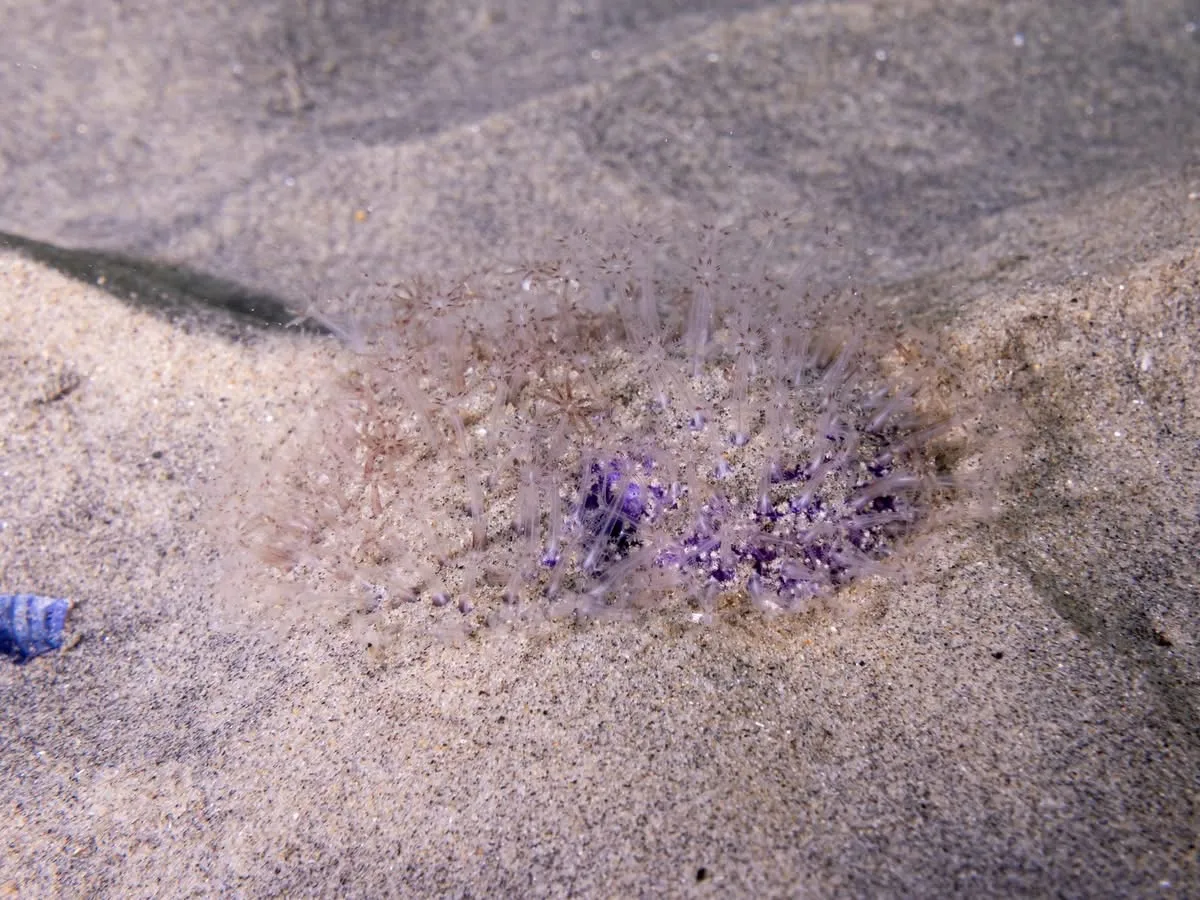
A sea pansy is a colony of animals, not a single one. It forms a flat purple disc, usually kidney or heart shaped and up to about 5 inches across, that sits in the sand. Small feeding polyps, the individual animals of the colony, open on the disc. A secreted net of mucus traps small animals and larvae, which the polyps then sting and swallow.
When a colony is disturbed at night, waves of blue, green or yellow light sweep across it. Light, polyp withdrawal and contraction are coordinated across the whole colony. A 1976 study reported that a colony under attack tends to orient so that currents uproot it and tumble it away.
Those predators include the spiny sand star and a sea slug. The festive tritonia, another sea slug, also eats sea pansies. The species' stinging cells cannot get through human skin.
Where to Find Them
Researched habitat and range candidates
San Diego · 4 beaches
Orange County · 1 beach
Los Angeles · 4 beaches
Channel Islands · 4 beaches
Ventura · 2 beaches
Santa Barbara · 2 beaches
These locations have suitable habitat within the species range. An assignment is a possible encounter, not a confirmed sighting at every beach. Season, depth, and local conditions still matter. Historical habitat without present-day evidence is excluded.