

Taxonomy
Rarity
Abundance rates how many are in suitable habitat. Find difficulty rates how hard it is to locate one on a daylight snorkel or freedive through 50 ft. A higher find score means a harder search. The rarity category also reflects the kind of encounter; it is not an average of the 2 scores.
Seasonality
Location
iNaturalist held 119 California, 45 Oregon and 18 Washington records on October 30, 2026, which sounds common until the records are read. The California Current works as a nursery, and juveniles strand along the coast in late summer and early fall, so a record may be a stranded young shark on the sand and not a live sighting. No diver sighting turned up for this page.
The range runs across the North Pacific, from Korea and Japan through the Bering Sea, and down the North American coast from the Gulf of Alaska to central Baja California. A record from Isla Guadalupe is listed as undocumented. FishBase says it usually stays in the top 500 feet, and the deepest record is about 6,110 feet.
Juveniles stay closer to the West Coast, and strandings mostly happen in water of about 54 to 61 degrees. Monterey Bay, Bodega Bay and Trinidad have all recorded them. This page lists the offshore spots along the coast, because this is an open-water animal.
Deep Dive
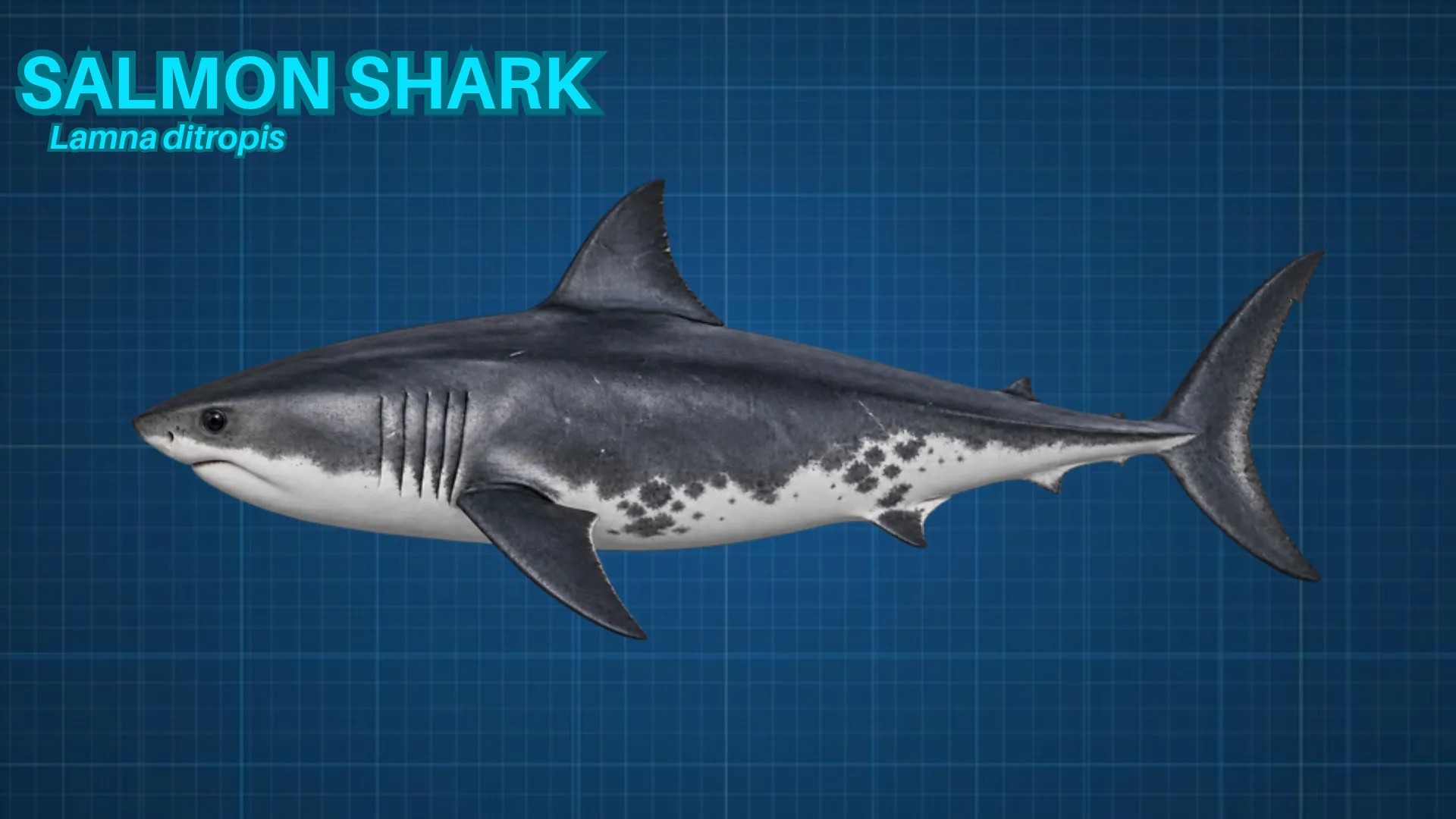
A salmon shark looks like a small white shark, and it is often mistaken for one. The back is dark gray to black, the belly is pale, and adults usually carry dark blotches below that juveniles lack. The snout is short and cone-shaped. The tail has 2 keels, low ridges along the base, and only the Atlantic porbeagle shares that feature. It reaches about 10 feet.
Like its mackerel shark relatives, it holds its body warmer than the water around it, which lets it hunt in cold seas. The diet is mostly fish, including salmon, herring, pollock and sablefish, along with squid. Groups of 30 to 40 have been recorded feeding in Alaska.
A study of 19 stranded California juveniles found bacterial brain infections, and a later study linked strandings to stress from upwelling, when cold deep water rises to the surface. Litters are small, reported at up to 4 or at 2 to 6 pups, after about 9 months of pregnancy.
FishBase rates it potentially dangerous, but says it has seldom or never been implicated in attacks. California's booklet does not give it a limit of its own, so the general limit of 10 applies.
Where to Find Them
Researched habitat and range candidates
San Diego · 2 beaches
Catalina Island · 2 beaches
Los Angeles · 1 beach
Channel Islands · 8 beaches
Ventura · 1 beach
San Luis Obispo · 12 beaches
Monterey · 1 beach
Cape Flattery · 1 beach
These locations have suitable habitat within the species range. An assignment is a possible encounter, not a confirmed sighting at every beach. Season, depth, and local conditions still matter. Historical habitat without present-day evidence is excluded.