



Taxonomy
Rarity
Abundance rates how many are in suitable habitat. Find difficulty rates how hard it is to locate one on a daylight snorkel or freedive through 50 ft. A higher find score means a harder search. The rarity category also reflects the kind of encounter; it is not an average of the 2 scores.
Seasonality
Location
Very few people will ever confirm a copper shark in California. iNaturalist held no California records under this species on October 30, 2026. The 2021 Love checklist places it in Southern California, including Santa Cruz Island, and a Los Angeles County Museum specimen from that island is cited. It is described as rare in the eastern Pacific, where it is rated Data Deficient.
The checklist gives the eastern Pacific range as Southern California to central Mexico and Colombia to Peru, including the Gulf of California and the Galapagos. Mexican Fish, a reference site on the fishes of Mexico, says it is the only shark in its genus, its group of closest relatives, that reaches temperate latitudes, and that a nursery lies off Guerrero Negro in Baja California.
This page lists offshore spots around Santa Cruz Island and south, matching the northern record. Young copper sharks elsewhere use surf and bays, so a shallow sighting would not be out of character, but none has been documented here.
Deep Dive
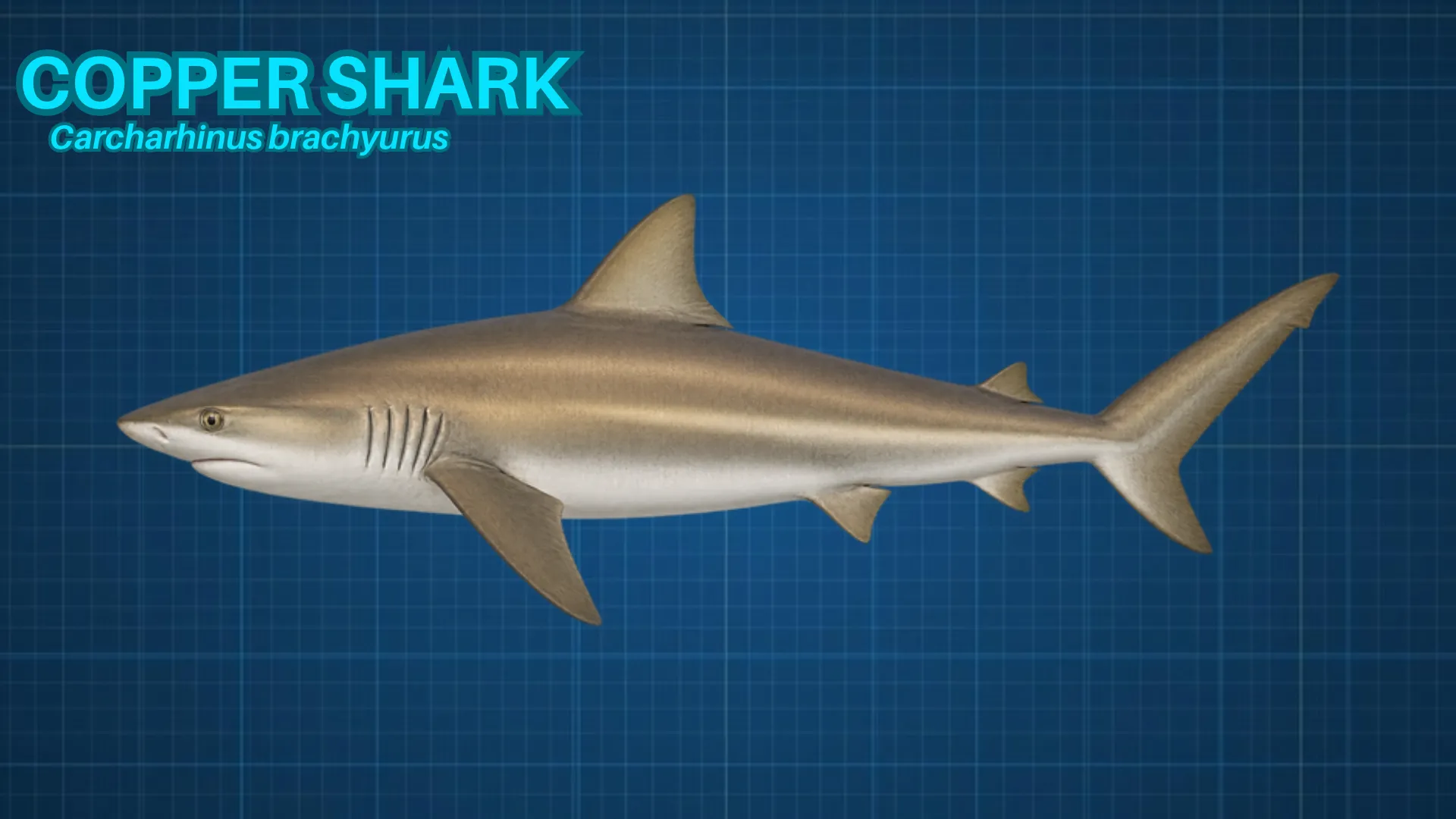
It is bronze to olive-gray above with a metallic sheen, and white below. The snout is long and narrow, the pectoral fins, the paired fins behind the head, are long and pointed, and the 1st dorsal fin on the back is tall. There is no ridge along the back between the 2 dorsal fins. It reaches about 10.7 feet.
It is hard to name on sight. Mexican Fish lists the blacktip, dusky, sandbar and spinner sharks as lookalikes, separated by tooth shape and fin markings. The same source says the overall range is poorly defined for that reason, and a genetic study suggests it may be more than 1 species.
Adults eat squid and octopus, fish, smaller sharks and rays, and carrion, while juveniles take jellyfish and bottom crustaceans such as crabs. It avoids water colder than about 54 degrees and can migrate about 820 miles. Females breed about every 2 years, and maturity takes 13 to 20 years.
FishBase lists it as implicated in attacks on people. California's booklet does not name it, so the general limit of 10 applies.
Where to Find Them
Researched habitat and range candidates
San Diego · 2 beaches
Catalina Island · 2 beaches
Los Angeles · 1 beach
Channel Islands · 8 beaches
Ventura · 1 beach
These locations have suitable habitat within the species range. An assignment is a possible encounter, not a confirmed sighting at every beach. Season, depth, and local conditions still matter. Historical habitat without present-day evidence is excluded.