
Also calledtintorera

Taxonomy
Rarity
Abundance rates how many are in suitable habitat. Find difficulty rates how hard it is to locate one on a daylight snorkel or freedive through 50 ft. A higher find score means a harder search. The rarity category also reflects the kind of encounter; it is not an average of the 2 scores.
Seasonality
Location
The tiger shark is a name on the California list more than an animal anyone expects to see. The 2021 Love checklist and FishBase both start its eastern Pacific range in Southern California. iNaturalist held no wild California record on October 30, 2026. A compiled list of Orange County sightings mentions a tiger shark caught off Seal Beach Pier in June 2021, but that report could not be confirmed.
The range runs from Southern California to Peru, including the Revillagigedo, Cocos and Galapagos Islands and the Gulf of California. FishBase places it on continental and island shelves, in estuaries, harbors, atolls and lagoons, with trips into open ocean, usually in the top 460 feet. This page lists offshore spots south of Point Conception, the usual northern edge of Southern California.
Deep Dive
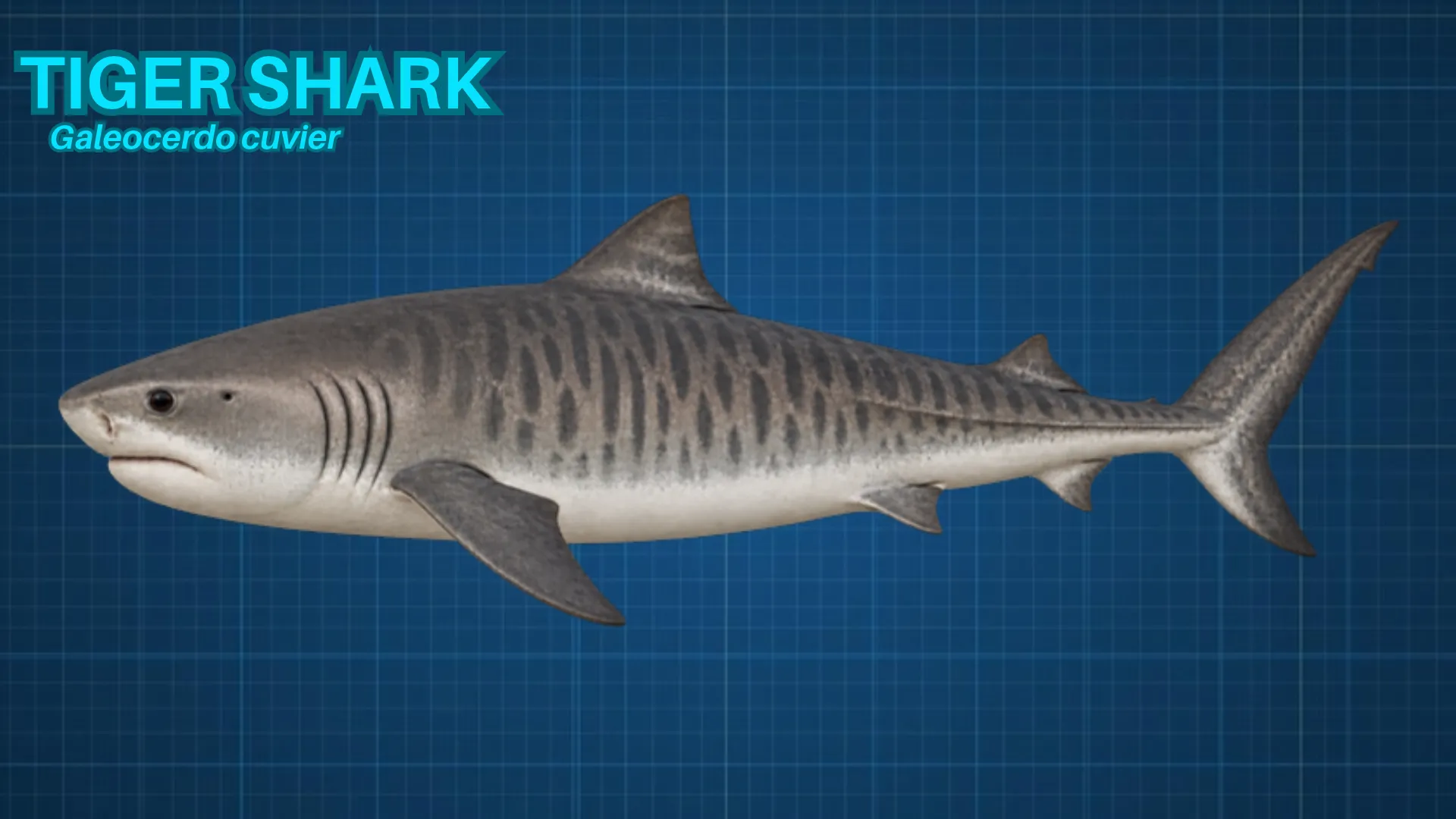
Young tiger sharks carry large dark spots that merge into vertical bars as they grow, and adults keep those bars along the upper sides. The head is wide and blunt, and the tail is long and thin. Mexican Fish, a reference site on the fishes of Mexico, says the color pattern means it cannot be confused with any other species. It reaches about 24.4 feet.
It is known for eating nearly anything. FishBase lists sharks, rays, fish, marine mammals, sea turtles, seabirds, sea snakes, squid, crustaceans and snails, along with carrion and garbage, including tin cans. It feeds mainly at night and moves inshore and nearer the surface to do it.
Litters are large, with 10 to 82 young after 13 to 16 months of pregnancy. Mexican Fish reports a lifespan of up to about 50 years and migrations of up to about 2,100 miles.
FishBase says it is 2nd only to the white shark in recorded attacks on people, with at least 27 documented. California's booklet does not name it, so the general limit of 10 applies.
Where to Find Them
Researched habitat and range candidates
San Diego · 2 beaches
Catalina Island · 2 beaches
Los Angeles · 1 beach
Channel Islands · 8 beaches
Ventura · 1 beach
These locations have suitable habitat within the species range. An assignment is a possible encounter, not a confirmed sighting at every beach. Season, depth, and local conditions still matter. Historical habitat without present-day evidence is excluded.