

Taxonomy
Rarity
Abundance rates how many are in suitable habitat. Find difficulty rates how hard it is to locate one on a daylight snorkel or freedive through 50 ft. A higher find score means a harder search. The rarity category also reflects the kind of encounter; it is not an average of the 2 scores.
Seasonality
Location
This is the least known of the 3 threshers on this coast. The 2021 Love checklist places it from Southern California to Panama, and iNaturalist held no California records on October 30, 2026. FishBase warns that reliable records are scarce, because the species is easily confused with the common thresher. Mexican Fish, a reference site on the fishes of Mexico, says it appears in Mexican Pacific waters only during El Niño years.
The range also takes in the Gulf of California, the Galapagos, Colombia and Peru. It is an open-ocean shark, usually in the top 490 feet, though FishBase says it sometimes comes close to shore. This page lists offshore spots south of Point Conception.
Deep Dive
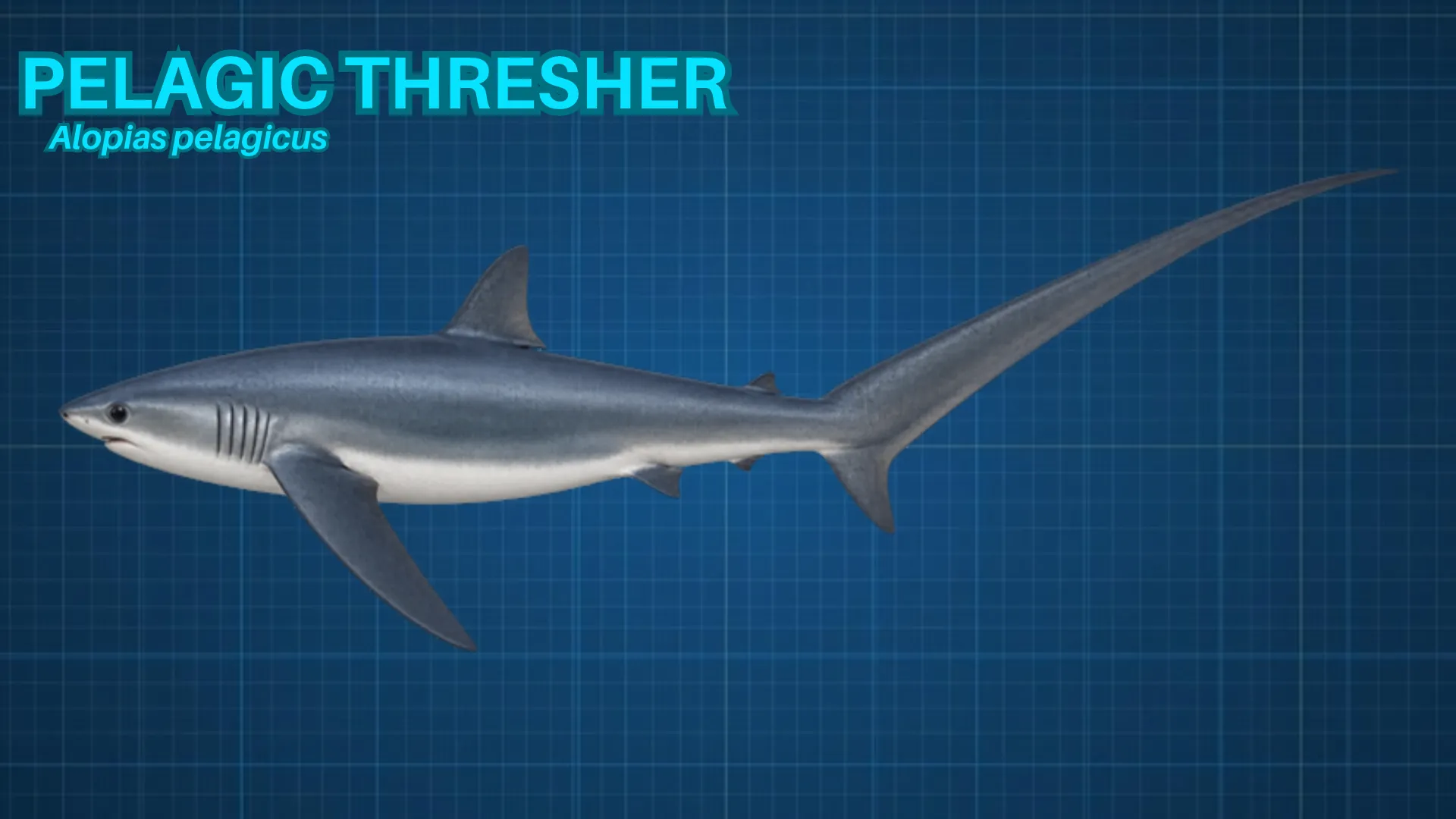
The upper lobe of the tail is very long, about as long as the rest of the shark, as in the other threshers. The way to separate them is the shoulder. The pelagic thresher has a dark patch of skin above the base of each pectoral fin, the paired fins behind the head, and the common thresher does not. The bigeye thresher has much larger eyes and deep grooves on top of the head. This is the smallest of the 3, reaching about 14 feet.
It feeds on schooling fish such as herring, flyingfish and mackerel, plus squid, and stuns them with blows from the tail. Litters normally hold 2 large pups, and sources give very different sizes at birth, from about 3.3 to 6.2 feet. Females mature at about 9 feet, at 8 to 9 years of age, which leaves the species little room to absorb fishing.
Mexican Fish calls it harmless to people and says it tends to avoid divers. California's limit covers threshers at 2 per day, though the rule does not name a species. A bigeye or pelagic thresher is covered if the word thresher is read plainly.
Where to Find Them
Researched habitat and range candidates
San Diego · 2 beaches
Catalina Island · 2 beaches
Los Angeles · 1 beach
Channel Islands · 8 beaches
Ventura · 1 beach
These locations have suitable habitat within the species range. An assignment is a possible encounter, not a confirmed sighting at every beach. Season, depth, and local conditions still matter. Historical habitat without present-day evidence is excluded.