

Taxonomy
Rarity
Abundance rates how many are in suitable habitat. Find difficulty rates how hard it is to locate one on a daylight snorkel or freedive through 50 ft. A higher find score means a harder search. The rarity category also reflects the kind of encounter; it is not an average of the 2 scores.
Seasonality
Location
FishBase gives the range as California south to the northern and central Gulf of California. Mexican Fish adds that on the Pacific coast of Baja California it is found only north of Magdalena Bay. It lives in shallow water over mud, and Mexican Fish records it no deeper than about 20 feet.
It has also been moved inland. Mexican Fish reports that it was successfully transplanted into the Salton Sea in 1930, and that it has been used as live bait in central Arizona and along the lower Colorado River. It does not breed in fresh water.
Deep Dive
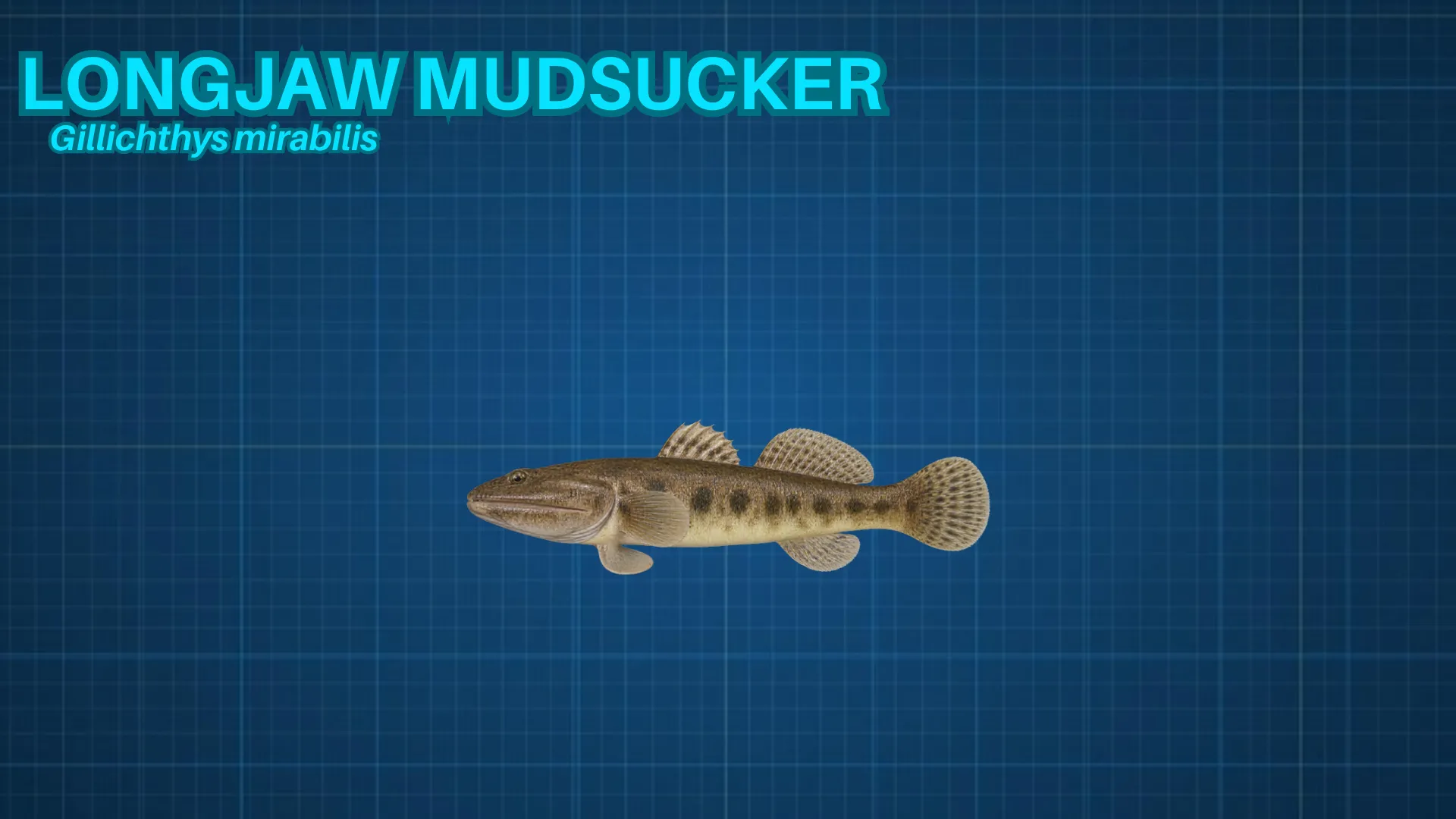
The longjaw mudsucker is a large goby, growing to about 8 inches. Mexican Fish describes a heavy body and a broad, flat, blunt head with small eyes set wide apart on top. Its mouth is enormous, and the long upper jaw reaches back to the gill openings. It is dark brown above and yellow below, with faint vertical bars, and its pelvic fins are joined into a sucking disc.
It can breathe air. The San Diego Natural History Museum's field guide explains that the fish takes in oxygen from the air through a special membrane in its mouth, which lets it survive if the falling tide leaves it on the mud. The guide adds that it can live out of water for 6 to 8 days if kept moist. Mexican Fish connects that ability to the bait trade, reporting that mudsuckers can be shipped packed in moist algae and stay alive for 6 to 8 days. Mexican Fish also reports that the fish tolerates salt water from about 48 to 95 degrees Fahrenheit but cannot survive long in fresh water.
It eats a mix of plants and animals. Mexican Fish lists small fishes such as California killifish, arrow gobies and topsmelt, along with algae and small crustaceans. The museum's field guide names larger fish, egrets, herons and people among its predators.
The male does the parenting. FishBase reports that the male builds a nest chamber, the female attaches several thousand club-shaped eggs to its walls, and the male guards them through a 10 to 12 day incubation. Mexican Fish reports that a female lays between 8,000 and 27,000 eggs, several times a year, and that the larvae drift in open water after hatching. The fish lives up to 2 years.
Where to Find Them
Researched habitat and range candidates
San Diego · 1 beach
Los Angeles · 1 beach
Ventura · 1 beach
Santa Barbara · 2 beaches
San Luis Obispo · 4 beaches
These locations have suitable habitat within the species range. An assignment is a possible encounter, not a confirmed sighting at every beach. Season, depth, and local conditions still matter. Historical habitat without present-day evidence is excluded.