
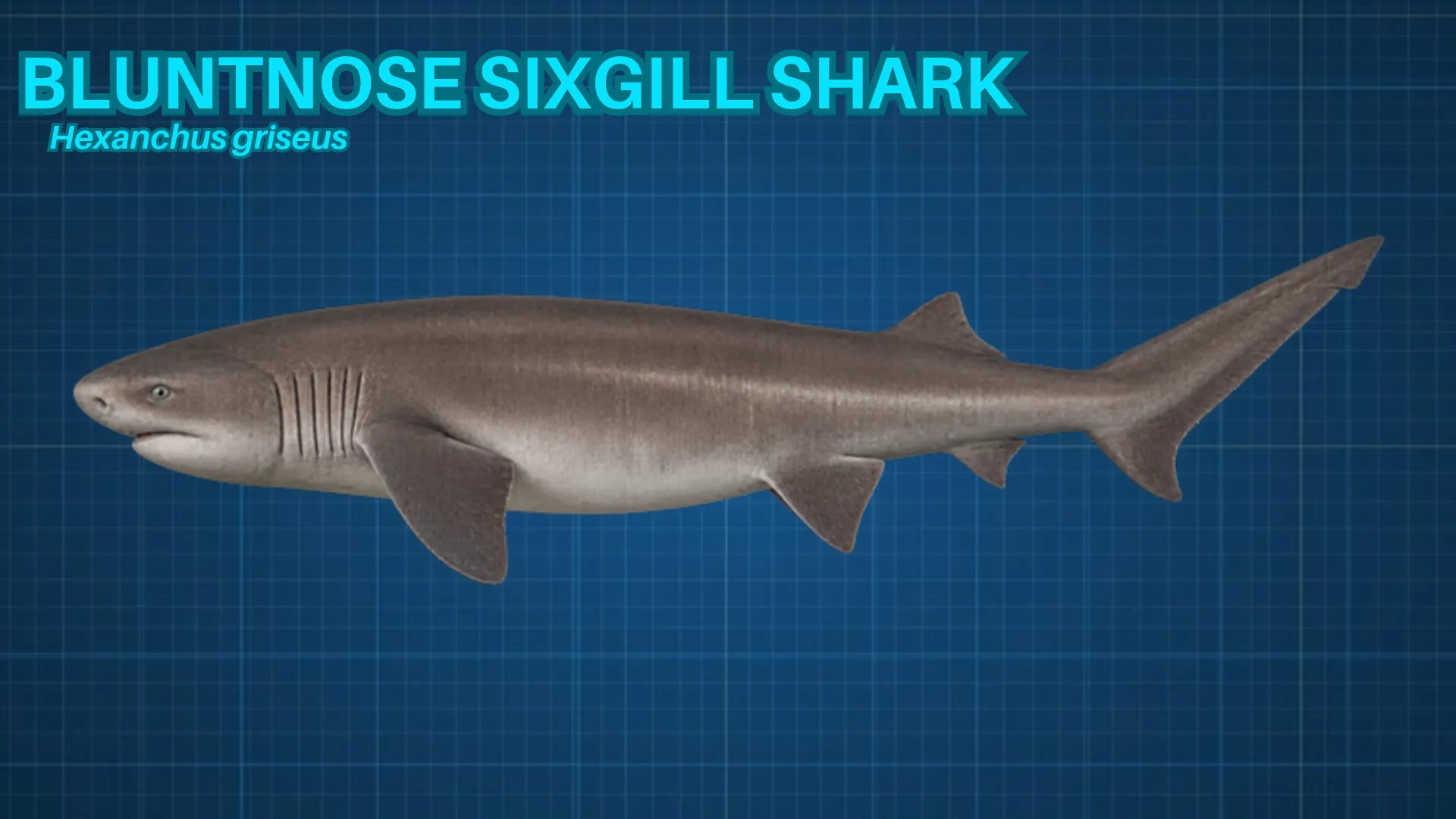
Also calledsixgill shark, mud shark

Taxonomy
Rarity
Abundance rates how many are in suitable habitat. Find difficulty rates how hard it is to locate one on a daylight snorkel or freedive through 50 ft. A higher find score means a harder search. The rarity category also reflects the kind of encounter; it is not an average of the 2 scores.
Seasonality
Location
Most bluntnose sixgills stay far below diving depth, which makes Puget Sound the exception. iNaturalist held 25 Washington records on October 30, 2026, many of them clustered at Redondo in Des Moines, against 1 each for Oregon and California. A diver at Hoodsport on Hood Canal logged one at 70 feet in May 2021.
Even there the numbers move. In a Seattle Aquarium study under its Elliott Bay facility, no sharks appeared on about 10% of research days from 2003 to 2005 and on 63.6% from 2008 to 2015, and the cause is unclear.
The 2021 West Coast fish checklist by Milton Love and colleagues runs the range from south of the Aleutian Islands to the Gulf of California and Chile. Adults usually live about 590 to 3,610 feet down. Young sharks come much shallower. The Washington Department of Fish and Wildlife has captured about 200 in Puget Sound, all of them juveniles, and Seattle Aquarium tagging found limited movement, with sharks more abundant from July to September.
To the north, sharks at the Flora Islets in the Strait of Georgia appeared only from late May to mid-October, and all of those seen were immature. This page lists central and south Puget Sound and Hood Canal. No California spot is listed, because no shallow California sighting turned up.
Deep Dive
This is a large, blunt-nosed shark with 6 gill slits, where most sharks have 5. The local sevengill shark has 7. The skin runs from tan to black, the eye shines a fluorescent blue-green, and the lower jaw carries 6 rows of saw-like teeth. Its confirmed length is about 15.8 feet and it probably reaches 18 feet. A 19.7-foot figure in 1 reference is undocumented.
It rests near the bottom by day and rises at night to feed. FishBase lists other sharks, rays, fish, squid, crabs, shrimp, carrion and seals. A Canadian study off Vancouver Island found 48 of 56 juveniles with empty stomachs, and 7 of the others had eaten salmon.
Litters are huge for a shark, with 47, 51 and 70 pups recorded. Scientists suspect Puget Sound is a nursery, where newborns stay a few years before moving to the ocean. Females appear to mature at about 14 to 16 feet and males at about 10 feet. A figure of 80 years for lifespan circulates online but has not been confirmed.
FishBase says it is not known to attack people unprovoked. The Puget Sound Institute reports that diver encounters are usually brief and that the shark seems more curious than aggressive. California allows 1 per person per day.
Where to Find Them
Researched habitat and range candidates
South Sound · 12 beaches
Hood Canal · 12 beaches
Central Sound · 13 beaches
These locations have suitable habitat within the species range. An assignment is a possible encounter, not a confirmed sighting at every beach. Season, depth, and local conditions still matter. Historical habitat without present-day evidence is excluded.