
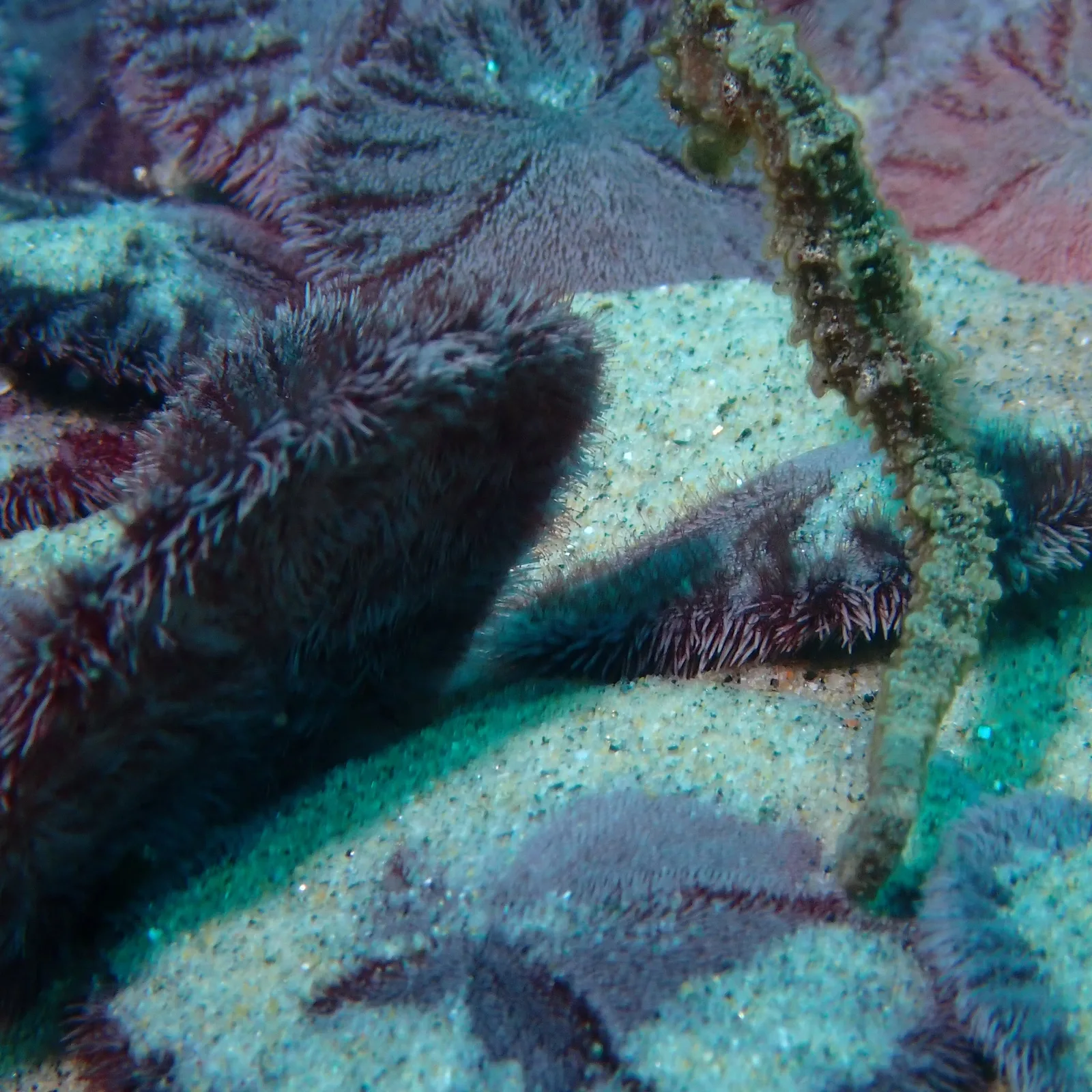
Also calledGiant Seahorse, Pacific Giant Seahorse


Photos: Monica Lea, La Jolla Shores, San Diego
Taxonomy
Rarity
Abundance rates how many are in suitable habitat. Find difficulty rates how hard it is to locate one on a daylight snorkel or freedive through 50 ft. A higher find score means a harder search. The rarity category also reflects the kind of encounter; it is not an average of the 2 scores.
Seasonality
Location
The Pacific seahorse lives from Point Conception, Santa Barbara, to Chile, including Isla Guadalupe, the Gulf of California and the Galapagos Islands. The species was first described in 1858 from San Diego, so California has been part of its known range from the start. Farther north, a 2021 checklist of the region's fishes lists a fish found beached at Pismo Beach, San Luis Obispo, and an old record from San Francisco Bay.
Most California records sit between San Diego and Los Angeles counties, though iNaturalist blurs the exact location of every one. Seahorses live in salt water and in the brackish water of bays, where fresh water mixes with the sea. The checklist gives a range from the surface to about 351 feet, and FishBase says they usually stay between 10 and 60 feet. They are found on reefs and in weed beds, sea whips, gorgonians and seagrass. Gorgonians are branching soft corals. FishBase and Mexican Fish also place the species well offshore, and FishBase says most of those fish are caught by dredges at 33 feet or deeper.
Deep Dive
The Pacific seahorse belongs to the same family as the pipefishes. It reaches about 12 inches, which makes it one of the largest seahorses in the world. Its long body has a curved neck, and the head sits at a right angle to the body. It has a long snout and a crown of 5 points on top of its head. It has no tail fin. It has a large dorsal fin on its back and small pectoral fins on its sides.
Color varies widely in this fish. Individuals can be red, yellow, tan, brown, gray, black or green, which helps them blend in with what they hold on to. Most also carry white spots, cross bands or lines. Mature females have a dark patch below the small anal fin on the underside. Males have a large keel, a raised ridge, on the chest. They also have the brood pouch under the tail.
Seahorses have no teeth and no stomach. A Pacific seahorse feeds by sucking small crustaceans and tiny drifting animals through its snout. FishBase describes it as active at night. Animal Diversity Web, an online encyclopedia written largely by college students, says it is usually seen alone, with its tail wrapped around eelgrass. That account also gives an estimated life of 3 to 5 years in the wild.
The male carries the young. The female places her eggs in his pouch. Animal Diversity Web gives about 2 weeks of development, depending on water temperature, and Mexican Fish gives 10 days to 6 weeks. Broods of up to 2,000 have been reported, and the young leave as miniature adults. Breeding may happen year-round. No source says whether seahorses breed in California. Documented predators include dorado, yellowfin and bluefin tuna, anglerfish, skates and rays, and young seahorses face more danger than adults.
California saw its biggest run of records in 2016, during an El Niño. Divers reported seahorses in San Diego and in Alamitos Bay, Los Angeles County, and Roger Uzun photographed them in La Jolla Canyon. That April, Coronado residents found a few on the shore, and others turned up from Orange County to Imperial Beach. Leslee Matsushige, curator of Birch Aquarium at Scripps, linked the sightings to El Niño, which warms the sea and changes the currents. Reef Check California added that a seahorse could drift north holding on to floating seaweed.
The site iSeahorse tracks sightings of seahorses, and the public can report them there.
Where to Find Them
Researched habitat and range candidates
San Diego · 2 beaches
These locations have suitable habitat within the species range. An assignment is a possible encounter, not a confirmed sighting at every beach. Season, depth, and local conditions still matter. Historical habitat without present-day evidence is excluded.