
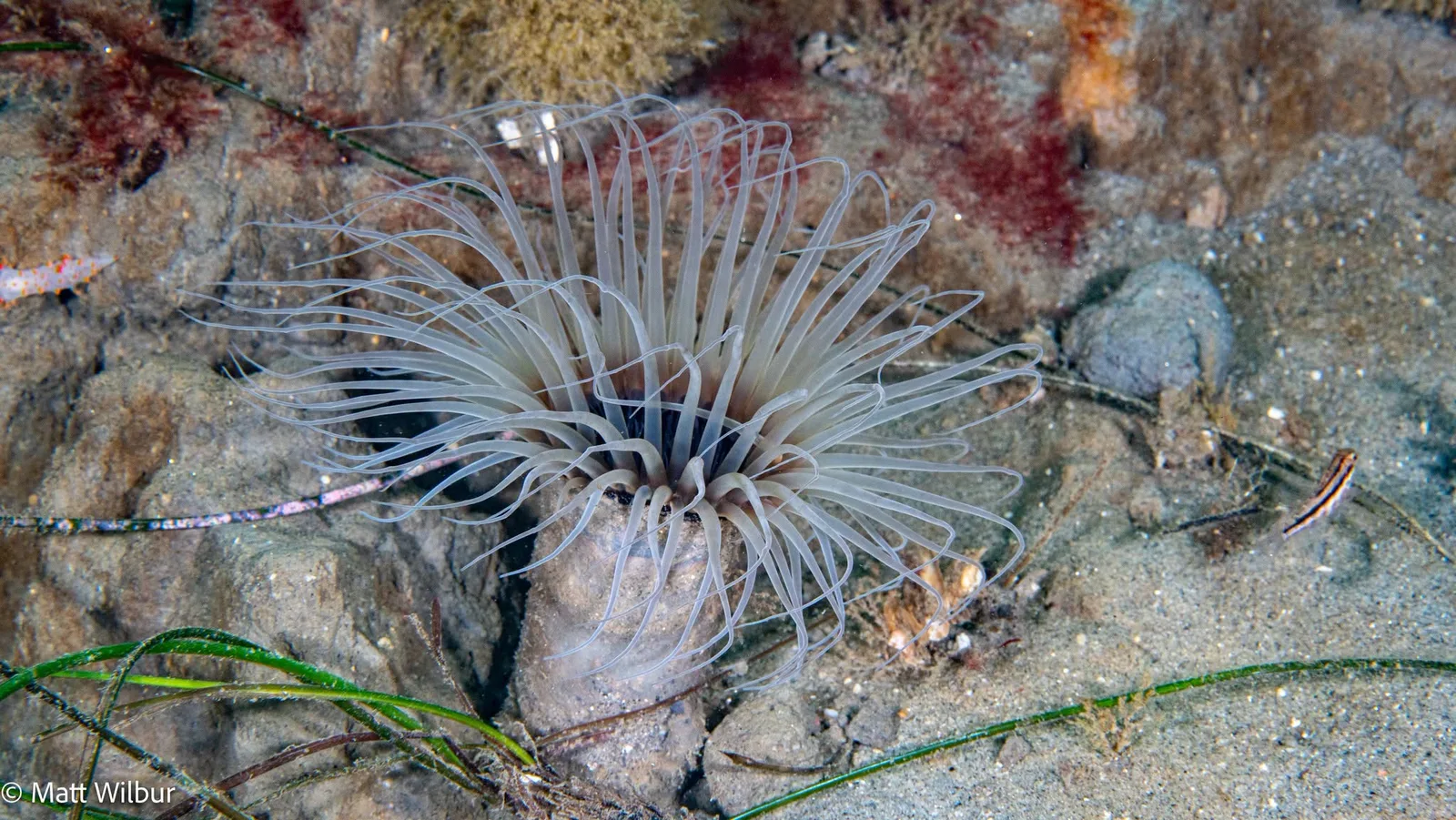
Also calledTube Anemone, Fringed Cerianthid

Photo: Matt Wilbur, La Jolla Shores, San Diego
Taxonomy
Rarity
Abundance rates how many are in suitable habitat. Find difficulty rates how hard it is to locate one on a daylight snorkel or freedive through 50 ft. A higher find score means a harder search. The rarity category also reflects the kind of encounter; it is not an average of the 2 scores.
Seasonality
Location
The tube-dwelling anemone ranges from southern Alaska to Baja California, Mexico. It always lives in soft bottom, on sandy or muddy seafloors below the low tide line, down to about 800 feet. It often grows in large groups, which the Department of Ecology compares to flowers in a meadow.
Deep Dive
This animal is not a true sea anemone. It belongs to a separate group called cerianthids, or tube anemones. Like true anemones, it is a relative of corals and jellyfish.
It digs into the bottom and builds a tube around its body. The tube is made of ptychocysts, a special kind of thread found only in tube anemones. Millions of these threads are woven together into a thick casing with a soft, velvety feel. The tube can run more than 3 feet down into the sediment and is about 1 inch across. The animal inside reaches about 13.5 inches. Small clams and other little animals settle on the outside of the tube.
The tentacles grow in 2 rings. The long, slender outer ring catches food and helps defend the animal. The short inner ring moves food to the mouth. Color varies from one animal to the next. Sources describe white, purple, orange, brown and black, and the tentacles are often banded. It feeds on small crustaceans, the group that includes shrimp and crabs. The Aquarium of the Pacific also lists other small animals without backbones and plankton, the tiny life that drifts in open water.
The best-documented predator is the giant nudibranch, a large sea slug that grazes on the tentacles. The slug crosses sandy bottoms, rears up and grabs the anemone, and it also lays its eggs on the outside of the tube. A tube anemone under attack pulls its whole body down into the tube. It can lose some tentacles and survive.
Its reproduction is not well studied. The young start out as larvae that drift in open water. An adult can live up to 10 years.
Where to Find Them
Researched habitat and range candidates
San Diego · 1 beach
These locations have suitable habitat within the species range. An assignment is a possible encounter, not a confirmed sighting at every beach. Season, depth, and local conditions still matter. Historical habitat without present-day evidence is excluded.