
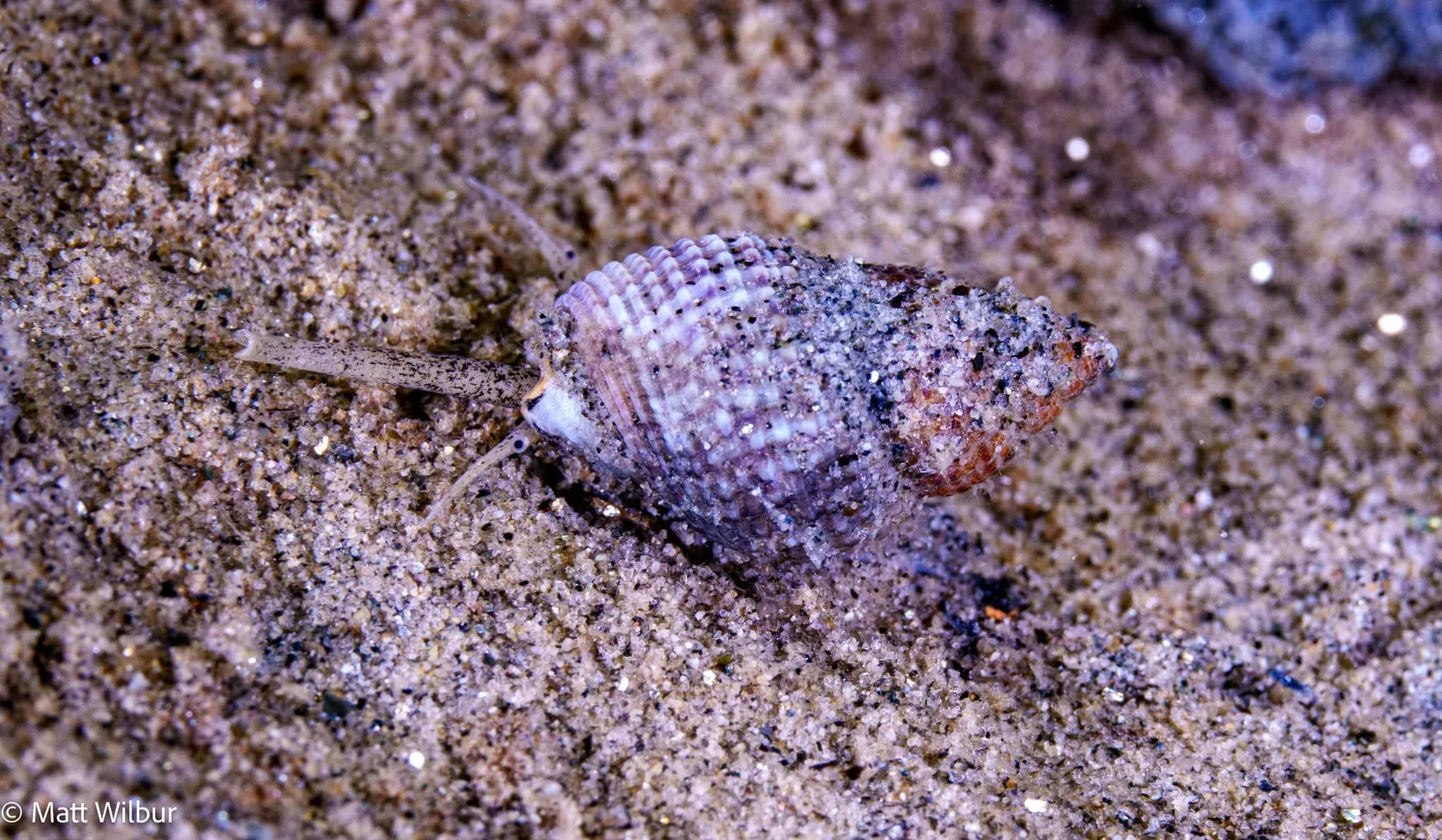
Also calledChanneled Basket Snail, Channeled Basket Whelk, Channeled Nassa, Channeled Dog Whelk

Photo: Matt Wilbur, La Jolla Shores, San Diego
Taxonomy
Rarity
Abundance rates how many are in suitable habitat. Find difficulty rates how hard it is to locate one on a daylight snorkel or freedive through 50 ft. A higher find score means a harder search. The rarity category also reflects the kind of encounter; it is not an average of the 2 scores.
Seasonality
Location
The range runs from Vancouver Island, British Columbia, to Laguna San Ignacio in Baja California. It lives on sand and mud, from mudflats at the low tide line down to about 59 feet, and the Walla Walla guide says it is more common below the tide line than above it.
Deep Dive
This is one of the largest snails in its group, reaching about 1.8 to 2 inches, with about 7 turns and a sharp pointed tip. Ribs running along the shell cross the spiral ridges in a wicker-basket pattern, which is where the basket snail name comes from. The ribs cover only about 1/3 of the last turn of the shell, and a deep groove cuts across the bottom of that turn. The shell is gray-brown to ash colored, and the smooth patch beside the opening is usually orange.
It is a predator and mainly a scavenger. It finds food by smell and can come from a long way off, with a dead fish drawing snails from as far as about 98 feet. When it reaches a meal, it wraps its foot around the food and rasps at it. It may also drill into clams and other snails.
It has a quick escape for a snail. When a predatory sea star comes near, it either crawls away fast, rocking its shell from side to side, or flips itself away with its muscular foot.
It lays eggs on eelgrass or other firm objects on mud flats in late winter and spring. A typical string is about 2.4 inches long and holds about 45 eggs, with the capsules overlapping like shingles. Older books list this snail under a different genus.
Where to Find Them
Researched habitat and range candidates
San Diego · 1 beach
These locations have suitable habitat within the species range. An assignment is a possible encounter, not a confirmed sighting at every beach. Season, depth, and local conditions still matter. Historical habitat without present-day evidence is excluded.