

One Whale Freed Off San Clemente, and the El Niño Math Pushing West Coast Entanglements Toward a Record
Rescuers cut a young humpback loose near the San Clemente Pier on October 18. It was 1 of 46 confirmed whale entanglements on the West Coast this year, 4 short of the record set during the last big El Niño, and NOAA expects this one to be stronger.
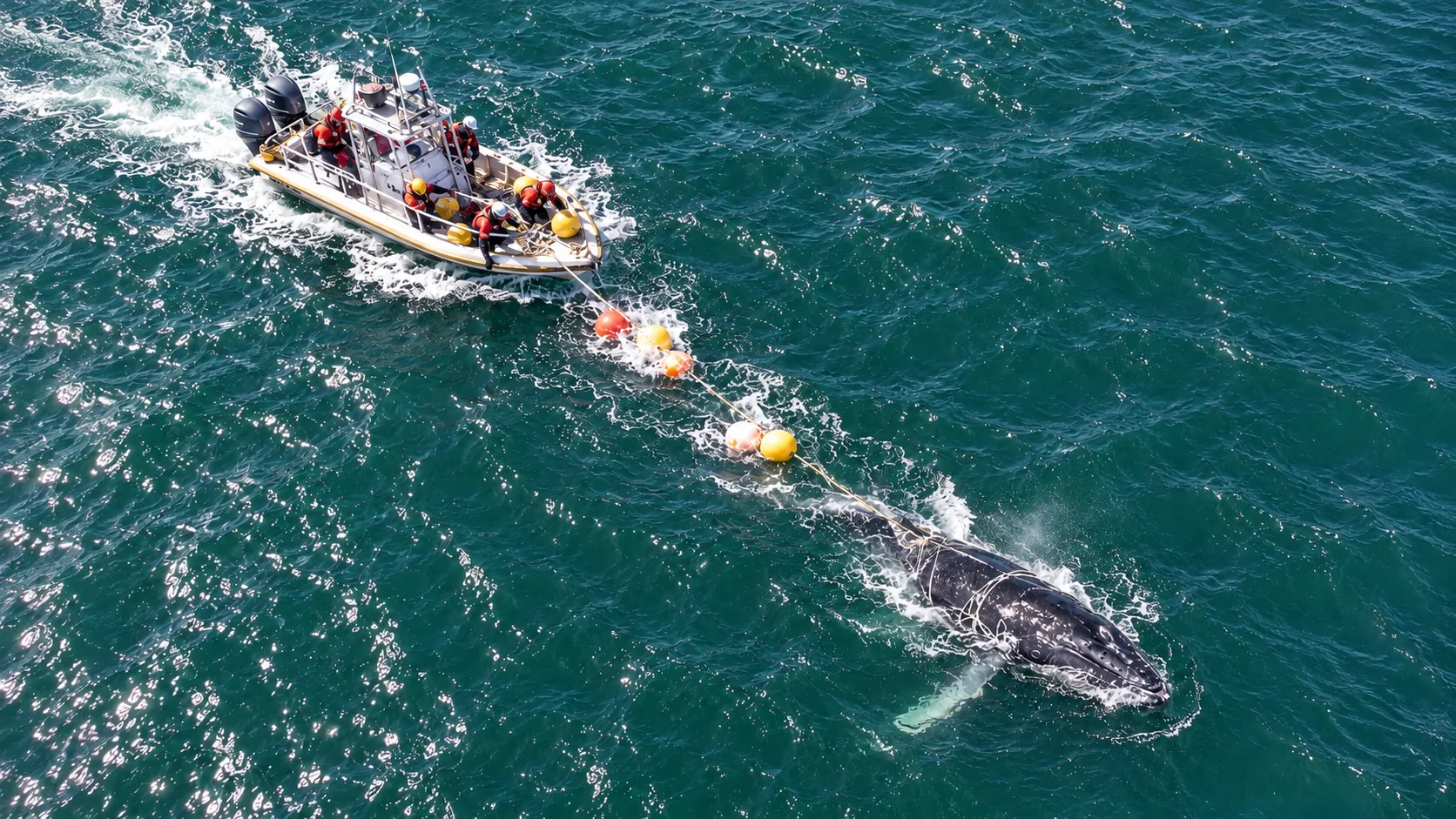
A local fisherman called it in at 9:30 a.m. on Sunday, October 18, from 5 miles off San Clemente: a humpback whale about 29 feet long, swimming north at 3 knots with roughly 100 feet of fishing line trailing from its fluke, the broad horizontal tail a whale swims with. By 12:30 p.m. a team from the Pacific Marine Mammal Center in Laguna Beach, Entangled Whale Response Orange County, and SeaWorld San Diego was on the water near the San Clemente Pier, where the crew of a Dana Point whale-watching boat and 2 private boaters had found the animal again, according to a release from the center.
Drones went up and GoPro cameras went under, showing line wrapped across the whale's underside, around the fluke, and around the peduncle, the thick stalk of muscle between a whale's body and its tail. The team clipped a GPS tag and a float onto the trailing line to slow the whale and hold it near the surface, an adaptation of an old whaling tactic called kegging. At about 3:20 p.m., Keith Yip of SeaWorld San Diego, 1 of the responders NOAA authorizes to cut gear from large whales, reached a knife on a long carbon fiber pole to the twisted line on the left side of the peduncle and sliced it. The whale dove, and the 100 feet of line slid off along with the tag and float. By 3:40 p.m. most of what remained on the tail had shaken loose, and footage reviewed the next day showed a fresh scar and an otherwise healthy whale. It was the first confirmed disentanglement off Southern California this year, the center said.
"In most cases an entanglement such as this can eventually lead to death," Yip said in the release. "Disentangling this whale gave it a second chance."
That is the rescue. The larger story is the count it belongs to.
46 and counting
NOAA has confirmed 46 whale entanglements on the West Coast so far in 2026, with 4 more cases pending, and most of them are humpbacks, the center said. The Center for Biological Diversity, citing preliminary NOAA Fisheries data on October 9, put the humpback count alone at 37, the most since 2016, with 3 months left in the year. By mid-June only 9 whales had been seen entangled, the group said, so most of this year's cases came in late summer and fall. That is the same season when 15 of 2024's cases piled up in September and October, most of them around Monterey Bay, according to NOAA's summary of that year.
The record is 50 confirmed cases, set in 2015, followed by 48 in 2016, according to NOAA Fisheries' West Coast entanglement response program, which calls those the highest annual totals since it started keeping records in 1982. The years since have stayed high, with 46 in 2018, 36 in 2024, and 33 in 2025, but none reached 50. Before 2014, humpback entanglements averaged about 10 a year, according to a University of California, Santa Cruz summary of research led by Jarrod Santora, a NOAA fisheries biologist. The Pacific Marine Mammal Center said 2026 could pass the record. The ocean that produced the record is the reason it might.
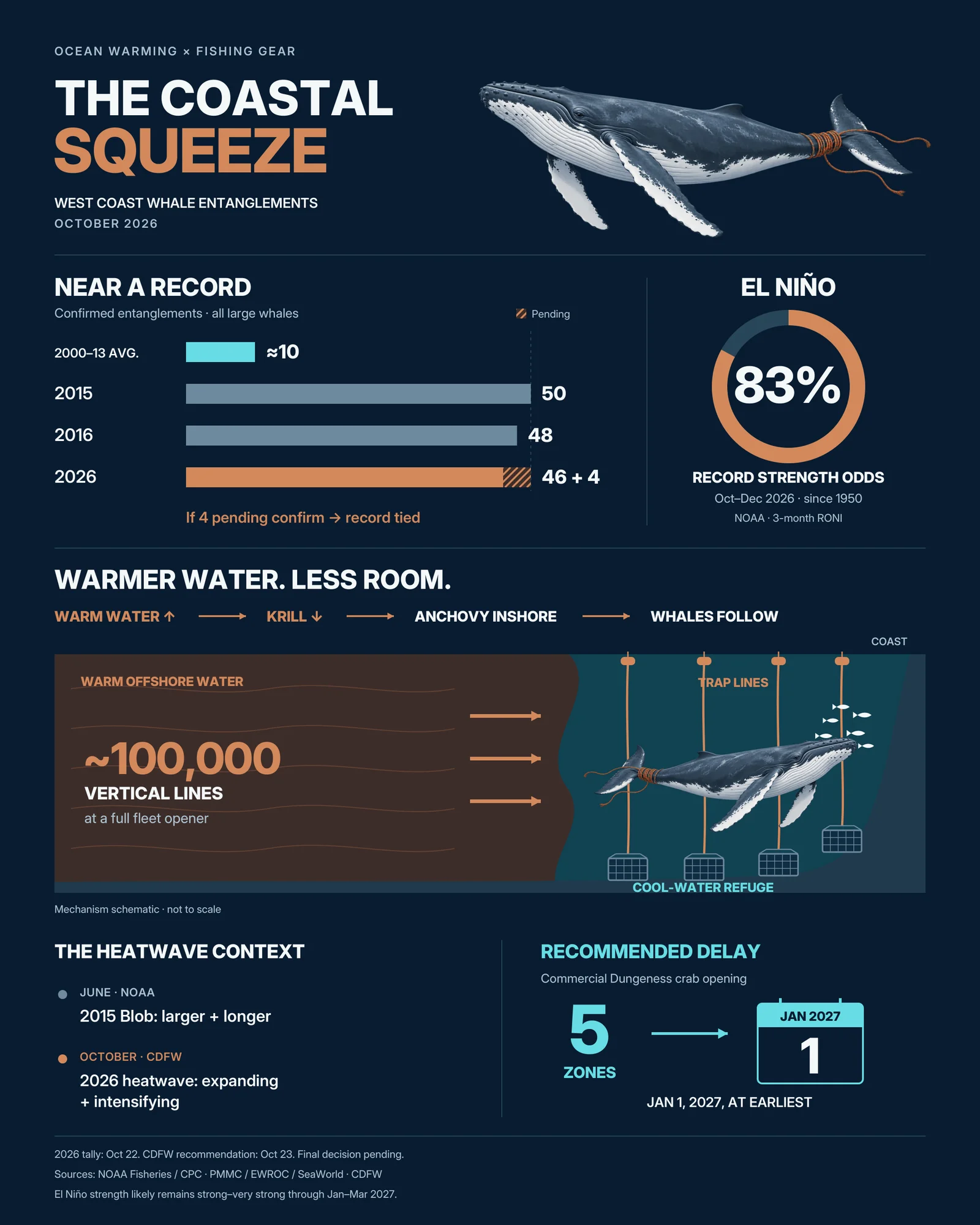 The year in 1 graphic: the count against the 2015 record, NOAA's odds on this El Niño, the squeeze that puts whales in the trap lines, and the crab season hold. Nautical News infographic.
What warm water does to a whale
The 2015 record came out of a specific ocean. A marine heatwave known as the Blob began warming the Northeast Pacific in 2014 and peaked in 2015, and one of the strongest El Niños on record followed in 2015 and 2016, amplifying the warmth, NOAA Fisheries wrote in a June assessment of this year's conditions. Santora's team, publishing in the journal Nature Communications in January 2020, found that the warm water squeezed the cool, nutrient-rich band along the California coast into a narrow strip against the shore. That band is fed by upwelling, the process that pulls cold, deep water to the surface, and the researchers named the squeeze habitat compression. Krill declined, anchovy increased near shore, and humpbacks, which can switch between the 2, followed the anchovy inshore.
"Predators that are normally more spread out offshore all moved inshore because that's where the food was," Santora said in the UC Santa Cruz summary. The inshore strip is also where the Dungeness crab fleet sets its traps, each tied to the surface by a vertical line. At least 100,000 vertical lines can be in California coastal waters when the crab season opens, Inside Climate News reported in February, in a story on a follow-up study by NOAA scientists that put 25 years of data behind the link and called habitat compression "an underlying driver of these entanglements."
Timing made 2016 worse. Domoic acid, a neurotoxin from an algae bloom, delayed the 2015-16 commercial crab season until late March 2016, so the fleet's gear went into the water just as the whales arrived for spring feeding. "All this gear was going out right during the peak arrival of whales, so that made things worse," Santora said. Entanglements had started climbing in late 2014, before the delay, which he attributed to the compression itself.
NOAA found the same squeeze at work 2 years ago. Habitat compression levels in 2024 were "similar to those in 2015-16 off California," the agency's 2024 summary said, and a nearshore increase in adult anchovy drew whales into Monterey Bay, where humpback entanglements doubled from 15 in 2023 to 30 in 2024.
This El Niño is bigger
The event building now is forecast to pass the one that helped set the record. NOAA's Climate Prediction Center, in its October 8 update, reported that the relative warming of the central tropical Pacific, the agency's measure adjusted for the ocean's long-term warming, rose from 1.7 degrees Celsius in August to 2.1 (3.8 degrees Fahrenheit) in September, and gave an 83 percent chance that the October through December average clears a threshold no El Niño has reached since the modern record began in 1950. "Chances remain high for a historic event that would exceed the strength of previous El Niño events dating back to 1950," the update said, and the center expects a strong to very strong El Niño to hold at least through January to March 2027. Nautical News has followed the buildup since June, through the state of emergency California declared in September.
NOAA Fisheries drew one honest distinction in June. The 2015 situation was more extreme, it said, because the Blob lasted longer and covered the entire West Coast, while this year's marine heatwaves were smaller. The agency expected El Niño to become the dominant influence on West Coast water by fall, and that has started. The California Department of Fish and Wildlife wrote on October 23 that the heatwave off the West Coast "has generally expanded and intensified in the past few weeks," that forecasts show warming moving from south to north as El Niño develops over the next several months, and that a prolonged run of warm coastal water "may lead to habitat compression of prey for humpback whales further elevating entanglement risk in nearshore areas."
The crab fleet is already on hold
That sentence appears in the department's preliminary risk assessment for the 2026-27 Dungeness crab season, and the recommendation beneath it is the clearest sign yet of how the year is running. State staff recommended that the commercial crab fishery stay closed in Fishing Zones 1 through 5, which include Monterey Bay, until at least January 1, 2027, and that recreational crab traps be prohibited in the same zones. The trigger is a rule in the state's Risk Assessment Mitigation Program: 3 or more confirmed humpback entanglements in California commercial crab gear in a calendar year, and the season cannot open before January 1. The 2026 score stands at 3.25, with more entanglements reported since August still waiting on NOAA's review. Surveys on October 15 and 16 counted 34, 38, and 30 humpbacks in 3 of those zones, each above the 20-whale mark that triggers action on its own. The department planned to confer with its working group on October 27 before a final decision, and the next assessment is expected in mid-to-late December.
The federal side moved the same month. In October, NOAA Fisheries published a final rule for the West Coast sablefish pot fishery requiring stricter line marking, so gear found on a whale can be traced to its source, and limiting the length of line that floats near the surface, the Center for Biological Diversity reported. The group counted 3 whales entangled in sablefish pot gear so far this year and criticized the rule for leaving the total amount of line in the water unchanged.
Report, then stand back
Humpbacks are in their southbound migration toward Mexico, which typically runs August through November, the Pacific Marine Mammal Center said, and whales can carry line for months and travel long distances before anyone sees it, NOAA's 2024 summary noted. The San Clemente whale was found by a fisherman and found again by a whale-watching crew, and a July rescue in Monterey Bay began with photos from whale watch vessels, NOAA Fisheries reported. Boaters are the reporting network.
The center asked that anyone spotting an entangled whale call the NOAA Entanglement Reporting Hotline at 1-877-SOS-WHALE, or 1-877-767-9425, or hail the U.S. Coast Guard on VHF Channel 16. Only trained and authorized responders should approach a tangled whale, the center said, and bystanders, including anyone flying a drone or riding a personal watercraft, should stay at least 100 yards away.
The San Clemente whale continued north on Sunday evening with a fresh scar on its peduncle and the trailing line gone. The 4 cases still pending would, if confirmed, tie the record on their own.
Sources
Pacific Marine Mammal Center press release, Successful Disentanglement of Humpback Whale off the Orange County Coast, October 22, 2026, https://www.pacificmmc.org/s/101826-Humpback-Whale-Disentanglement-Orange-County.pdf
AwesomeOcean, A Young Humpback Was Dragging 100 Feet of Line Off San Clemente. A SeaWorld-Led Team Cut It Free, October 26, 2026, https://awesomeocean.com/whales/a-young-humpback-was-dragging-100-feet-of-line-off-san-clemente-a-seaworld-led-team-cut-it-free/
Hoodline, Ben Levine, San Clemente crews free 29-foot humpback from 100 feet of fishing line, October 25, 2026, https://hoodline.com/2026/10/san-clemente-crews-free-29-foot-humpback-from-100-feet-of-fishing-line/
NOAA Fisheries, West Coast Large Whale Entanglement Response Program, https://www.fisheries.noaa.gov/west-coast/marine-mammal-protection/west-coast-large-whale-entanglement-response-program
NOAA Fisheries, 2024 West Coast Whale Entanglement Summary, April 2025, https://www.fisheries.noaa.gov/s3/2025-04/2024-whale-entanglements-report.pdf
Center for Biological Diversity, West Coast Whale Entanglements Still High in 2025, 9 Seen in 2026 So Far, June 15, 2026, https://biologicaldiversity.org/w/news/press-releases/west-coast-whale-entanglements-still-high-in-2025-9-seen-in-2026-so-far-2026-06-15/
Center for Biological Diversity, New Federal Rules Fall Short on Protecting West Coast Whales From Entanglements, October 9, 2026, https://biologicaldiversity.org/w/news/press-releases/new-federal-rules-fall-short-on-protecting-west-coast-whales-from-entanglements-2026-10-09/
UC Santa Cruz News, Whale entanglements linked to marine heatwave and ecosystem shifts (Santora et al., Nature Communications), January 2020, https://news.ucsc.edu/2020/01/whale-entanglements.html
Inside Climate News via Santa Barbara News-Press, Teresa Tomassoni, Whale entanglements in fishing gear surge off West Coast during heat waves, February 27, 2026, https://www.newspress.com/2026/02/27/whale-entanglements-in-fishing-gear-surge-off-west-coast-during-heat-waves/
NOAA Fisheries, 7 Ways El Niño and Large Marine Heatwave Could Affect West Coast Marine Species, June 12, 2026, https://www.fisheries.noaa.gov/feature-story/7-ways-el-nino-and-large-marine-heatwave-could-affect-west-coast-marine-species
NOAA Climate Prediction Center, ENSO Diagnostic Discussion, October 8, 2026, https://www.cpc.ncep.noaa.gov/products/analysis_monitoring/enso_advisory/ensodisc.shtml
NOAA Climate.gov, Rebecca Lindsey, Highlights from NOAA's October 2026 El Niño forecast, October 7, 2026, https://www.climate.us/news-features/blogs/enso/highlights-noaas-october-2026-el-nino-forecast
California Department of Fish and Wildlife, 2026-2027 Risk Assessment, Preliminary Assessment and Management Recommendations, October 23, 2026, https://nrm.dfg.ca.gov/FileHandler.ashx?DocumentID=247809
NOAA Fisheries, Photos from Whale Watch Vessels Help Responders Free Entangled Humpback Whale in Monterey Bay, July 22, 2026, https://www.fisheries.noaa.gov/feature-story/photos-whale-watch-vessels-help-responders-free-entangled-humpback-whale-monterey-bay
NOAA Fisheries, Large Whale Entanglement Response, https://www.fisheries.noaa.gov/national/marine-life-distress/large-whale-entanglement-response