

The Pacific Runs a Fever: A Possibly Record El Niño Is Forming, and California's Water, Fish, and Kelp Will Feel It
NOAA says El Niño has formed and could become one of the strongest on record. Here is how it changes ocean visibility, the fish, and the health of the coast.
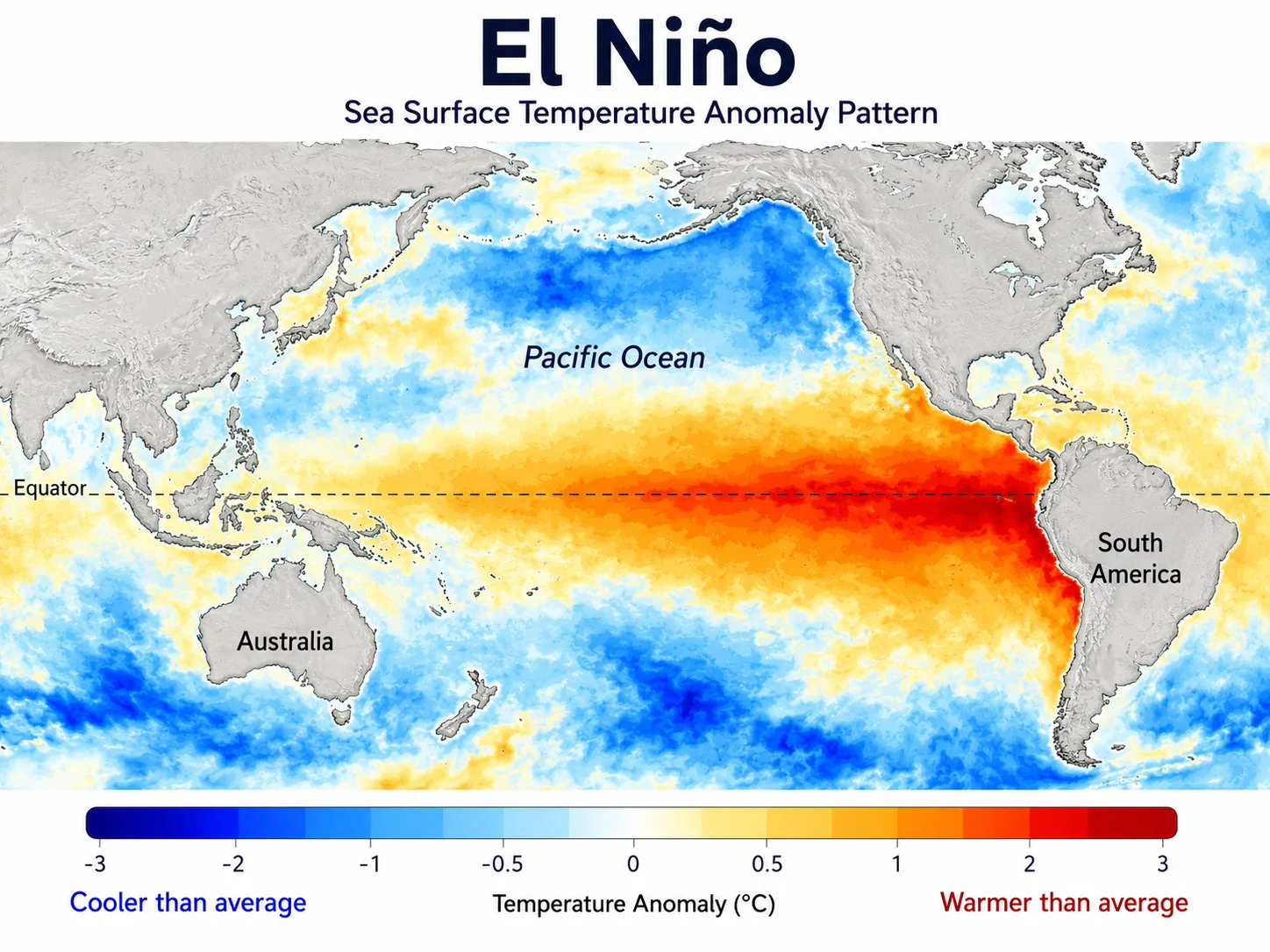
Along the equator in the Pacific, a band of ocean has been running warmer than normal for months. On June 11, NOAA made it official: El Niño has formed, and forecasters expect it to strengthen through the fall. Some models suggest it could become one of the strongest on record.
El Niño is the warm phase of a vast Pacific climate cycle, and a strong one rearranges weather and ocean life far beyond the tropics. For the California coast, it can mean warmer water, bigger winter storms and surf, marine life out of its usual range, clearer water in some places and murkier water in others, and stress on the kelp forests that anchor the whole nearshore ecosystem. NOAA now puts the odds of a "very strong" event at better than even.
The agency's National Weather Service issued its El Niño Advisory on June 11. Forecasters give a 63 percent chance that sea surface temperatures in the central tropical Pacific will climb more than 2 degrees Celsius above average, the threshold NOAA uses to call an event "very strong." El Niño is the warm half of a pattern scientists call the El Niño Southern Oscillation, or ENSO, the slow back-and-forth warming and cooling of the tropical Pacific. In ordinary years, trade winds drag warm surface water west toward Indonesia. When those winds slacken and the warm water slides back east toward South America, El Niño takes hold, and the warmth nudges the jet stream and storm tracks around the planet.
"Every El Niño is not the same; each one is unique with its own imprint on our weather," said Ken Graham, director of NOAA's National Weather Service. "Advanced monitoring and an improved understanding of El Niño patterns allow the NWS to better predict and better prepare the public and our core partners for what is to come."
For a diver, the first thing El Niño changes is what the water looks like. Along the California coast, cold, nutrient-rich water normally wells up from below in a process called upwelling, feeding blooms of phytoplankton, the microscopic drifting plants that turn coastal water green and cloudy. A strong El Niño suppresses that upwelling. With fewer nutrients reaching the surface, less plankton grows, and the water often turns warmer, bluer, and clearer offshore. Closer to shore the picture flips, because the same pattern brings heavier winter storms, and the runoff and churned sediment that follow them can drop visibility to a few feet for days at a time.
The fish change too. NOAA expects warm-water species to push north and cold-water species to retreat deeper or farther up the coast, shifting where fish feed, grow, and breed. Off Southern California, past El Niños have brought warm-water visitors like yellowtail and dorado, and in strong years even swarms of pelagic red crabs washing onto beaches, while cold-water staples grow scarce. The catch does not simply improve or worsen; it moves. And because El Niño starves the base of the food web of nutrients, the broader productivity of the coast tends to fall, which is why strong events have repeatedly disrupted fisheries up and down the eastern Pacific.
The deepest mark a strong El Niño leaves is on the kelp forests. NOAA's Office of National Marine Sanctuaries notes that El Niño events, with their combination of warm water and severe storms, "often devastate kelp forests." Giant kelp needs cool, nutrient-rich water, and the warm, nutrient-poor water of an El Niño starves it just as the bigger swells tear it loose. During the 1997 and 1998 El Niño, kelp forests south of Point Conception suffered up to 100 percent mortality in some areas, while cooler waters to the north came through largely intact. When the kelp thins, the loss cascades: the forests are nursery and shelter for much of the nearshore fish life, and bare rock can give way to urchins. Warm El Niño water has also fed harmful algal blooms along the West Coast, the dense outbreaks of microscopic algae that can close fisheries and sicken sea lions and seabirds.
What has forecasters watching most closely is the possible scale. Several models, from NOAA, the European Centre for Medium-Range Weather Forecasts, and Australia's Bureau of Meteorology, have converged on an unusually strong event, one that some reports say could rival the El Niño of 1877 and 1878, among the most powerful ever recorded. That event helped drive catastrophic droughts and famines across India, China, and beyond. A few models even show the central Pacific warming past 3 degrees Celsius, a mark reached only once in the modern record, in January 1878.
The name is older than the science. Peruvian fishermen coined it generations ago, calling the warm current that arrived near Christmas El Niño, "the Christ child," for the season it appeared. The warming they noticed at the coast, and the fish that vanished with it, was the near edge of the same Pacific-wide shift that forecasters now track by satellite.
El Niño usually peaks in the northern hemisphere winter, and its mark on California will arrive with it. The warm water is already moving east.
Sources
- The Economist (reference article, not directly accessible), "The coming El Niño could be the strongest ever recorded", https://www.economist.com/science-and-technology/2026/06/16/the-coming-el-nino-could-be-the-strongest-ever-recorded
- BBC News (reference article, not directly accessible), https://www.bbc.com/news/articles/c75ylx7g00xo
- NOAA, "El Nino forms, expected to strengthen, say NOAA forecasters" (June 11, 2026), https://www.noaa.gov/news-release/el-nino-forms-expected-to-strengthen-say-noaa-forecasters
- NOAA Office of National Marine Sanctuaries, "Impacts on Kelp Forests", https://sanctuaries.noaa.gov/visit/ecosystems/kelpimpacts.html
- Down To Earth, "The 2026 El Niño is developing unusually fast and may rival the strongest ever recorded", https://www.downtoearth.org.in/climate-change/the-2026-el-nino-is-developing-unusually-fast-and-may-rival-the-strongest-ever-recorded