
Whitetail Damselfish
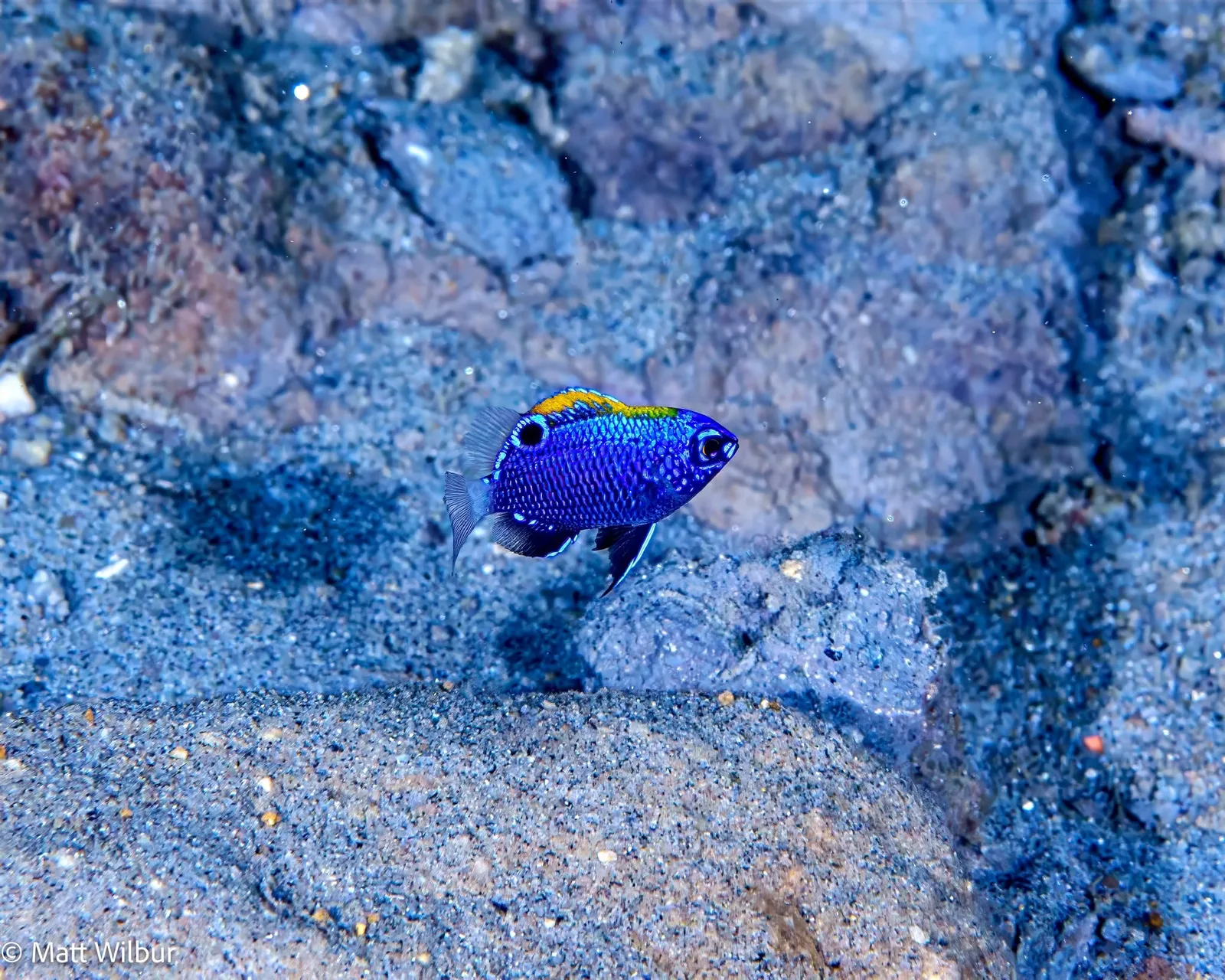
Also calledwhitetail major, jaqueta rabo blanco
Love and colleagues list it north to Santa Catalina and San Clemente islands, so its listed range reaches Southern California. iNaturalist held no California records on October 31, 2026.
Sightings
2026 season, numbered oldest first, every one sourced
Southern California
- #1Oct 31, 2026La Jolla ShoresJuvenile in a rock crevice
Juvenile Juvenile Photos: Matt WilburID: Nautical Nick, from Matt Wilbur's photosSource: Matt Wilbur photos, Facebook, Oct 31
Photos
More of each life stage
The California photos sit with their numbered sightings above. If you photographed this animal in California this season, post it to the Coastal Bulletin.
Home Range
Where it normally lives
Santa Catalina and San Clemente islands in Southern California to Mazatlán, Mexico, including Isla Guadalupe and the Revillagigedo Islands.
Range source: Love et al. 2021, via Zenodo · FishBase · Mexican Fish.com
Love and colleagues list this damselfish at Santa Catalina and San Clemente islands in Southern California, then at Islas Coronados, Isla Guadalupe, Islas San Benito, Bahía Magdalena and southwestern Baja California, and at Mazatlán and offshore islands. FishBase adds the Revillagigedo Islands, where Mexican Fish says about 90% of the population lives. Mexican Fish calls the fish uncommon in coastal waters and describes its range as limited and poorly documented.
Identification
The whitetail damselfish has an oval, flattened body. Adults are dark brown with darker outlines on their scales, blue eyes, a narrow blue edge on the anal fin and a white edge on the pectoral fins. Most adults carry a subtle white band on the tail, which gives the fish its name. The Acapulco damselfish, the beaubrummel and the Cortez damselfish all look similar. The Acapulco damselfish is lighter on the front half of its body, the beaubrummel has yellow fin tips, and the Cortez damselfish has white fin tips.
Mexican Fish describes juveniles as dark with an olive-green tinge, a dark spot at the rear base of the dorsal fin and a broad white bar across the base of the tail. The juvenile photographed at La Jolla Shores is much brighter than that description. It is electric blue with a yellow saddle along its back and a pale tail, and its dark spot is ringed in bright blue.
Natural History
Whitetail damselfish live on shallow rocky and coral reefs, including the surge zone, from the surface to about 60 feet. FishBase puts the largest fish at about 5.5 inches, measured to the base of the tail, and Love and colleagues at about 6.7 inches in total length. They eat algae, small bottom animals and plankton, and they defend their territory aggressively. Their eggs stick to the bottom, and the males guard and aerate them. The IUCN listed the species as Vulnerable in 2007. Mexican Fish calls it poorly studied.
In California
On October 31, 2026, Matt Wilbur photographed a juvenile in a rock crevice at La Jolla Shores and identified it as a whitetail damselfish, and Nautical Nick confirmed the ID. Love and colleagues cite earlier records from Santa Catalina and San Clemente islands. iNaturalist held no California records of the species on October 31, 2026.
Taxonomy
Rarity
Rarity in the compendium is Nautical Nick's call on how likely a diver is to run into the animal on the California coast this season, not how rare it is where it normally lives.