

The Second Wave: Dead Seabirds Wash Up Across San Diego as California's Murres Go Hungry
About 35 dead seabirds, most of them common murres, turned up on Pacific Beach on November 4, part of a statewide run of starving seabirds that rescuers say has been building since mid-August, as a year-long marine heat wave and a strengthening El Niño keep California's coastal water warm.
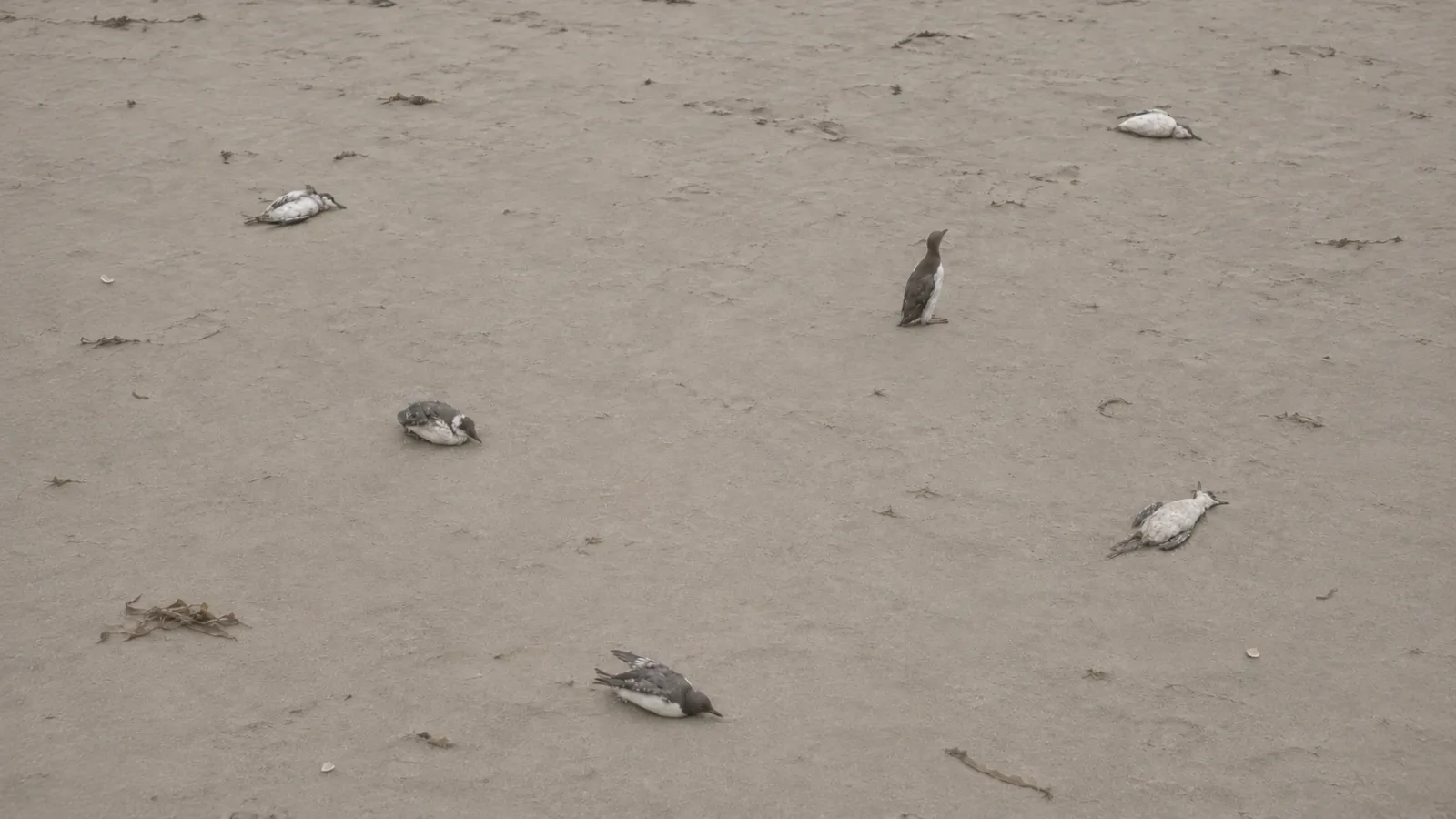
After dark on November 4, a crew from Wildlife Jewels went down to Pacific Beach for a western grebe that someone had reported in trouble. The grebe was alive, critically weakened, and the crew took it in. Along Pacific Beach, the group says, lay about 35 dead seabirds, most of them common murres (Uria aalge), black-and-white diving birds that hunt small fish underwater.
Wildlife Jewels, a nonprofit based in Solana Beach and Corona del Mar, says deaths of murres, cormorants, and grebes have also been documented in La Jolla, Solana Beach, Cardiff, and San Elijo. The group says the cause of the San Diego deaths has not been confirmed. Up and down the state, though, the pattern has a name. International Bird Rescue calls it the 2026 California starvation event, and it reports 332 common murres admitted to its clinics since August 15, the year's second wave by its count. The birds are arriving severely emaciated, or starved thin.
What the Rescuers Are Seeing
Of those 332 murres, 263 came in from Northern California and 69 from Southern California, according to International Bird Rescue's update of November 9. The counts are admissions, birds found alive and brought into care, and so they measure only the share of the event that people reach in time. Many of the birds arrive with worn, broken, and badly weathered feathers, the organization says, and many are being treated for Babesia uriae, a parasite that lives in red blood cells.
The mix of ages has also shifted. Clinics usually see large numbers of orphaned murre chicks at this point in the year, but adults are now arriving in greater numbers than chicks, which International Bird Rescue calls unusual. The first wave of the year, from March through June, brought 392 birds into its care, 80 of them common murres.
Other clinics report the same surge. Pacific Wildlife Care, a rehabilitation center on the Central Coast, admits around 100 murres in a typical year and took in a record 556 emaciated murres in 2015, National Geographic reported on November 4. Between September 1 and November 2 of this year, it received 922.
A Year of Hungry Seabirds
The California Department of Fish and Wildlife (CDFW) looked into that first wave in the spring. In a release on March 27, the agency said increased deaths of Brandt's cormorants, common murres, and California brown pelicans along the coast from Mendocino to San Diego County were mostly among younger birds, which were often emaciated, some with fungal respiratory infections or heavy loads of parasites. CDFW tied the deaths to high mortality among juveniles after an unusually good 2025 breeding season, since young birds are less practiced at catching prey and less able to ride out a change in their food supply. The fall wave runs the other way, heavier on adults.
Bird flu did not appear to be the explanation. Avian influenza was not detected in the 33 Brandt's cormorants CDFW had examined, the agency said, although partners reported preliminary detections in 2 cormorants and 4 murres from San Francisco, San Mateo, Marin, and Santa Cruz counties. In May, Tammy Russell, a marine seabird expert at Scripps Institution of Oceanography, told NBC San Diego that seabirds washing up on beaches were dying of starvation and testing negative for avian flu. Warmer water, she said, could be making food harder to find, because the fish the birds rely on live in cool ocean water.
An El Niño Stacked on a Heat Wave
The warm water came first. A marine heat wave has sat off parts of the West Coast for about a year, the Associated Press reported in July, only the third time on record, according to NOAA, that such a large stretch of coastal water stayed warm that long. The California Underwater Glider Network, run from Scripps, describes the heat wave as intensifying since early 2025. NOAA confirmed in June that an El Niño had formed in the tropical Pacific, and NOAA Fisheries notes that the recent coastal warmth predates it.
El Niño now adds heat to water that was already warm, and it reaches the coast by 2 routes, according to NOAA Fisheries. In the ocean, weakened winds along the equator set off Kelvin waves, slow pulses of warm water that travel east and then turn north along the coast of the Americas, pushing down the thermocline (the layer where water temperature drops quickly with depth). In the air, the tropical warming shifts pressure patterns over the North Pacific in ways that can weaken or reverse the winds that normally pull cold, nutrient-rich water up from below, a process called upwelling. "The oceanic teleconnection is particularly impactful off Southern California," said Michael Jacox, a research oceanographer with NOAA's Southwest Fisheries Science Center, using the scientists' term for a link between conditions in distant places. As of late June, glider surveys had found warm anomalies below 100 meters (330 feet) off California reaching deeper than in 20 years of monitoring, and the network calls that deep warmth "the first sign of El Niño conditions off California."
Reporting from this year traces how that warmth starves the birds. Record ocean temperatures shrank the band of cold, nutrient-rich water near shore where krill, anchovies, and sardines thrive, the Associated Press reported. National Geographic reported that anchovies and sardines retreat into deeper, cooler water, so murres dive again and again after prey that keeps moving away and burn more calories than they catch, a deficit that can turn fatal during the birds' late-summer molt, when they replace their feathers. "Many stressors are converging at once," Kelley Boland, development coordinator at Pacific Wildlife Care, told the magazine.
Warm Water and Toxic Algae
Starvation is the leading explanation statewide, but it has not been confirmed for the birds on Pacific Beach, and warm water feeds a second possibility. On November 4, the same day the Pacific Beach birds were reported, NOAA's California Current Integrated Ecosystem Assessment updated its harmful algal bloom outlook, saying that unusually warm sea surface temperatures, particularly within the Southern California Bight (the ocean inside the bend of coast from Point Conception south to Baja California), suggest a higher than usual likelihood of harmful algal blooms, overgrowths of algae that can poison wildlife. Some of those blooms produce domoic acid, a toxin made by certain microscopic algae that builds up in the small fish and shellfish feeding on them, and CDFW listed those blooms among the possible factors it was monitoring in this year's seabird deaths.
The last heat wave showed how that can happen. In the spring of 2015, a coastwide bloom of Pseudo-nitzschia, a diatom (a single-celled alga with a glassy shell), produced the largest outbreak of domoic acid ever recorded along the west coast of North America. A 2016 study in Geophysical Research Letters led by Ryan McCabe concluded that anomalously warm ocean conditions set it off: one toxic species thrived north of its usual range in the warm water, spring upwelling then supplied the nutrients for a large bloom, and storms carried it to the coast. In the team's experiments, the algae grew fastest at higher temperatures.
Warm water raises the odds, but it is not the only trigger. A 2018 review in the journal Harmful Algae of 15 years of records from the Southern California Bight found that domoic acid there appears mostly in spring, and it linked toxic years in 2003, 2006, 2007, 2011, and 2017 to mass deaths of marine mammals and seabirds. The red tides that turn San Diego water brown come from a different organism, a dinoflagellate (a single-celled alga that swims with a whiplike tail). Michael Latz of Scripps has described those blooms as associated with relaxed upwelling and a stratified water column, warm water layered over cold, and has said that local populations do not produce yessotoxin, the toxin the same species makes in other parts of the world.
Local measurements that could settle the question are not yet public. The weekly harmful algae samples taken at Scripps Pier by the California Harmful Algal Bloom Monitoring and Alert Program (CalHABMAP) run through October 5 in the public data set served by the Southern California Coastal Ocean Observing System. A gap in posted data is not a clean result, and it says nothing either way about what is in the water now.
The Last Time the Ocean Ran Hot
California has seen this before, on a far larger scale. During the northeast Pacific marine heatwave of 2014 to 2016, about 62,000 dead or dying common murres washed ashore between the summer of 2015 and the spring of 2016 on beaches from California to Alaska, about 3 in 4 of them in the Gulf of Alaska, according to a 2020 study in PLoS ONE led by John Piatt of the U.S. Geological Survey. The authors estimate that total deaths approached 1 million birds, and about 2 in 3 of the murres killed were adults.
Most of those birds were severely emaciated, and the study found no evidence of anything other than starvation. The authors proposed what they call an "ectothermic vise" (ectothermic means cold-blooded): the warm water squeezed the small forage fish murres eat from below and above at once, which left too little prey for the birds. Colonies failed too: the team documented 22 complete breeding failures at murre colonies from 2015 through 2017. That heat wave also overlapped one of the strongest El Niños on record, in 2015, according to the Associated Press.
How Long the Warm Water May Last
Federal forecasts point to warm water through the winter. In its October 8 discussion, NOAA's Climate Prediction Center said El Niño continues to strengthen, with a strong to very strong event likely through January to March 2027, and it put the chances high that the event becomes historic, exceeding the strength of every El Niño since 1950. Warming along the West Coast typically trails the tropics by a few months, according to NOAA Fisheries. Nate Mantua, a research scientist at the Southwest Fisheries Science Center, said the impacts of the first Kelvin waves, which reached California in May and June, "will likely be minor compared to this fall and winter."
An experimental forecast from NOAA's Physical Sciences Laboratory, started in October, gives an 80 to 100 percent likelihood of marine heat wave conditions off California and Baja California through early 2027, with high confidence. Neither forecast names a date when the coast will cool. The Climate Prediction Center's next update is due November 12.
What to Do With a Bird on the Beach
CDFW asks the public not to touch, harass, feed, or take photographs with weakened seabirds, and not to try to remove fishing line or hooks from a tangled bird. A live, stranded seabird goes to a local wildlife rehabilitation center, or to International Bird Rescue's Bird HelpLine at 866-767-2473. A dead seabird can be reported, with photos if possible, through CDFW's Wildlife Health Laboratory mortality reporting form. Wildlife Jewels takes reports of wildlife in distress through an online form on its website.
The grebe from Pacific Beach was one of the lucky ones, found alive and rescued. Speed matters for every bird like it, International Bird Rescue says.
"The longer a severely weakened bird goes untreated, the more difficult recovery can become."
Pacific Beach, San Diego, California
Sources
- Wildlife Jewels, "Seabird mortality: common murres at Pacific Beach, San Diego" (November 4, 2026), https://www.wildlifejewels.org/wildlife-jewels-rescue-updates/seabird-mortality-common-murres-pacific-beach-san-diego
- Wildlife Jewels, "Wildlife Jewels rescues critically weakened western grebe after dark at Pacific Beach" (November 8, 2026), https://www.wildlifejewels.org/wildlife-jewels-rescue-updates/wildlife-jewels-rescues-critically-weakened-western-grebe-after-dark-at-pacific-beach
- Wildlife Jewels, Report Wildlife, https://www.wildlifejewels.org/report-wildlife
- International Bird Rescue, "2026 California Starvation Event" (updated November 9, 2026), https://www.birdrescue.org/2026-california-starvation-event/
- California Department of Fish and Wildlife, "CDFW Finds Starvation to be Primary Cause of Increased Mortalities in California Seabirds" (March 27, 2026), https://wildlife.ca.gov/News/Archive/cdfw-finds-starvation-to-be-primary-cause-of-increased-mortalities-in-california-seabirds
- NBC San Diego, "San Diego's coast experiencing a marine heat wave, Scripps researchers find" (May 21, 2026), https://www.nbcsandiego.com/news/local/san-diegos-coast-experiencing-marine-heat-wave-scripps-researchers-find/4027445/
- National Geographic, Avery Schuyler Nunn, "Across a Fevered Pacific Ocean, Seabirds Are Starving" (November 4, 2026), https://www.nationalgeographic.com/environment/article/el-nino-murre-sea-bird-deaths-wildlife-rehabilitation-california
- Associated Press via KPBS, Julie Watson, "A marine heat wave caused seabird deaths off California. El Nino could worsen the die-off" (July 1, 2026), https://www.kpbs.org/news/environment/2026/07/01/a-marine-heat-wave-caused-seabird-deaths-off-california-el-nino-could-worsen-the-die-off
- NOAA Fisheries, Southwest Fisheries Science Center, "Ocean indicators were tracking El Niño's arrival on the West Coast" (September 3, 2026, updated October 2, 2026), https://www.fisheries.noaa.gov/feature-story/ocean-indicators-were-tracking-el-ninos-arrival-west-coast
- California Underwater Glider Network (Scripps Institution of Oceanography), "What is El Niño?" recent conditions (June 25, 2026), https://spraydata.ucsd.edu/products/el-nino/
- NOAA Climate Prediction Center, ENSO Diagnostic Discussion (October 8, 2026), https://www.cpc.ncep.noaa.gov/products/analysis_monitoring/enso_advisory/ensodisc.shtml
- NOAA Physical Sciences Laboratory, Marine Heatwave Forecast (forecast initialized October 2026, accessed November 8, 2026), https://psl.noaa.gov/marine-heatwaves/
- McCabe, R.M., Hickey, B.M., Kudela, R.M., et al., "An unprecedented coastwide toxic algal bloom linked to anomalous ocean conditions," Geophysical Research Letters (2016), https://repository.library.noaa.gov/view/noaa/20927
- Smith, J., et al., "A decade and a half of Pseudo-nitzschia spp. and domoic acid along the coast of southern California," Harmful Algae (2018), https://repository.library.noaa.gov/view/noaa/57789
- Scripps Institution of Oceanography, Michael Latz, "Everything you wanted to know about red tides" (April 28, 2020), https://scripps.ucsd.edu/news/everything-you-wanted-know-about-red-tides
- NOAA California Current Integrated Ecosystem Assessment, "Harmful Algal Blooms (HABs): US West Coast Impacts and Implications" (updated November 4, 2026), https://www.integratedecosystemassessment.noaa.gov/regions/california-current/harmful-algal-blooms-habs-us-west-coast-impacts-and-implications
- SCCOOS ERDDAP, CalHABMAP Scripps Pier data set (accessed November 8, 2026), https://erddap.sccoos.org/erddap/tabledap/HABs-ScrippsPier.html
- Piatt, J.F., Parrish, J.K., Renner, H.M., et al., "Extreme mortality and reproductive failure of common murres resulting from the northeast Pacific marine heatwave of 2014-2016," PLoS ONE (2020), https://www.usgs.gov/publications/extreme-mortality-and-reproductive-failure-common-murres-resulting-northeast-pacific