

Giant Squid Are Much More Common Than We Think... We Just Didn't Know Where To Look
For a century we read the ocean's giant squid, and their even larger cousin the colossal squid, as rare. A new wave of stealth cameras suggests the problem was never the animals. It was our blinding white lights.
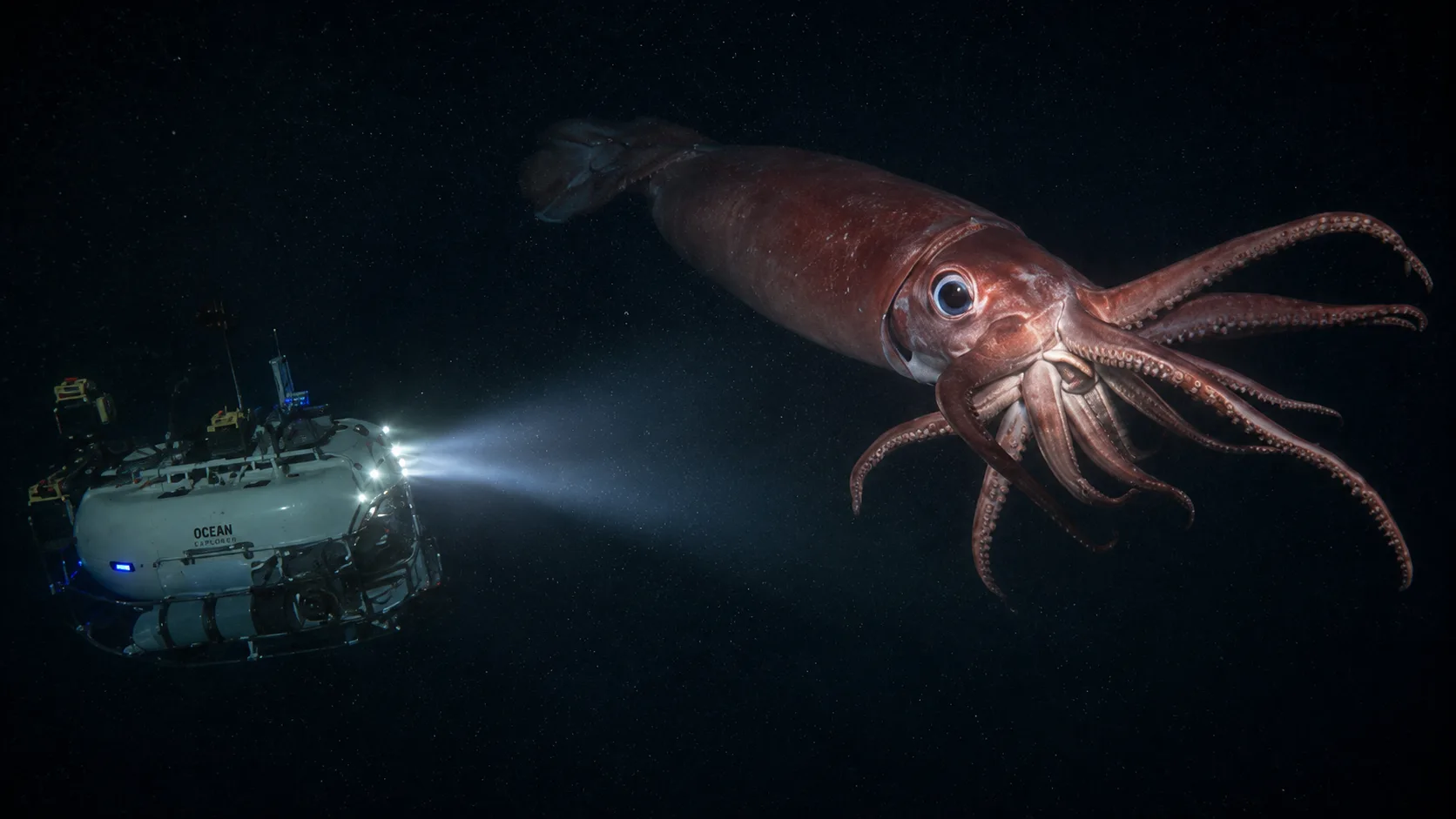
In March 2025, a remotely operated submersible drifted at 600 meters off the South Sandwich Islands, in the far South Atlantic, when a small, glassy, ghostlike animal passed its lens. The scientists aboard Schmidt Ocean Institute's research vessel realized they were watching a colossal squid alive in the deep for the first time. It was a juvenile, about 30 centimeters long. A century after the species was named, no one had ever filmed one in its own world.
The colossal squid is the largest invertebrate on Earth. Adults are thought to reach 7 meters and 500 kilograms, the bulk of a small bus, yet until that moment the living animal had only ever been glimpsed as dying specimens hauled up by fishing boats. For a hundred years, that near-total absence from our cameras was read as rarity. A growing number of deep-sea scientists and filmmakers now argue close to the opposite: the giants are likely abundant, and the reason we so seldom see them has less to do with the squid than with how we have been looking. For most of the history of deep-sea exploration, we arrived in the dark with floodlights blazing, and the animals fled.
The case for abundance comes from an unlikely place: the stomachs of sperm whales. Colossal squid are a mainstay of the sperm whales that hunt the Southern Ocean, accounting for much of the squid found in their bellies. Working backward from how much a population of sperm whales must eat, researchers estimate the squid that feed them must number in the millions. An animal the size of a bus, in other words, may be one of the more common large predators in the Southern Ocean, and still effectively invisible to us.
The trouble is the light. Below about 200 meters, sunlight gives out, and the animals there have spent millions of years evolving eyes for near-total darkness. The colossal squid has the largest eye of any known animal, roughly the size of a dinner plate, tuned to catch the faintest glow of bioluminescence, the light that living things make, from far off in the black. Into that world a submersible descends like a stadium floodlight. Researchers warned decades ago that such brightness can damage the sensitive eyes of deep-sea animals, many of which have no way to limit how much light reaches the retina, because nothing in their world had ever been that bright.
The larger problem is behavior. A 2021 study that lowered instruments through the water column found that animals actively flee artificial light, retreating as far as 94 meters and thinning the density of life around the instrument by as much as 99 percent. The creatures were there. They had simply been driven off. For decades, deep-sea expeditions announced their arrival with the underwater equivalent of a lighthouse, then puzzled over why the dark looked so empty.
The way back in was to learn the ocean's own language. Edith Widder, a marine biologist who has spent four decades studying bioluminescence, built a camera she calls the Medusa that runs silent and lights its scene with red, a color most deep-sea animals cannot see well. She paired it with an optical lure, an electronic jellyfish, a ring of blue LEDs that imitates the pinwheeling distress display of an Atolla jellyfish. That display is a kind of burglar alarm, a flash a jelly throws when something seizes it, in the hope of drawing a bigger predator to attack its attacker. Newer work complicates the idea that any light is truly invisible down there, the same 2021 study found animals shy from red light too, but the quiet, dim approach changed what the cameras saw.
In 2012, off Japan, the Medusa recorded what a century of submarines, nets, and expeditions had never managed: a giant squid, the colossal squid's long-famous relative, alive in the deep. A single deployment caught three separate sightings. Widder's team filmed a giant squid again in 2019, in the Gulf of Mexico. The animal that had eluded everyone for more than a century appeared, and reappeared, the moment people stopped shouting into the dark.
The lesson is reaching far cheaper gear. Barny Dillarstone, an independent underwater filmmaker whose video is the basis for this story, lowers baited cameras, weighted frames that hold a camera and a canister of bait and simply sit and wait, into water that almost no one has filmed. Off Nusa Penida, a busy dive island in Bali, he dropped a rig to around 170 meters and recorded what may be the first living footage of a purple eagle ray, along with an Indonesian wobbegong shark seen far deeper than the species had been documented. A passive camera, he notes, lets animals behave as if no one were watching, because no one is.
The same blind spot covers a far larger territory. Between the sunlit surface and the seafloor lies the mesopelagic, or twilight, zone, from roughly 200 to 1,000 meters, where almost no light reaches and most cameras never go. It is not empty. A 2014 study using acoustic data concluded that the mass of fish living there had been underestimated by at least tenfold, and that the twilight zone may hold more fish than the rest of the ocean combined. The reason for the miss was almost comic: the fish can see a trawl net coming and swim away, so for a century the nets had been catching mostly the slow and the sick.
A new generation of tools is built for animals that cannot be caught without being destroyed. One, called DeepPIV, sweeps a sheet of laser light through the water to scan a living creature in three dimensions without touching it; researchers at the Monterey Bay Aquarium Research Institute used it to look, for the first time, inside the mucus house of a giant larvacean, a thumb-sized animal whose discarded filters sink and carry carbon to the seafloor. Another, environmental DNA, reads the genetic traces an animal sheds into the water, mapping what lives in the deep without ever laying eyes on it.
The history of deep-sea discovery has rarely been a story of the right people arriving with the right equipment. More often it has been a story of cameras going into dark places and animals appearing. No one has yet filmed a fully grown colossal squid in the deep. On the present evidence, the giant is almost certainly down there in numbers. We are only now learning how to look without being seen.
Sources
- Barny Dillarstone, deep-sea exploration video (reference, provided by the editor)
- Schmidt Ocean Institute, "First Confirmed Footage of a Colossal Squid, and it's a Baby!" (2025), https://schmidtocean.org/first-colossal-squid-footage/
- Sci.News, "Live Colossal Squid Captured on Film for First Time", https://www.sci.news/biology/colossal-squid-13838.html
- NOAA Ocean Exploration, "The Medusa", https://oceanexplorer.noaa.gov/explorations/19biolum/background/medusa/medusa.html
- National Geographic, "How scientists filmed a giant squid in U.S. waters for the first time", https://www.nationalgeographic.com/animals/article/giant-squid-us-waters-first-video
- Scientific Reports, "Pelagic organisms avoid white, blue, and red artificial light from scientific instruments" (2021), https://www.nature.com/articles/s41598-021-94355-6
- Nature Communications, "Large mesopelagic fishes biomass and trophic efficiency in the open ocean" (Irigoien et al., 2014), https://www.nature.com/articles/ncomms4271
- PetaPixel, "Man Drops Camera to the Bottom of Black Magic Island and Discovers New Creatures", https://petapixel.com/2026/02/24/man-drops-camera-to-the-bottom-of-black-magic-island-and-discovers-new-creatures/