
Massive Seaweed Die-Offs Stink Up the Coast and Murk Up the Water in the Florida Keys
A record-size belt of sargassum is burying the Keys, rotting in the canals, killing fish, and turning clear water to soup. Scientists say it is probably the new normal.
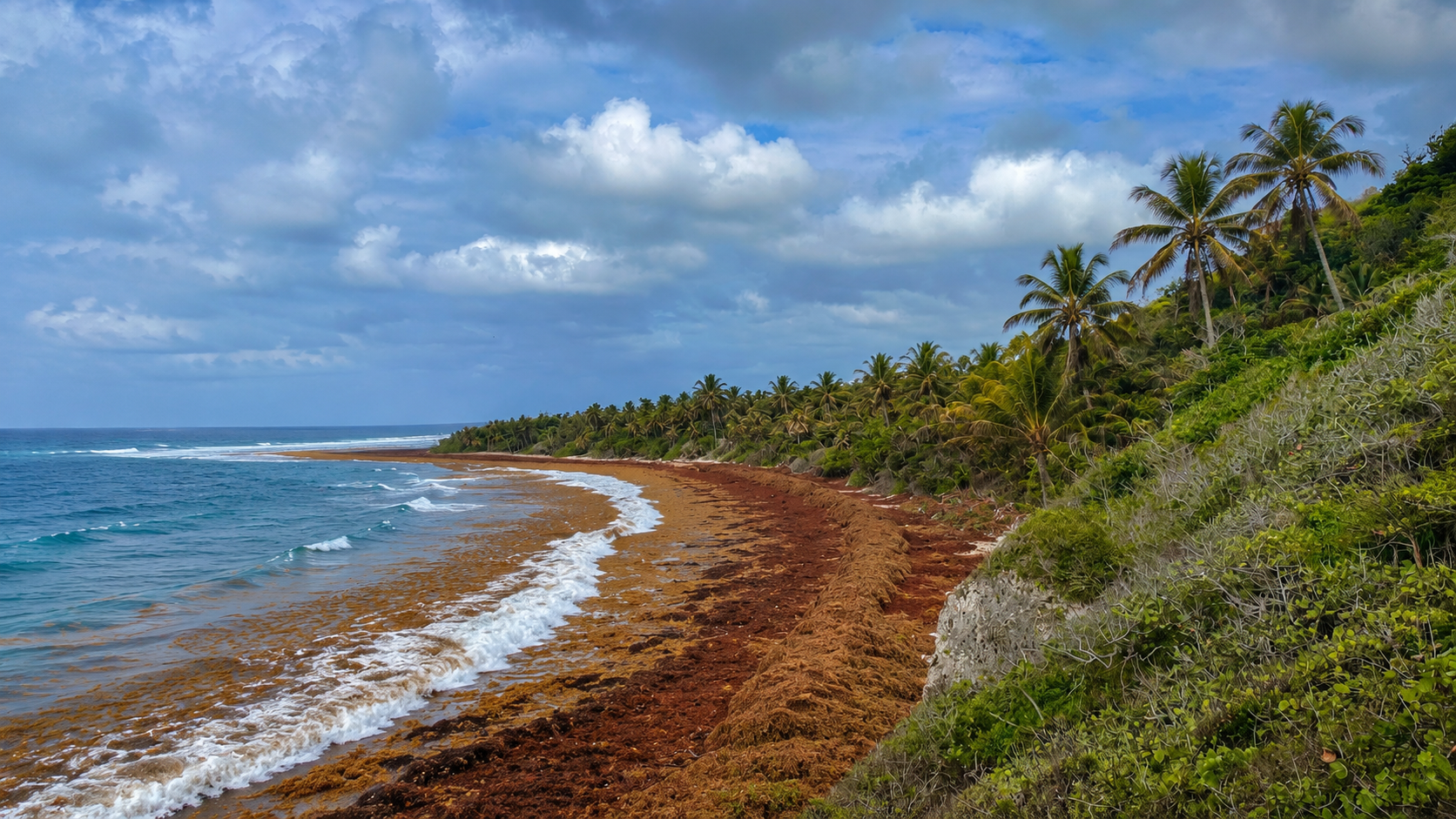
Stephen Frink has been diving off Key Largo since the late 1970s, and he knows what a good year of sargassum looks like: golden rafts of living seaweed drifting in from the open ocean, alive with tiny crabs and fish. What is washing into the Florida Keys this summer is something else. "It's not a vibrant mass of life," Frink told the Keys Weekly. "It's just dead material."
The Keys are being buried, along with much of the Caribbean and southeast Florida, in one of the worst sargassum years on record. Scientists at the University of South Florida, who track the weed by satellite, say 2026 is on pace to set a record by summer, fed by a vast belt of the algae that stretches for thousands of miles across the Atlantic. Where it piles up onshore, it rots, pulls the oxygen out of canals, kills fish, and fills the air with the smell of sulfur. It also turns the water to soup. In one Key Largo basin, Frink said, "you couldn't see two feet down."
Driven by south and southeast winds, the seaweed has jammed into canals and coves up and down the island chain. At Tavernier's Harry Harris Park, it lines the shore and the boat ramp in decomposing piles. The stink has been bad enough to change plans. In the Lower Keys, officials moved this year's Juneteenth event from its usual home at Higgs Beach to city hall, and at the Ocean Reef resort, Frink said, a friend had to give up an oceanfront room because the smell was too much.
Offshore, sargassum is a good thing, a floating nursery that shelters fish, sea turtles, and crabs far from land. The trouble starts at the coast. "Once it gets close to shore, you see fish kills because it gets pushed into canals or coves," said Shelly Krueger, a marine biologist with the University of Florida and the county's extension agent in Key West. "As it breaks down, it sucks oxygen out of the water." Fish get trapped in the rotting mats, and the decay draws down the dissolved oxygen they need to breathe.
What is arriving now is a relatively new phenomenon. For most of recorded history, the world's floating sargassum was concentrated in the Sargasso Sea, a calm stretch of the North Atlantic east of the United States. Then, in 2011, satellites picked up something new: an enormous band of the weed forming near the equator and reaching from West Africa to the Gulf. Scientists named it the Great Atlantic Sargassum Belt, and it has bloomed larger most years since, in a trend researchers link to warming seas and a rising load of nutrients washing off the land. "This is a new source of sargassum, something we've never seen before," Krueger said.
The seaweed itself is old and storied. Portuguese sailors named it sargaco centuries ago, and in 1492 the crews of Christopher Columbus sailed into thick mats of it in the mid-Atlantic and feared, wrongly, that their ships would run aground on hidden shoals. That is the Sargasso Sea, the only sea on Earth defined not by a coastline but by the weed that floats in it, its edges drawn by ocean currents. The belt now fouling the Keys is a different creature, a coast-hugging bloom that did not exist a generation ago.
By the standards of the region, the Keys are getting off lightly. Krueger points to Martinique, Barbados, and Mexico, where beaching events have been far worse. And the Keys' misery is wind-driven and, for the moment, temporary. When the wind swings around, the mats will drift back out to sea. "Basically, as soon as the wind changes, it will go back offshore," Krueger said. The catch is that it will keep coming back. "This is probably the new normal," she said.
For now, the islands wait it out. "We're stuck for a few weeks, no matter what the wind does," Frink said. The rafts of dead weed will thin, the water will clear, and the smell will fade. Then, somewhere past the reef, the belt will keep growing, and the next south wind will bring it back.
Sources
- Keys Weekly (reference article), Kellie Butler Farrell, "Sargassum creates stinky mess on the Florida Keys shoreline; how long will it last?" (June 25, 2026), https://keysweekly.com/42/sargassum-creates-stinky-mess-on-the-florida-keys-shoreline-how-long-will-it-last/
- University of South Florida, Sargassum Watch System, Optical Oceanography Lab, College of Marine Science, https://optics.marine.usf.edu/projects/saws.html
- WUSF / WLRN, "Record tons of sargassum arriving in Southeast Florida, Florida Keys, Caribbean" (May 2026), https://www.wlrn.org/environment/2026-05-26/record-tons-of-sargassum-arriving-in-southeast-florida-florida-keys-caribbean
- Shelly Krueger, UF/IFAS Monroe County Extension, "2026 Sargassum Inundation Event" (June 17, 2026), https://blogs.ifas.ufl.edu/monroeco/2026/06/17/2026-sargassum-inundation-event/