
Bounty Fishers Part 2: Get Paid to Kill Lionfish
A Brazilian beach town is paying fishermen about 2 US dollars a fish to pull venomous lionfish off its reefs, and the program started roughly 2 months after the town's first sighting.
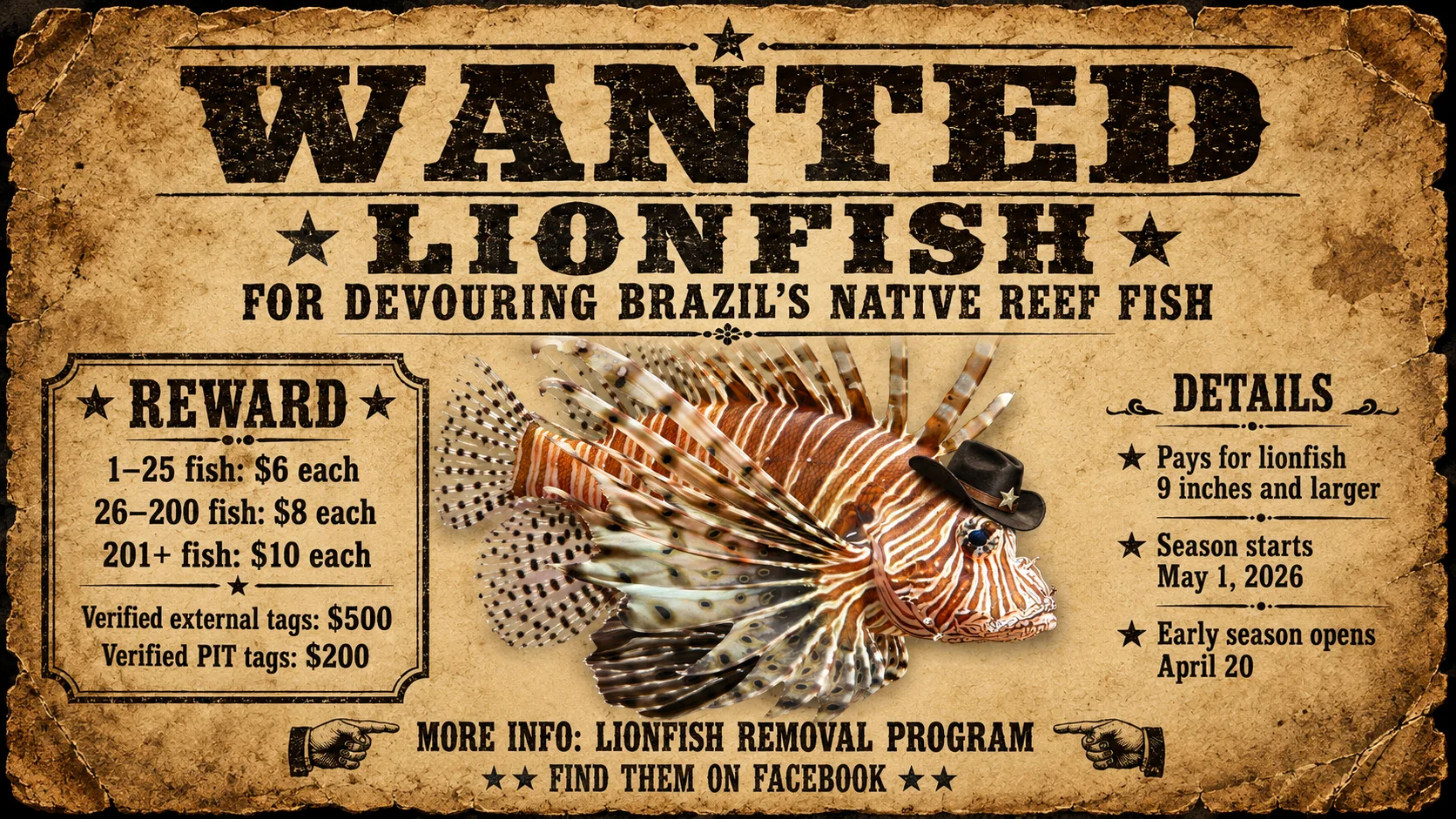
In Porto Seguro, on the coast of Bahia, a fisherman who catches a lionfish can turn it in at the Colônia de Pescadores Z-22, the local fishermen's guild, and collect 10 reais, worth about 2 US dollars in early September 2026. The program's rule is short and absolute: a captured lionfish is never returned to the water alive.
Porto Seguro recorded its first lionfish in June 2026, inside the Parque Natural Municipal Marinho do Recife de Fora, a protected reef park off its own beaches. The town published a municipal lionfish action plan in August, and the bounty followed. By early September, Gazeta do Povo reported 442 fish removed, a total the Times of India rounded to nearly 500. Porto Seguro sits at the northern end of the Abrolhos Bank, which holds the largest and richest reefs in the South Atlantic, and the municipal plan is built on early detection and rapid removal while the local population is still small.
The Price of a Fish
A bounty of 10 reais is modest by international standards. On the Columbia and Snake rivers, the Northern Pikeminnow Sport-Reward Fishery pays on a rising scale, 6 US dollars each for an angler's first 25 fish of a season, 8 dollars for the next 175, and 10 dollars for every fish after that, several times the Porto Seguro rate. It pays those rates for a fish native to the river it is removed from.
Porto Seguro pays a fraction of that for an animal native to the Indo-Pacific, and the town has taken several hundred out of the water in a month. The program runs as a partnership between the Secretaria Municipal de Meio Ambiente e Causa Animal, the city's environment department, and the fishermen's guild. Fish are handed in by the people who catch them and passed to the Laboratório de Ecologia e Conservação Marinha at the Universidade Federal do Sul da Bahia, a marine ecology and conservation lab that studies the fish's diet, reproduction, and population structure. Every payment buys a research specimen along with a removal.
How the Lionfish Got Past the Amazon
Lionfish entered the Atlantic through Florida in 1985, an introduction researchers attribute to aquarium releases, and spread through the Caribbean, the Gulf of Mexico, and north to Bermuda and North Carolina. For decades Brazil looked insulated, and the reason was a river.
The Amazon and Orinoco pour an enormous volume of fresh, sediment-heavy water into the western Atlantic, creating a plume that functions as a biogeographic barrier, a natural boundary that reef species have historically been unable to cross. That plume is a large part of why Caribbean and Brazilian reef life evolved along separate lines.
Brazil's first invasive lionfish was collected on May 10, 2014, at Arraial do Cabo in the southeast. Carlos Ferreira, Osmar Luiz, Sergio Floeter, and colleagues described it in PLOS ONE the following year as an adult Pterois volitans of 10 inches (25 centimeters), spotted by recreational divers roughly 3,400 miles (5,500 kilometers) from the Caribbean, and their genetic work matched it to Caribbean populations.
That fish was a single animal in the southeast. The invasion that eventually reached Bahia came later and from the opposite direction. Rodrigo Maggioni and coauthors, publishing in Scientific Reports in 2023, reported that between 2020 and 2023 roughly 350 lionfish were documented across 1,700 miles (2,800 kilometers) of Brazil's north and northeast coastline, a group that included juveniles and reproductive females, the signature of an established breeding population. Their genetic analysis found no bottleneck, meaning the invaders arrived with their genetic diversity intact.
The same study explained the route. Lionfish crossed the plume by using mesophotic reefs, the deeper twilight-zone habitat that sits below the plume's freshwater influence, as stepping stones. The fish went underneath the barrier.
What Is at Stake on the Reef
Lionfish are effective in the Atlantic because nothing there evolved alongside them. They ambush prey, carry venomous spines that deter predators, produce very large numbers of eggs, and eat the small fish that snappers, groupers, and other commercially important species depend on.
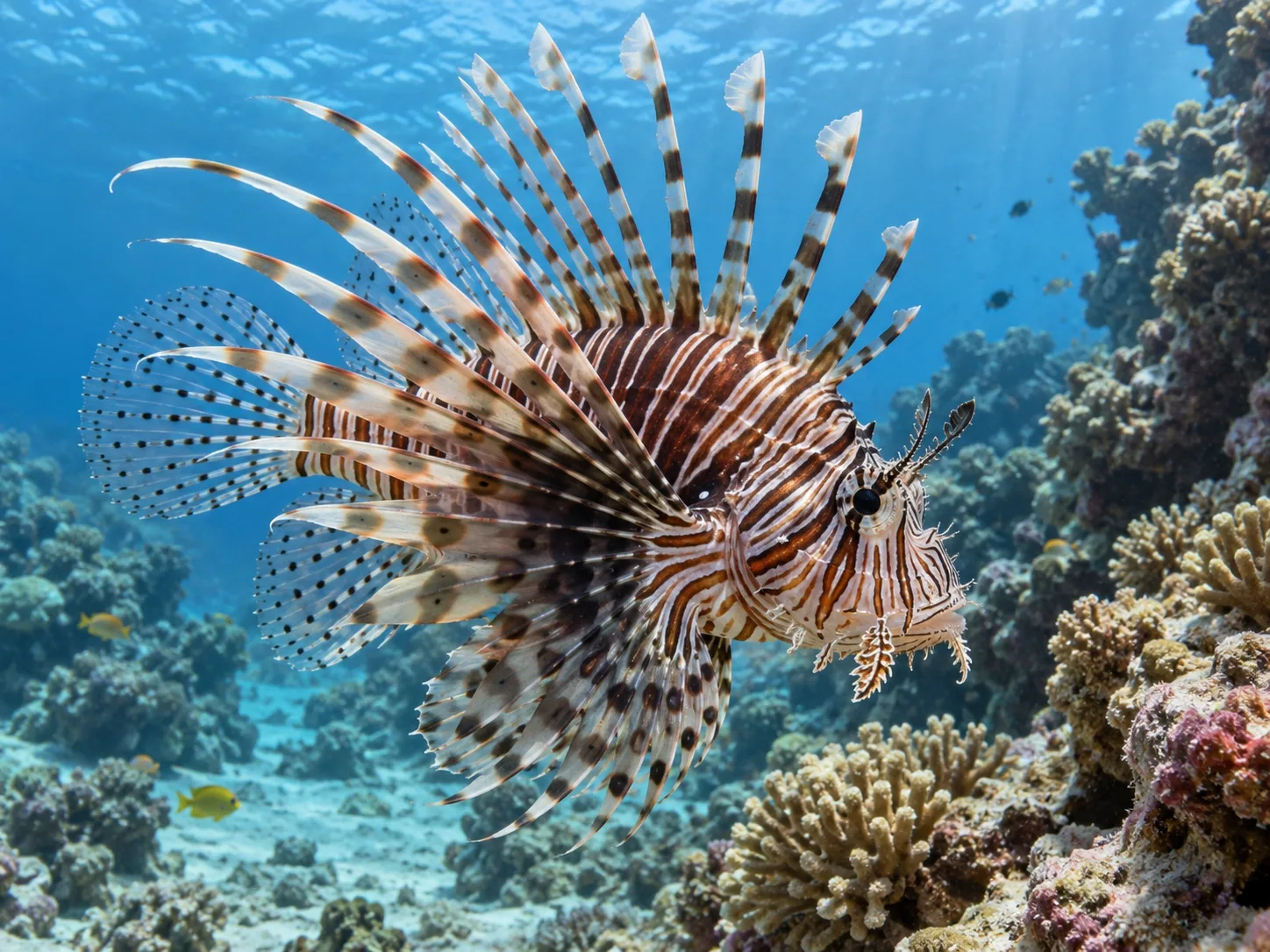
A lionfish hovers over a reef with its spines fanned out. The species is native to the Indo-Pacific and has spread through the western Atlantic since 1985.
Mark Albins and Mark Hixon of Oregon State University measured the effect directly in the Bahamas. Writing in Marine Ecology Progress Series in 2008, they reported that lionfish reduced the recruitment of native reef fishes, meaning the rate at which young fish successfully settle onto a reef, by an average of 79 percent over the 5 weeks of their experiment.
For Bahia the exposure runs 2 ways. The Abrolhos reefs hold coral species found nowhere else, and Porto Seguro sits at their northern doorstep. The region's artisanal fishing communities, small-scale operations working from small boats, depend on mangroves and estuaries that serve as nursery grounds, which is the shallow habitat lionfish colonize readily. Researchers led by Marcelo Soares and Tommaso Giarrizzo of the Universidade Federal do Ceará launched an online lionfish monitoring dashboard in April 2022, open to reports from fishers and divers. Osmar Luiz, an aquatic ecologist at Charles Darwin University, has warned that losing those nurseries would raise the risk of hunger in a region already grappling with substantial social inequality.
Whether Killing Them Works
The Reef Environmental Education Foundation, or REEF, has organized lionfish derbies, timed competitive removal events, for years. The organization maintains that culling lowers lionfish numbers and has been shown to stabilize or reverse declines in native prey fish, and that partial culling is often as effective as complete local eradication at a fraction of the effort.
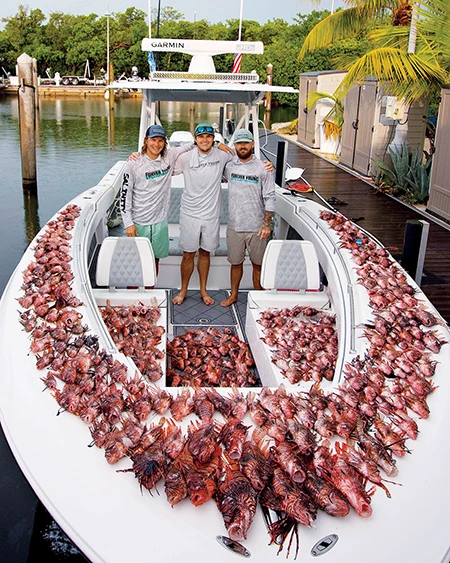
The Forever Young crew of Tony Young, Billy Moscatello, and Luke Rankin caught 321 lionfish over the 2-day 2024 Florida Keys Lionfish Derby hosted by Reef Environmental Education Foundation (REEF). © Chris Rankin
The limits are documented as well. Nicholas Smith, Stephanie Green, Lad Akins, and Isabelle Côté, writing in Biological Invasions in 2017, found that infrequent culling reduced lionfish density by 60 to 79 percent and still failed to stop native prey from declining. Culling 4 times a year and culling twice a year produced similar outcomes, because lionfish recolonized cleared reefs quickly from surrounding areas. After a hurricane passed through their study system, prey biomass on the reefs culled twice a year fell by 92 percent.
Removal works where it is intense and continuous. Sustained pressure holds a reef; a program that slows down loses the ground it gained to recolonization within a season. A bounty is a way of buying that continuity from people who are already on the water every day.
The Same Idea, Pointed the Other Way
The 2 bounty programs look alike on paper and answer different problems. On the Columbia and Snake, the Bonneville Power Administration, the federal agency that markets electricity generated by the dams and funds power-related work at them, pays anglers to remove a native predator whose advantage over young salmon was created by the reservoirs those dams produce. The dams are operated by the US Army Corps of Engineers and the Bureau of Reclamation. The bounty there offsets a distortion built into the river by people.
Porto Seguro's version answers a problem that no longer depends on human maintenance. The lionfish was introduced by people in Florida 41 years ago and has since crossed an ocean barrier under its own power. Nothing sustains its advantage except the fish itself, and the only available lever is removing individuals faster than they arrive.
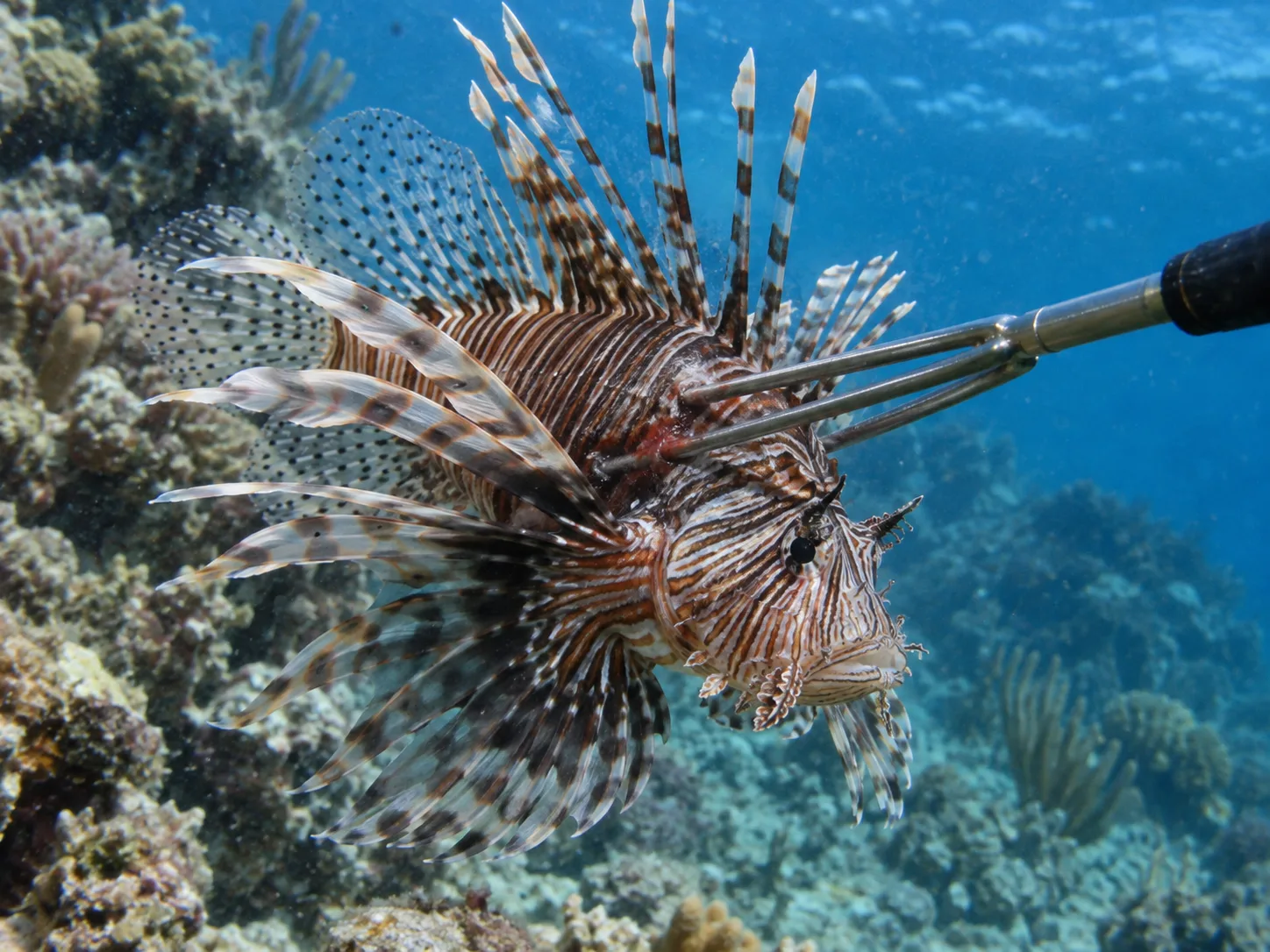
A diver's pole spear holds a lionfish just off the reef. AI-generated illustration, Nautical Nick.
Soares, who has tracked the invasion since it reached Brazilian waters, has been direct about the ceiling on that effort. "Eliminating the species from the Brazilian coast is not a realistic possibility," he told Mar Sem Fim.
Each lionfish turned in at the Z-22 guild earns 10 reais and gives a university lab another fish to study. What 442 fish in a month buys Porto Seguro is time, measured against how long the town is willing to keep paying for it.
Sources
- Times of India, "Brazil's Porto Seguro is paying for each captured lionfish, nearly 500 have been removed as they threaten native reefs and local fisheries," https://timesofindia.indiatimes.com/world/rest-of-world/brazils-porto-seguro-is-paying-10-for-each-captured-lionfish-nearly-500-have-been-removed-as-they-threaten-native-reefs-and-local-fisheries/articleshow/133871472.cms
- Gazeta do Povo, "Porto Seguro paga recompensa para pescadores que capturarem o peixe-leão," September 3, 2026, https://www.gazetadopovo.com.br/brasil/porto-seguro-paga-recompensa-para-pescadores-que-capturarem-o-peixe-leao/
- Mar Sem Fim, "Peixe-leão na Bahia: Porto Seguro paga R$ 10 por captura," September 2, 2026, https://marsemfim.com.br/peixe-leao-na-bahia-porto-seguro-paga-r-10-por-captura/
- Ferreira, C. E. L., O. J. Luiz, S. R. Floeter, et al., "First Record of Invasive Lionfish (Pterois volitans) for the Brazilian Coast," PLOS ONE 10(4):e0123002, 2015, https://journals.plos.org/plosone/article?id=10.1371/journal.pone.0123002
- Maggioni, R., R. S. Rocha, J. T. Viana, et al., "Genetic diversity patterns of lionfish in the Southwestern Atlantic Ocean reveal a rapidly expanding stepping-stone bioinvasion process," Scientific Reports 13:13469, 2023, https://www.nature.com/articles/s41598-023-40407-y
- Albins, M. A., and M. A. Hixon, "Invasive Indo-Pacific lionfish Pterois volitans reduce recruitment of Atlantic coral-reef fishes," Marine Ecology Progress Series 367:233-238, 2008, https://www.int-res.com/abstracts/meps/v367/p233-238/
- Smith, N. S., S. J. Green, J. L. Akins, and I. M. Côté, "Density-dependent colonization and natural disturbance limit the effectiveness of invasive lionfish culling efforts," Biological Invasions 19(8):2385-2399, 2017, https://www.reef.org/news/publications/density-dependent-colonization-and-natural-disturbance-limit-effectiveness
- Reef Environmental Education Foundation, "Setting the Record Straight on Invasive Lionfish Control: Culling works," https://www.reef.org/news/publications/setting-record-straight-invasive-lionfish-control-culling-works
- Bonneville Power Administration, Federal Columbia River Power System, https://www.bpa.gov/-/media/Aep/power/hydropower-data-studies/fcrps_brochure_17x11.pdf
- Northern Pikeminnow Sport-Reward Program, https://www.pikeminnow.org/
- PLOS ONE, "Abrolhos Bank Reef Health Evaluated by Means of Water Quality, Microbial Diversity, Benthic Cover, and Fish Biomass Data," https://journals.plos.org/plosone/article?id=10.1371/journal.pone.0036687
- Luiz, O. J., "Invasive lionfish have spread south from the Caribbean to Brazil, threatening ecosystems and livelihoods," The Conversation, https://theconversation.com/invasive-lionfish-have-spread-south-from-the-caribbean-to-brazil-threatening-ecosystems-and-livelihoods-199229
- NOAA Fisheries, "Impacts of Invasive Lionfish," https://www.fisheries.noaa.gov/southeast/ecosystems/impacts-invasive-lionfish
- NOAA Ocean Service, "What is a lionfish?", https://oceanservice.noaa.gov/facts/lionfish-facts.html
- Reef Environmental Education Foundation, "1,527 Invasive Lionfish Collected During REEF Florida Keys Lionfish Derby & Festival," https://www.reef.org/news/press-releases/1527-invasive-lionfish-collected-during-reef-florida-keys-lionfish-derby