
 Spearfishing
Taxonomy
Rarity
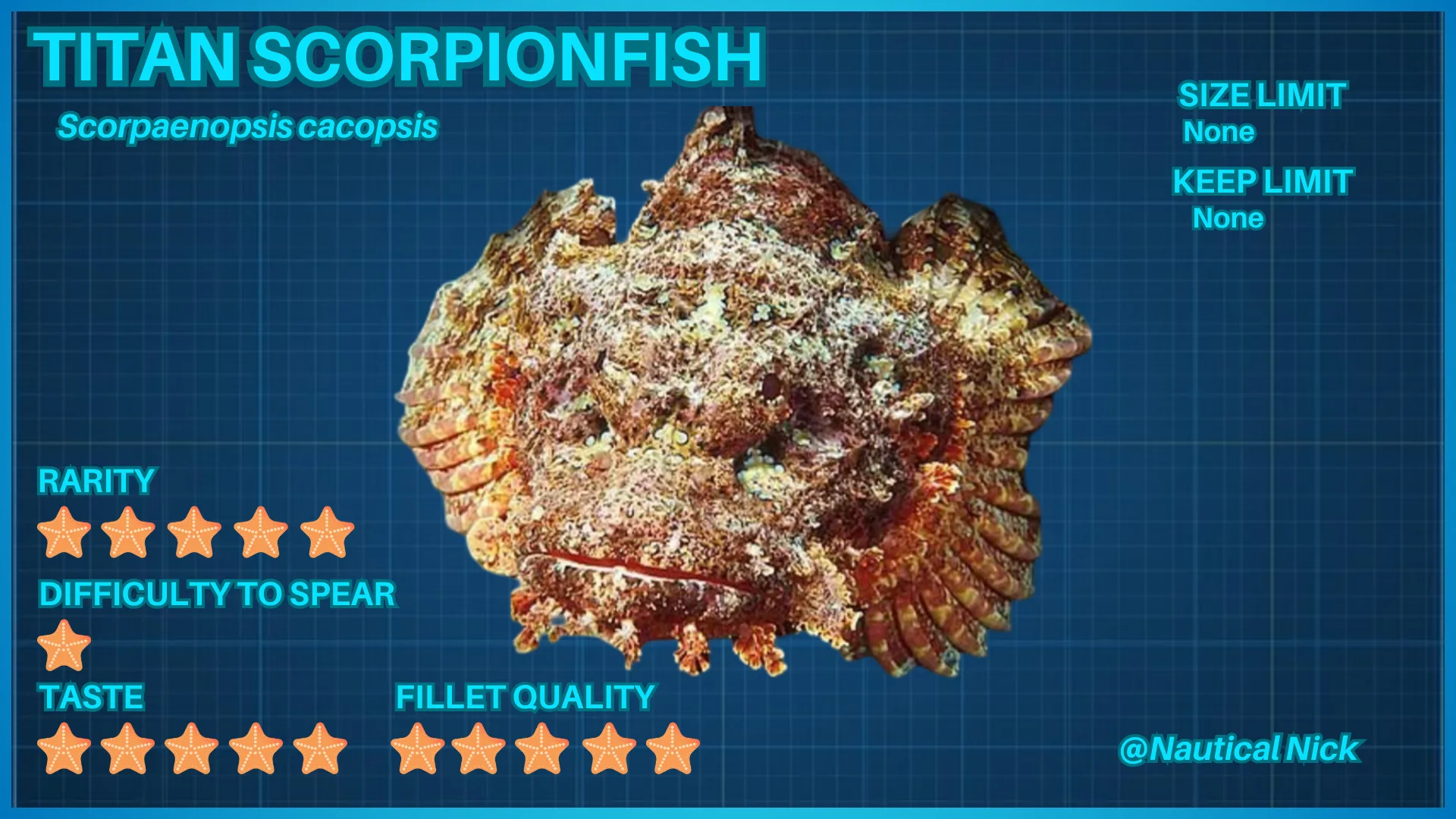
The titan scorpionfish is found only in the Hawaiian Islands and nowhere else in the world. It is the largest of the roughly 25 scorpionfish species that live in Hawaiian waters, reaching 20 inches and about 8 pounds. It holds on outer coral reef from 10 to 200 feet. It used to be more common than it is now. FishBase records the species as a prized food fish whose population has been greatly reduced in the main Hawaiian islands by fishing pressure, and spearfishing pressure specifically. The IUCN Red List category is Data Deficient, assessed in 2015, meaning the available information was not enough to place the species on any of the threatened tiers. Data Deficient is not the same as safe. It is a note that no one has done the population count that would answer the question. On the reef, a diver may spend a full day searching outer ledges without seeing one. Even a diver who swims directly over a titan scorpionfish often misses it.
Regulations
Spearfishing species only — CDFW rules verified Thu Jul 16 2026 00:00:00 GMT+0000 (Coordinated Universal Time)
Seasonality
Edibility
Location
The titan scorpionfish is endemic to the Hawaiian Islands. It does not occur along the mainland Pacific coast, and it does not occur elsewhere in the tropical Pacific. Within Hawaii, adults hold on the outer coral reef, usually beneath ledges or right at the entrance to caves, from 10 feet down to about 200 feet. The species is solitary, and individuals come together only to spawn. During the day, a titan scorpionfish sits motionless on the reef. Its flattened, mottled brown-to-reddish body, its skin flaps that resemble tufts of algae, and the loose orange or red flaps along its lower jaw break up the outline of the fish so completely that a diver can be within arm's length and not register it at all. The fish is a night hunter that rests through the day.
Spearfishing Brief
The titan scorpionfish is a find-driven hunt, and the shot is the easy half. Once a diver spots a fish, it will usually hold rather than flee, though a close approach can still send one into a crack. The whole difficulty is spotting one in the first place, which is why the find rating is a 4 and the shot rating is a 1.
The camouflage is the reason. A titan scorpionfish lies flat against the reef with skin appendages that look like algae growing off its head and jaw, and its mottled brown and reddish coloration matches the coral and rock it sits on. The best identifying mark is the fringe of loose orange or red flaps along the lower jaw, which is the one part of the fish that does not blend in on close inspection. A Hawaii observer who watched one on a shallow reef reported losing track of the outline again and again after having found it once, in the same short stretch of reef. That is what a spearo is up against. The best places to look are the outer edge of a coral reef, the underside of ledges, the shaded entrance of a cave, and the dark line where reef meets sand. A slow, methodical approach along the ledge line, looking under and up rather than out across the reef, is the search that turns them up.
Once the fish is found, the shot is inside a few feet, often from directly above the head. The titan holds. Because the fish holds still, a diver can take it with the gear most Hawaii divers already carry from shore: a pole spear or a Hawaiian sling with a 3-prong paralyzer tip, both used on a single breath-hold. SCUBA spearfishing is prohibited inside the West Hawaii Regional Fishery Management Area, so a shot taken along that coast is a freedive shot. A speargun is legal and workable, but the fish is a short-range target and the 3-prong tip is what suits shots taken up against reef structure, where a single-point shaft can bury into coral and hang up.
The dorsal and pectoral spines carry venom that stays active in a dead fish, so the same spines that could sting a diver on the reef can sting the diver holding the fish on the boat. The documented practice is to bring the fish out of the water on the shaft rather than by hand, to keep it in the game bag away from bare skin, and to leave the cleaning until the dorsal and pectoral spines have been snipped off with heavy kitchen shears while wearing puncture-resistant gloves. The specifics of what a sting does and how it is treated are in the Deep Dive below; a spearo carrying nohu home needs to know that information before the shot, not after.
FishBase lists the titan scorpionfish under both a commercial fishery and the aquarium trade. A spearfisher after nohu is one of several people after the same fish. The advantage of the spear on this species is that the diver sees exactly which fish is under the ledge before pulling the trigger, and can pass on a small one rather than taking whatever bites the hook.
Deep Dive
The titan scorpionfish was first described in 1901 by the American ichthyologist Oliver P. Jenkins from specimens collected in Hawaiian waters, and the species has never been recorded outside Hawaii since. It belongs to the scorpionfish family, a group of roughly 400 species worldwide, of which about 25 live in Hawaii. Within that group, the titan is the largest species in the Hawaiian Islands by a wide margin, reaching a documented 20 inches and about 8 pounds. Its Hawaiian name is nohu, a name it shares with a small ground-hugging desert plant known as the puncture-vine, whose fruit carries hard, sharp spines that can pierce a bare foot. Tahitian settlers arriving in Hawaii did not find the stonefish they had known at home, and they gave its close relative the same name.
The species is a bottom-dwelling ambush predator. During the day it holds on the reef, motionless in the same posture for hours, and prey come to it. Feeding is heaviest at night. The fish targets small reef fishes, and stomach-content work in Hawaii has identified soldierfishes and squirrelfishes, surgeonfishes and their close relatives, and the trumpetfish as prey items. Crustaceans round out the diet. The strike is fast. When a small fish drifts within reach, the titan opens its unusually large mouth, and the sudden pressure drop pulls the prey and a slug of water in at once. The fish is swallowed whole. The strike is over in a fraction of a second.
The camouflage that makes the strike work is the same camouflage that makes the fish hard to find. The body is flattened top to bottom and side to side, dark mottled brown grading into rust-red along the head and sides. Skin appendages, small fringed flaps of tissue, project off the head, chin, and body and give the outline of the fish the ragged look of an algae-covered rock. The lower jaw carries the loose orange-and-red flaps that are the single most reliable field mark. All of it is body-color and shape, not something the fish switches on or off, so a titan is camouflaged whether it is aware of a diver or not.
The venom is the safety fact that governs every interaction with this fish. The dorsal, pelvic, and anal spines carry venom in glandular tissue that runs along paired grooves down the front face of each spine, wrapped in a sheath of skin. When a spine punctures skin, the venom is pushed out along a groove in the spine and driven into the wound, in the same way a snake's fangs deliver venom. A sting causes immediate, severe, throbbing pain that can spread up the affected limb, and cases severe enough to send the victim to the hospital are documented. The standard first aid is hot-water immersion. The affected limb goes into water as hot as the person can tolerate without scalding, in the range of 109 to 115 degrees Fahrenheit, for 30 to 90 minutes. Heat breaks down at least one component of the venom and reduces the pain. Someone else tests the water temperature first, because the injury blunts a victim's temperature judgment. Ice, a tourniquet, and pressure bandages are documented not to help and are not applied. Rebound pain hours later is common, and a second hot-water soak is used to manage it. Wounds frequently take weeks to months to close fully, and a physician should follow up because pieces of spine can break off in the wound and drive infection. The venom is not destroyed by the fish dying. The spines on a dead nohu in a cooler are as dangerous as the spines on a live one on the reef, which is the reason handling practice matters as much as any hunting decision.
Once the spines are dealt with, the eating side of the species is the reason the population has been pushed as low as it has. The meat is white. Hawaiians count it as a favorite, and it is prized enough on outside markets to sit in FishBase's records as both a commercial food fish and an aquarium fish. No source reviewed for this entry describes the flavor of this species, or how it is usually cooked. That combination of accessible depth, a fish that holds still once found, and a plate that most Hawaii diners rate as top-shelf is what has pulled spearfishers to nohu hard enough to draw the population down in the main islands over decades. That is what the guides mean when they say the population has been greatly reduced. The Papahānaumokuākea Marine National Monument, which covers the uninhabited Northwestern Hawaiian Islands, prohibits take of any fish inside its boundary.